Bitcoin withdrawals from Binance accelerated to their strongest weekly level in more than three years in late September, while large investors simultaneously increased stablecoin transfers to

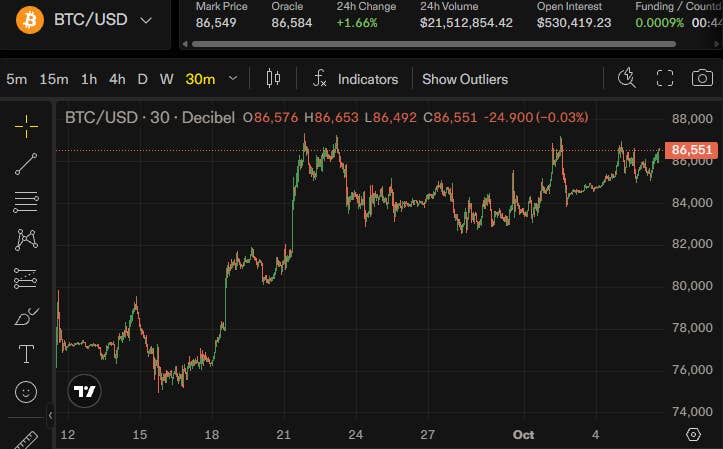
Bitcoin withdrawals from Binance accelerated to their strongest weekly level in more than three years in late September, while large investors simultaneously increased stablecoin transfers to the exchange, creating an unusual combination of falling available BTC supply and rising potential buying power. CryptoQuant data show Binance recorded net outflows of 23,137 BTC during the seven days through Sept. 27, the largest weekly withdrawal since June 2023, when the exchange's Bitcoin balance fell by 44,942 BTC. Binance reserves also declined by nearly 40,000 BTC from Sept. 20 as withdrawals continued. The movement has not yet produced a decisive price breakout. Bitcoin was trading near $85,300 on Oct. 6 and remained below the $87,400 September high, which
FinanceFeeds identified as the immediate resistance level. The $82,500 area remains the main nearby support.
Do Record Binance Outflows Mean Investors Are Accumulating Bitcoin?
CryptoQuant interprets the withdrawals as evidence of accumulation because Bitcoin leaving a liquid trading venue can indicate that holders are moving coins into longer-term custody rather than keeping them immediately available for sale. That interpretation is plausible, but the transactions themselves do not establish who controls the destination wallets or what ultimately happens to the coins. Exchange withdrawals can also reflect custody transfers, internal wallet management, institutional settlement or movement to other venues. The scale nevertheless stands out. The last comparable weekly Binance withdrawal occurred in June 2023, when Bitcoin subsequently moved from roughly $26,300 to $30,500. That historical comparison does not establish that the current market will follow the same path, particularly because today's institutional ownership, ETF activity and macro environment differ substantially. Recent whale behavior provides additional context. FinanceFeeds reported in August that
large Bitcoin holders had accumulated roughly 43,000 BTC over a 60-day period, even while smaller investors remained more cautious.
Investor Takeaway
Falling exchange balances reduce the amount of Bitcoin immediately available for trading, but withdrawals alone do not prove fresh buying. The stronger bullish case would combine persistent outflows with rising spot demand and a confirmed break above the September price range.
Why Are Whale Stablecoin Inflows Rising at the Same Time?
A separate CryptoQuant dataset shows investors sending more than $1 million in stablecoins at a time to Binance increased their rolling 30-day inflows from $21.7 billion in mid-August to $30.5 billion by the end of September, an increase of more than 40%. Stablecoins deposited onto exchanges are often described as market “dry powder” because they can be deployed quickly into Bitcoin and other digital assets. But stablecoin inflows do not necessarily translate directly into spot purchases. The funds may also support derivatives collateral, market-making activity, arbitrage or transfers between stablecoin rails. The increase represents a change from conditions earlier in the year. In July, FinanceFeeds reported that
Binance had lost approximately $1.55 billion in stablecoin reserves over 30 days as exchange buying power declined. Earlier in February, Binance's stablecoin holdings had
surpassed $45 billion, illustrating how sharply liquidity conditions on the venue have shifted during 2026.
Investor Takeaway
Bitcoin leaving Binance while large stablecoin deposits increase creates a potentially constructive supply-demand setup. The missing evidence is deployment: stablecoin balances become more meaningful for BTC only if they translate into sustained spot buying.
What Could Trigger Bitcoin's Next Move?
Bitcoin has spent much of the period since Sept. 21 between approximately $82,500 and $87,400, leaving the exchange-flow data ahead of price rather than confirming a breakout. There are also counter-signals. U.S. spot Bitcoin ETFs recorded $89.8 million of net withdrawals on Oct. 5 after attracting $189.9 million on the previous trading day. The reversal shows that institutional demand remains uneven even as Binance's on-chain balances point toward reduced sell-side inventory. Bitcoin's third-quarter recovery has already been substantial. FinanceFeeds reported that the asset
gained roughly 42% during Q3, recovering much of its first-half decline. That makes confirmation above the September high more important than interpreting any single on-chain metric in isolation.
Investor Takeaway
The combination of lower Binance BTC reserves and higher whale stablecoin inflows improves the conditions for an upside move, but price and spot demand still need to confirm it. A sustained break above $87,400 would strengthen the accumulation thesis, while a loss of $82,500 would show that reduced exchange supply has not been enough to overcome selling pressure.