



Bitcoin ETF Flows Today: $73M Inflow, $423M Weekly Outflow
 ETF
ETF
 ETF
BTC
ETF
BTC
 MM
MM
 READ
READ
U.S. spot Bitcoin ETFs returned to positive territory on March 30, 2026, posting an estimated one-day net inflow of 1,090 BTC, worth approximately $73.24 million according to unconfirmed reports. The daily gain, however, sits against a still-negative seven-day trend, highlighting uneven institutional demand as Bitcoin trades near $66,857 amid extreme fear across the broader crypto market.
Bitcoin ETFs Added Over $69 Million in a Single Session
According to a single unconfirmed source, U.S. spot Bitcoin ETFs recorded a one-day net inflow of +1,090 BTC (+$73.24M). Separately, Farside Investors data confirmed a net daily inflow of $69.4 million across listed U.S. spot Bitcoin ETFs on March 30, providing independent corroboration that the session was firmly positive.
Fidelity's FBTC led the day at +$33.0 million, followed by Grayscale's GBTC at +$28.9 million and BlackRock's IBIT at +$7.5 million. Those three funds accounted for nearly all of the session's net buying. The growing role of crypto derivatives alongside spot products has been a theme across exchanges, as seen in Dubai's recent tightening of crypto derivatives rules.
The positive day pushed cumulative net flows across all listed U.S. spot Bitcoin ETFs to $55.98 billion since launch, reflecting the scale of institutional capital that has entered Bitcoin through regulated ETF wrappers even as shorter-term flows swing between inflows and outflows.
The Seven-Day Bitcoin ETF Trend Remains Deeply Negative
Despite the encouraging daily print, the trailing week tells a different story. According to unconfirmed reports, the 7-day net flow stood at -6,301 BTC, or roughly -$423.4 million, indicating that sustained withdrawals over the prior sessions far outweighed the latest day's gains.
The outflow pressure was visible earlier in March as well. On March 5, spot Bitcoin ETFs shed $227.9 million in a single day, the largest daily exit since February 12. Analysts cited in that reporting noted that longer-term flows were stabilizing even as day-to-day swings remained sharp, a pattern that appears to be repeating now.
The contrast between a positive daily session and a deeply negative weekly total illustrates why single-day ETF snapshots can mislead. One strong session does not erase a multi-day drawdown, and the weekly trend remains the more reliable gauge of whether institutional conviction is genuinely returning.
What the Mixed ETF Signal Means for Bitcoin Sentiment
Bitcoin traded at $66,857 at press time, down 1.19% over 24 hours, with a market capitalization of approximately $1.34 trillion and 24-hour trading volume near $52.1 billion.
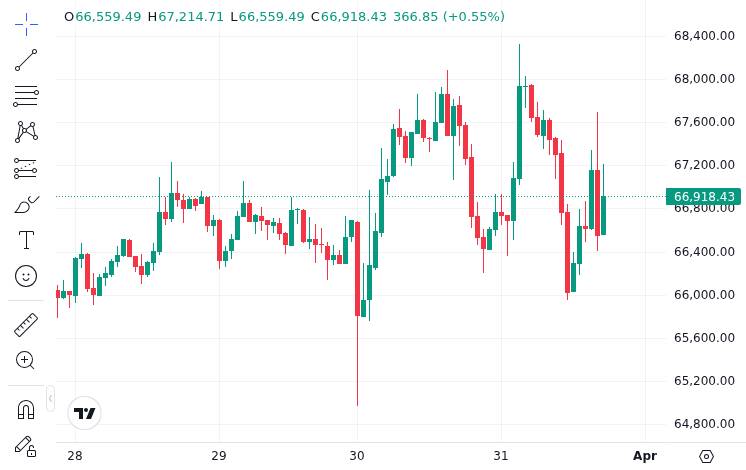
The Fear & Greed Index sat at 11, classified as Extreme Fear. That reading reflects broad risk aversion across crypto markets even as ETF flows showed a flicker of renewed buying on March 30.
The divergence between a positive one-day ETF inflow and a negative seven-day total supports a mixed institutional demand reading rather than a clean bullish reversal. Fresh capital entered on March 30, but cumulative withdrawals over the prior week still dominate the broader picture. The environment has also weighed on newer market segments, where token issuance failure rates have hit record highs, according to 21Shares research.
For that weekly trend to turn positive, daily inflows would need to string together several consecutive sessions of the magnitude seen on March 30, or larger. With risk appetite depressed and Bitcoin still down on the day, that outcome is far from certain. Even emerging applications like Trust Wallet's new prediction markets reflect a market searching for alternative engagement amid cautious sentiment.
The metric to watch from here is whether the next several trading sessions sustain inflows large enough to repair the negative seven-day total. Until that happens, the March 30 session is a data point, not a trend reversal.
Disclaimer: This article is for informational purposes only and does not constitute financial or investment advice. Cryptocurrency and digital asset markets carry significant risk. Always do your own research before making decisions.
Read original article on tokentopnews.com