Bitcoin ETF outflows returned to the spotlight after U.S. spot funds recorded another day of heavy withdrawals, even as Bitcoin and Ether extended their recovery. The growing gap between risi
Bitcoin ETF outflows returned to the spotlight after U.S. spot funds recorded another day of heavy withdrawals, even as Bitcoin and Ether extended their recovery. The growing gap between rising prices and weakening institutional demand has become one of the market’s biggest talking points, raising fresh questions about whether the rally has enough support to continue.
According to verified data, U.S. spot Bitcoin ETFs recorded nearly $95 million in net outflows on Thursday, while the Ethereum ETF market lost about $52 million, ending a five day inflow streak. Based on the reported ETF flow data, investors pulled a combined $147 million from U.S. spot Bitcoin and Ethereum ETF products during the session, despite stronger market sentiment.
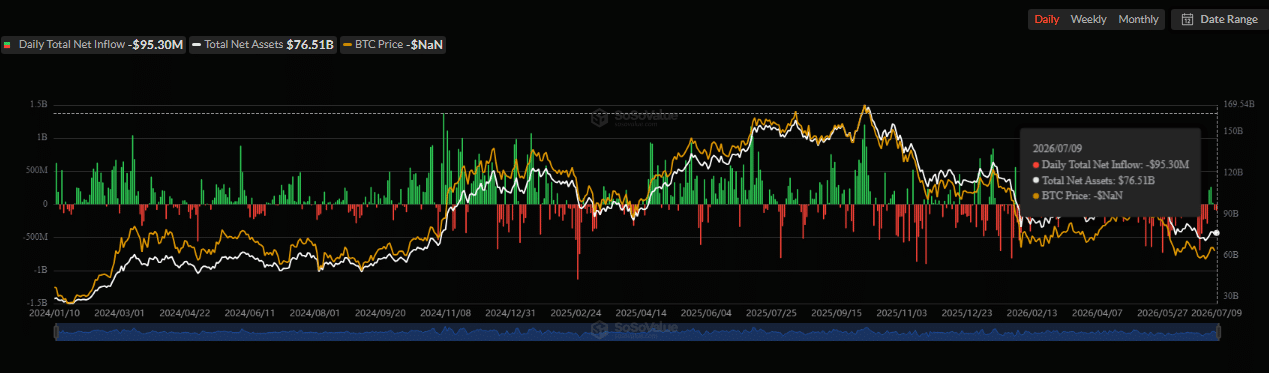
Source:
SosovalueBitcoin ETF Outflows Show Institutions Are Still Holding Back
The latest Bitcoin ETF outflows were led by Fidelity’s FBTC, which recorded withdrawals of around $63 million. ARK 21Shares’ ARKB followed with nearly $40 million in outflows. BlackRock’s IBIT finished the day unchanged, while VanEck’s HODL and Morgan Stanley’s MSBT were the only Bitcoin ETFs to post net inflows. Total assets across spot Bitcoin ETFs remained close to $77 billion.
Despite these Bitcoin ETF outflows, Bitcoin climbed about 3.5% on Friday to nearly $64,000 and is up roughly 4.2% for the week. The world’s largest cryptocurrency also recovered all the losses it suffered after President Donald Trump warned that military strikes involving Iran could intensify.
The contrast between prices and ETF activity tells the real story. Although Bitcoin and Ether rallied, ETF investors continued withdrawing capital. This suggests the recent market recovery has been driven more by improving risk sentiment than by fresh institutional accumulation. Simply put, fund flows are still lagging behind the market.
Ethereum ETF Loses Momentum After Leading Institutional Demand
The Ethereum ETF market also reversed course after serving as the steadier side of institutional crypto investment over the previous five trading sessions. Before Thursday’s decline, Ethereum ETFs had provided one of the few consistent signs of institutional buying.
That momentum ended as Fidelity’s FETH recorded approximately $34 million in outflows, while BlackRock’s ETHA lost around $13 million. Bitwise and another BlackRock Ethereum fund also finished the session in negative territory. Most importantly, no Ethereum ETF recorded net inflows, leaving total assets under management near $9 billion.
The pullback came even as Ether gained about 2.6% to roughly $1,760. Like the ongoing Bitcoin ETF outflows, the weakness across the Ethereum ETF market shows that higher prices alone are not enough to encourage institutions to increase exposure.

Asia Fueled the Rally While Institutions Stayed on the Sidelines
The broader crypto rebound was largely supported by stronger risk appetite across Asian markets. South Korea’s Kospi index climbed about 4% after renewed optimism surrounding artificial intelligence demand. At the same time, chipmaker SK Hynix priced a $26.5 billion American depositary share offering, helping lift confidence across global risk assets.
Even with those positive developments, Bitcoin ETF outflows continued as institutions remained cautious. Bitcoin has traded between roughly $59,000 and $66,000 for most of the past month without breaking decisively in either direction. Such range bound trading often encourages large investors to wait for stronger confirmation before committing new capital.
Recent ETF flow data suggests institutional investors have remained cautious even as Bitcoin and Ether continue to recover.
Conclusion
The latest Bitcoin ETF outflows highlight a widening gap between market momentum and institutional participation. While Bitcoin and the Ethereum ETF market have rebounded alongside improving global sentiment, large investors continue reducing exposure rather than adding to positions.
Institutional investors have largely remained on the sidelines throughout the past month despite improving prices, suggesting confidence has yet to return. Until Bitcoin breaks out of its current trading range and Bitcoin ETF outflows begin to ease, ETF flow data may remain one of the clearest indicators of where the crypto market heads next.
Glossary of Key Terms
Bitcoin ETF Outflows: Money withdrawn from spot Bitcoin ETFs over a given period.
Ethereum ETF: An ETF that offers exposure to Ethereum without owning the asset directly.
Spot ETF: An ETF backed by the actual cryptocurrency.
Institutional Investors: Large organizations that invest on behalf of clients or funds.
Net Outflows: When more money leaves a fund than enters it.
FAQs About Bitcoin ETF Outflows
Why do Bitcoin ETF outflows matter?
They reflect institutional sentiment toward Bitcoin.
Why did Ethereum ETF inflows stop?
Major Ethereum ETFs recorded net withdrawals after five straight days of inflows.
Why did crypto prices rise despite ETF outflows?
Improved market sentiment and stronger Asian markets supported prices.
What is a range-bound Bitcoin market?
It means Bitcoin is trading within a set price range without a breakout.
Sources / References
Coindesk
SoSoValue
BlackRock IBIT
Read More:Bitcoin ETF Outflows Hit $95M as Markets Flash a Warning">Bitcoin ETF Outflows Hit $95M as Markets Flash a Warning