Bitcoin slid to an intraday low of $78,442 on August 28, 2026, its steepest single-session drop of the month, after Fed Chair Kevin Warsh used his debut Jackson Hole keynote to dismiss softer
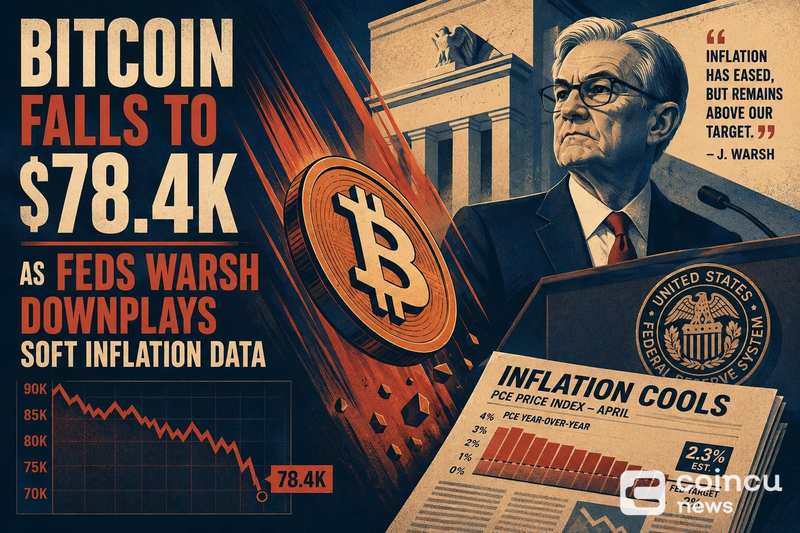
Bitcoin slid to an intraday low of $78,442 on August 28, 2026, its steepest single-session drop of the month, after Fed Chair Kevin Warsh used his debut Jackson Hole keynote to dismiss softer summer inflation prints and permanently scrap the central bank's forward guidance, severing the signaling channel crypto traders have relied on for years to front-run rate decisions.
The token had entered the week riding its best August since 2017, up more than 23% over the prior 30 days, before Warsh's hawkish tone reversed risk sentiment across digital assets. Total crypto market capitalization fell 2.4% to $2.63 trillion on the day, with Bitcoin down roughly 3.3% to near $77,700 at its intraday trough, according to BSCN. For related coverage, see What Is Bitcoin L2 Finality? Sequencers, Proofs, and Withdrawal Confidence.
Bitcoin Slides to $78,400 as Risk Sentiment Sours
Bitcoin printed an intraday low of $78,442 on Bitstamp during the Jackson Hole session, cutting against a month in which the asset had rallied hard toward its October 2025 all-time high of $126,080. For related coverage, see Cornell Tech Policy Institute Says Small Bitcoin Tax Exemption Could Raise US Revenue by $859M.
Bitcoin (BTC) — Intraday Low
$78,400
▼ ~2.0% on the session · August 28, 2026 (post-Warsh speech, Jackson Hole) For related coverage, see How Are Bitcoin L2 Fees Calculated? Bridge, Gas, Swap, and Withdrawal Costs.
Source: CoinGecko
As of September 5, 2026, Bitcoin had stabilized at $79,574 with a 24-hour decline of 1.50%, holding a market capitalization near $1.598 trillion on 24-hour volume of roughly $33.75 billion.
The drawdown was not mirrored in traditional risk assets, a divergence that framed the move as crypto-specific rather than a broad macro flight. Equities absorbed the same speech comfortably, with the S&P 500 and Nasdaq each closing up about 0.5%, suggesting TradFi read Warsh's tone as firm but non-catastrophic even as Bitcoin took the harder hit.
Warsh Dismissed Soft Inflation Prints and Killed Forward Guidance
Warsh told the symposium that recent summer PCE and CPI readings "do not tell me that underlying trends have meaningfully improved," explicitly refusing to treat cooler prints as evidence of durable disinflation, per his prepared remarks.
His case rested on the level, not the direction, of prices: 12-month PCE inflation running at 3.7% and the 6-month annualized rate at 4.1%, both well clear of the Fed's target. Warsh reframed the 2% objective as "a firm, fixed target" with "no excuses," language that closed the door on the tactical patience markets had priced.
He also pointed to breadth, noting that 54% of PCE basket components posted price gains above 3% over the past year, down from a 77% pandemic peak but far above the roughly 32% pre-pandemic baseline. Warsh laid the persistence directly at the central bank's feet, attributing "65 months of sustained, elevated inflation" to a problem that "sits squarely with the central bank."
The structural shock was procedural. Warsh permanently eliminated forward guidance, declaring the practice "has overstayed its welcome" and committing "to a discipline, not to a decision," removing the pre-signaling mechanism that let traders position ahead of policy shifts. Bitcoin.com News captured the pivotal framing live from the symposium.
"The Fed's price stability objective of 2%... is a firm, fixed target," says Fed Chair Kevin Warsh live from the 2026 Jackson Hole Symposium. Warsh adds, "It's the Fed's job to deliver stable prices, no excuses."
Bitcoin.com News (@BitcoinNews)
Rate-Hike Odds Repriced Higher, Not Lower
The immediate market translation was a repricing toward tighter, not looser, policy. CME FedWatch September rate-hike probability climbed from 35% to 42% after the speech, while Polymarket year-end hike odds jumped to 68%, according to derivatives data compiled by Blockonomi.
That repricing is the causal link to Bitcoin's slide: higher-for-longer expectations lift real yields and the dollar, compressing appetite for long-duration risk assets, of which Bitcoin remains the most liquid crypto proxy. The mechanism echoed prior hawkish shocks, and it arrived just as a Binance research team had recently attributed a separate Bitcoin drop to a liquidity scramble, a reminder of how quickly leveraged positioning can amplify macro headlines, as detailed in Binance's report on the earlier crash.
Some coverage put the post-speech September hike probability as high as 57%, a figure that diverges from the 42% CME reading; that higher number should be treated as unconfirmed given the discrepancy between sources. One single source also reported roughly $485.86 million in 24-hour liquidations affecting some 95,731 traders, with longs accounting for about $368 million, though that liquidation tally remains unverified pending direct exchange data.
Why the End of Forward Guidance Reshapes Bitcoin's Macro Playbook
The lasting consequence for crypto is not the single-day dip but the removal of the Fed's signaling channel. With forward guidance retired, traders lose the pre-meeting roadmap that historically let Bitcoin price rate moves in advance, raising the odds of sharper, event-driven repricings around each data release and FOMC decision.
Internal Fed dynamics reinforce the hawkish read. The July 2026 FOMC held rates steady but drew a dissent from Fed President Beth Hammack, who pushed for an immediate hike, signaling that a tightening bias already had a voice inside the committee before Warsh spoke.
A competing policy vector complicates the outlook: Treasury Secretary Bessent has pledged to intervene in Treasury markets to cap long-term rates, a stance that runs against Warsh's market-driven philosophy and could blunt the yield transmission that pressured Bitcoin. How that contradiction resolves will shape whether future hawkish rhetoric keeps hitting crypto as hard as it did on August 28.
Sentiment, notably, has not broken. The Crypto Fear & Greed Index still reads 73, or "Greed," indicating positioning remains constructive despite the Warsh shock, and leaving room for a sharper unwind if incoming data validates his hawkish framing. That resilience has coincided with renewed institutional appetite, as spot Bitcoin ETFs recently rebounded even while Ethereum and XRP products lost momentum.
What to Watch Next
The next concrete catalysts are the August CPI and PPI releases due before the September FOMC meeting, the two prints most likely to confirm or contradict Warsh's claim that underlying inflation has not improved. With hike odds already elevated, an upside surprise on either would validate the hawkish repricing and pressure Bitcoin further.
Traders are watching whether Bitcoin holds the $78,400 area that marked the intraday floor; a sustained break below it would open the range that leverage-heavy positioning could accelerate. A reversal, by contrast, would likely require a soft CPI print or a dovish counter-signal, harder to obtain now that the Fed has stripped away the guidance that once telegraphed such shifts. Policy watchers should also track whether Hammack's dissent gains company and whether Bessent acts on his rate-capping pledge, a tension that will define crypto's macro sensitivity into year-end.
Frequently Asked Questions
Why did Bitcoin drop to $78,400? Bitcoin fell after Fed Chair Kevin Warsh, in his August 28, 2026 Jackson Hole keynote, dismissed softer summer inflation data and eliminated forward guidance, prompting markets to reprice toward higher-for-longer rates and pushing CME September hike odds up to 42% from 35%.
Who is Kevin Warsh and why does his Fed view matter for crypto? Warsh was confirmed as Fed Chair in early 2026 and set monetary policy tone in his debut Jackson Hole address, where he called the 2% inflation target "firm" and "fixed"; his hawkish stance directly influences rate expectations that drive dollar strength, real yields, and risk appetite for Bitcoin.
Will Bitcoin recover if the Fed cuts rates? Rate cuts typically ease pressure on risk assets, but with forward guidance eliminated, traders can no longer rely on pre-meeting Fed signals, meaning any recovery would hinge on hard data such as the upcoming August CPI and PPI releases rather than telegraphed policy shifts.
Disclaimer: This article is for informational purposes only and does not constitute financial or investment advice. Cryptocurrency and digital asset markets carry significant risk. Always do your own research before making decisions.
The post Bitcoin Falls to $78.4K as Fed's Warsh Downplays Soft Inflation Data was initially published on Coincu.