



Bitcoin Scholars Fund Launches With $21M K-12 Tax Redirect Plan
 BASED
BASED
 CCY
BTC
CCY
BTC
 BASED
BASED
 READ
READ
Bitcoin Scholars Fund is being described as a plan to move $21M of federal tax liability into K-12 Bitcoin education, but the material supplied for this draft only verifies a narrower picture on btcsf.org and scholarshiptaxcredit.org: an existing Bitcoin Scholarship Foundation program and a real federal scholarship tax credit that states can choose to join. On that record, the headline reads as an unconfirmed claim layered onto a documented education model and a documented tax mechanism.
TLDR Keypoints
- Bitcoin Scholarship Foundation says it is a 501(c)(3) nonprofit pairing financial education with $500 Bitcoin scholarships that unlock at age 25.
- btcsf.org says lessons are built for ages 5-18, while its FAQ says scholarships focus on underserved youth aged 13-18 and use multi-signature cold storage.
- ScholarshipTaxCredit.org says the federal credit was signed in July 2025, starts on January 1, 2027, and lets donors claim up to $1,700 per year in states that opt in.
What the official program pages show
Bitcoin Scholarship Foundation presents itself as a 501(c)(3) nonprofit that combines financial literacy with $500 Bitcoin scholarships that stay locked until age 25. The same site says the model is aimed at underserved students who would otherwise miss long-term exposure to Bitcoin ownership.
btcsf.org says its curriculum is age-appropriate for ages 5-18, while the FAQ narrows the scholarship program to underserved youth aged 13-18 and says the Bitcoin is overseen in multi-signature cold storage. That is the clearest evidence in the brief connecting the project to K-12 education.
How the federal credit actually works
ScholarshipTaxCredit.org says the federal program was signed into law in July 2025, takes effect on January 1, 2027, and now sits in Internal Revenue Code Section 25F. The same page says eligible donors can claim a non-refundable federal credit of up to $1,700 per year, but only in states that opt in.
AP's report on Nebraska shows what opt-in looks like in practice: individual taxpayers can direct up to $1,700 in federal income taxes owed to scholarship-granting groups for eligible K-12 private-school expenses. That state-level implementation question places this story closer to NFTENEX's Fed policy coverage than to a routine market move.
What remains unproven in the headline
Based on the materials cited from btcsf.org, scholarshiptaxcredit.org, and AP, the brief does not document a separate official entity called Bitcoin Scholars Fund, a published calculation for the headline figure, or evidence that Bitcoin Scholarship Foundation is already an approved scholarship-granting organization under Section 25F. That missing-mechanics problem resembles the disclosure gap NFTENEX highlighted in its piece on World Liberty Financial's token unlock plan.
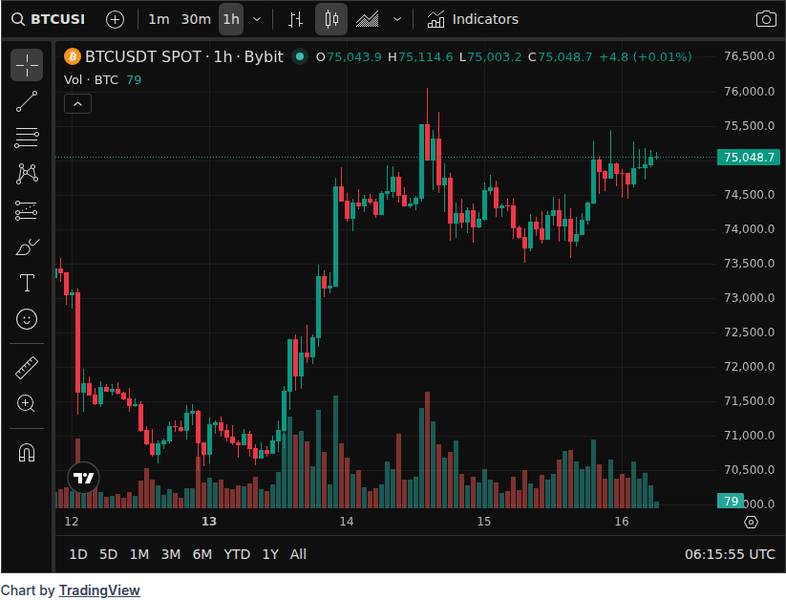
Bitcoin still provides the economic backdrop for the education pitch: the asset was trading near $75,045, with a 1.44% 24-hour gain, a $1.50 trillion market cap, and $40.02 billion in 24-hour volume in the market snapshot attached to the brief. Those figures describe the price environment around the story, not proof that any federal scholarship-credit dollars are already flowing into a Bitcoin-specific K-12 vehicle.
The practical checkpoint is simpler than the headline: readers need a documented state opt-in, a named qualified scholarship-granting organization, and a public link between that organization and the curriculum described on btcsf.org before any Bitcoin-specific tax redirect can be treated as confirmed. Until those pieces are public, the mechanism looks closer to the regulatory rollout issues in NFTENEX's prediction market contracts coverage than to a finished launch.
Disclaimer: This article is for informational purposes only and does not constitute financial or investment advice. Cryptocurrency and digital asset markets carry significant risk. Always do your own research before making decisions.
Read original article on nftenex.com