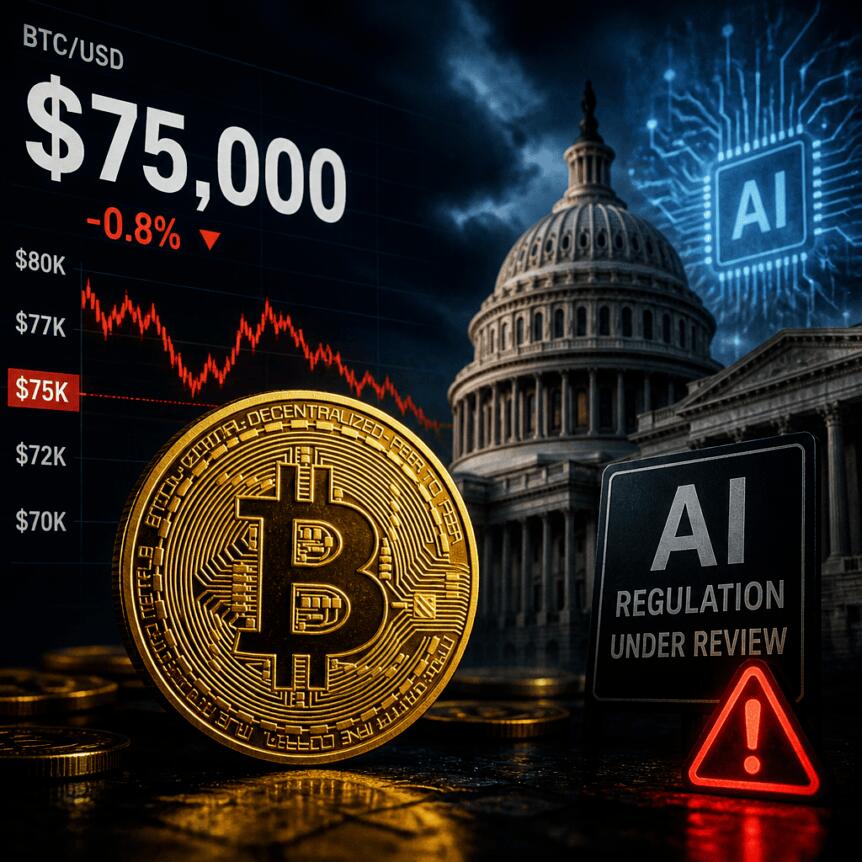
Bitcoin held above $75,000 on Friday as broader risk markets continued to wobble, with a sell-off in US technology stocks rippling into Asia. Data from TradingView showed BTC/USD trading near
Bitcoin held above $75,000 on Friday as broader risk markets continued to wobble, with a sell-off in US technology stocks rippling into Asia. Data from TradingView showed BTC/USD trading near its 50-week simple moving average (SMA), around $75,733, after sharp losses the previous day.
While crypto traders watched macro headlines for direction, the day’s biggest story unfolded in South Korea. The KOSPI Composite Index triggered a circuit breaker after plunging more than 8% shortly after the open, prompting authorities to step in with measures aimed at curbing forced selling—another reminder that liquidity conditions across traditional markets can quickly spill over into crypto.
Key takeaways
- Bitcoin steadied after dropping as much as 6.6% on Thursday, with the pair trading near the 50-week SMA around $75,733.
- South Korea’s KOSPI Composite Index triggered a 20-minute trading halt after falling more than 8% early Friday, then closed down 6%.
- The South Korean government announced a three-month waiver of margin-loan collateral requirements for brokerages starting Monday.
- Analysts linked Thursday’s US tech-heavy losses to expectations of tighter AI regulation after Democrats’ election gains, alongside existing concerns about capital spending.
- Commentary from market analysts suggested the latest US decline may have been “more technical than fundamental,” with losses concentrated in the technology sector.
Bitcoin’s bounce tracks a wider risk-off wave
Bitcoin’s pullback accelerated late Thursday as US equities saw sustained selling across the trading session. According to Cointelegraph’s market coverage referenced in the article, the S&P 500 and the Nasdaq Composite finished down 4.4% and 5.5%, respectively.
By Friday, the selling pressure carried into Asia. TradingView data showed BTC/USD hovering close to its 50-week simple moving average at roughly $75,733. That technical reference point matters to many traders because it often functions as a widely watched trend gauge; in this case, Bitcoin’s ability to stay above the average suggested some demand returned after Thursday’s sharper move.
KOSPI sell-off prompts collateral relief for brokerages
The traditional market shock that framed Friday’s tone came from South Korea. The KOSPI Composite Index fell more than 8% shortly after the open, triggering a circuit breaker that halted trading for 20 minutes. The index later pared losses and closed 6% lower at 5,059.69 points, its lowest close since March 31.
In response, South Korean officials held an emergency meeting. Korea’s deputy prime minister and finance minister Lee Hyoung-il announced steps aimed at reducing forced selling dynamics. Specifically, brokerages will be exempt for three months from a requirement to maintain a 140% collateral ratio on margin loans starting Monday, according to local media coverage cited in the article.
The same report indicated authorities would consider additional measures if volatility increases further. An unnamed government source, quoted by Chosun, framed the situation as a reaction to global volatility following the US midterm elections while also noting that the domestic market had become “overly reactive” to external factors.
AI regulation fears and semiconductors deepen the equity rout
In the US, commentary tied Thursday’s sell-off to expectations of tighter AI regulation following Democrats’ election gains in the House and Senate. The article also points to existing market concerns about the technology sector’s capital spending, implying that the AI narrative acted more like a catalyst than a standalone cause.
Market analysis in the article cited fears tied to a pause on advanced AI development. A Democratic representative, Yassamin Ansari, urged a “pause on advanced AI development” in social media commentary referenced by The Kobeissi Letter. The Kobeissi Letter argued that an outright US ban on AI was unlikely, stating that the US would not realistically surrender its position in the global AI race.
Crucially, the Kobeissi Letter also suggested the sharp move was “more technical than fundamental.” It attributed the decline largely to concentrated selling in tech, noting that the S&P 500 dropped roughly 2.5% when excluding the sector. The Philadelphia Semiconductor Index—covering 30 semiconductor companies—fell 12.2% on Thursday, underscoring how heavily high-beta areas were hit during the risk-off session.
Economist Mohamed El-Erian, cited in the article via a Substack note, called for lawmakers to find common ground on AI policy. He described the US “let it rip” approach as aligning with productivity and national security imperatives, but said it has fallen short on safety, diffusion, and broader social buy-in—elements he characterized as behind the backlash and the broader policy debate.
Cointelegraph previously reported, as referenced in the article, that historical patterns show Democrat midterm sweeps under Republican presidents have often been followed by stronger stock returns. The same earlier coverage noted that Bitcoin’s correlation with the S&P 500 has become more positive in recent months, which helps explain why a sharp equity drawdown can quickly translate into pressure on crypto risk sentiment.
What traders may watch next
With Bitcoin sitting near a widely tracked technical level while equity volatility remains elevated—particularly in regions where margin mechanics can amplify sell-offs—investors may want to monitor whether KOSPI stabilization measures reduce forced selling and whether US tech losses broaden or remain concentrated. Any shift in the market’s confidence around AI policy expectations could also change how aggressively risk is priced across both stocks and crypto.
This article was originally published as Bitcoin Stays Near $75K as AI Regulation Concerns Hit Markets on Crypto Breaking News – your trusted source for crypto news, Bitcoin news, and blockchain updates.