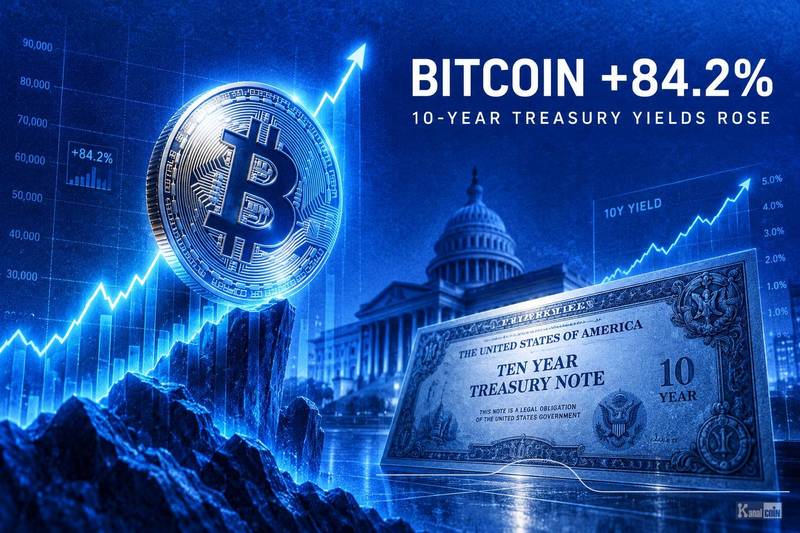
Bitcoin gained 84.2% between January 10, 2024 and October 5, 2026, according to CryptoSlate, even as the U.S. 10-year Treasury yield climbed 127 basis points over the same period. The pairing
Bitcoin gained 84.2% between January 10, 2024 and October 5, 2026, according to CryptoSlate, even as the U.S. 10-year Treasury yield climbed 127 basis points over the same period. The pairing challenges the conventional view that rising risk-free yields must suppress Bitcoin prices, though analysts note the relationship is weak at best.
Bitcoin's 84.2% gain versus rising 10-year Treasury yields
CryptoSlate reported that Bitcoin returned 84.2% across the comparison window, a period that encompassed the approval of spot Bitcoin ETFs in the United States. That structural shift in institutional access is central to why analysts say the yield-pressure argument is harder to apply to Bitcoin today than it was before ETF-driven demand became a market force. This backdrop is worth reading alongside our earlier coverage of the Bitcoin Q4 outlook covering Fed policy, bond yields, and key price levels. For related coverage, see Bitcoin, Ether, XRP Drive 2,633% Liquidation Imbalance.
84.2%
Bitcoin return reported by CryptoSlate, Jan. 10, 2024 to Oct. 5, 2026
Over the same dates, the U.S. 10-year Treasury par yield moved from 4.04% on January 10, 2024 to 5.31% on October 5, 2026, according to official U.S. Treasury daily curve data. That is a 1.27 percentage-point increase in the yield investors can earn from a risk-free government instrument.
+1.27 pp
10-year Treasury yield: 4.04% (Jan. 10, 2024) → 5.31% (Oct. 5, 2026)
The comparison is descriptive, not causal. Bitcoin and the 10-year yield moved in the same direction across this window, but that coincidence does not establish that yields drove Bitcoin prices, nor that Bitcoin thrived because of rising yields. Other forces, including ETF inflows, halving dynamics, and broader risk appetite, were also at work during this period. For Southeast Asian investors on exchanges such as Indodax, Tokocrypto, and Coins.ph, the practical implication is that rising U.S. yields alone did not prevent Bitcoin from delivering substantial returns denominated in local currencies. For related coverage, see Bitcoin Holds Above $78,000 as HYPE Leads, Majors Slip.
What CryptoSlate's weak-data finding means
CryptoSlate's headline framed the 5.3% Treasury yield level as a "hurdle" for Bitcoin while simultaneously noting that Bitcoin's post-ETF performance record complicates that threat. The outlet concluded the statistical relationship between 10-year yields and Bitcoin prices is weak. The original article was not independently accessible for this report, so the 84.2% return and the full methodology remain attributed to CryptoSlate rather than independently audited.
Analyst commentary from the period supports the weak-relationship characterisation. Capital.com senior market analyst Kyle Rodda said crude-driven yield pressure was capping non-yielding assets and pausing Bitcoin's rally. That framing, sourced from Decrypt's late-September 2026 coverage, describes a short-term headwind rather than a structural inverse correlation. Bitcoin was trading around $84,000 at that point, down roughly 2% on the week while the 10-year yield had peaked near 5.274%.
B2PRIME analyst Alex Tsepaev offered a complementary reading: "When U.S. Treasury yields are above 4.5% and the market prices out future Fed cuts, some allocations naturally flow toward cash and bonds," he told Decrypt. That dynamic was visible in ETF flow data from earlier in 2026, when institutional sellers trimmed Bitcoin exposure during a Treasury-yield spike, even as retail demand held prices broadly steady. The September Federal Reserve vote and yields near 5% illustrated how quickly sentiment shifted on Fed-cut expectations in this cycle.
The distinction between correlation and causation matters because policy decisions across ASEAN markets, from Bank Indonesia to Bangko Sentral ng Pilipinas, are partly calibrated to U.S. rate movements. A demonstrably weak relationship between Bitcoin and U.S. yields means regional crypto allocations cannot be modelled as a simple mirror of Fed policy, a point Southeast Asian fund managers and regulators should weigh carefully. The U.S. Treasury's $5.187 billion bond buyback program earlier in 2026 highlighted how actively the Treasury has been managing its yield curve, adding further noise to any simple yield-versus-Bitcoin comparison.
Key takeaways
Bitcoin's current price sits near $83,257, down 2.4% over the past 24 hours, with market sentiment reading at 64 on the Fear and Greed Index, classified as Greed. That places it within the range where the 84.2% gain cited by CryptoSlate was measured, though the gain figure itself remains a single-source attribution pending independent verification. When reviewing Bitcoin's resilience above $78,000 during earlier hawkish Fed bets, a consistent pattern emerges: the post-ETF era has made Bitcoin more resistant to yield pressure than the pre-2024 era suggested it would be.
Three points summarise the evidence. First, Bitcoin gained 84.2% from January 10, 2024 to October 5, 2026, according to CryptoSlate; that figure was not independently reproduced for this report. Second, the 10-year Treasury yield rose 1.27 percentage points across the same dates, confirmed by official U.S. Treasury data. Third, CryptoSlate found the statistical link between those two movements is weak, meaning the yield rise does not reliably predict Bitcoin's direction, and the 84.2% gain does not imply yields were irrelevant to shorter-term price volatility within the window.
Disclaimer: This article is for informational purposes only and does not constitute financial or investment advice. Cryptocurrency and digital asset markets carry significant risk. Always do your own research before making decisions.
Read original article on kanalcoin.com