



BNP Paribas launches Bitcoin and Ether ETNs from March 30 in France
 KNDM
KNDM
 UTED
UTED
 2026
BTC
2026
BTC
France enters a new financial era with the arrival of 6 Bitcoin and Ether ETNs offered by BNP Paribas. From March 30, 2026, retail clients will be able to invest in these regulated products without directly holding crypto. A breakthrough that could transform the investment landscape in France.
In brief
- BNP Paribas launches 6 ETNs indexed on Bitcoin and Ether, accessible via regular securities accounts in France from March 30, 2026.
- The ETNs offer simplified exposure to cryptos, without direct holding, with clear tax treatment and enhanced security.
- Despite benefits like MiFID2 regulation, investors must consider volatility and credit risks before investing.
BNP Paribas Bitcoin and Ether ETNs arrive in France on March 30
ETNs (Exchange-Traded Notes) are financial products indexed on the performance of an underlying asset, here Bitcoin and Ether. Unlike direct cryptos, they are bought via a regular securities account, thus simplifying access for retail investors. To this end, BNP Paribas offers 6 ETNs available from March 30, 2026 for its clients in France, including entrepreneurs and Hello bank users.
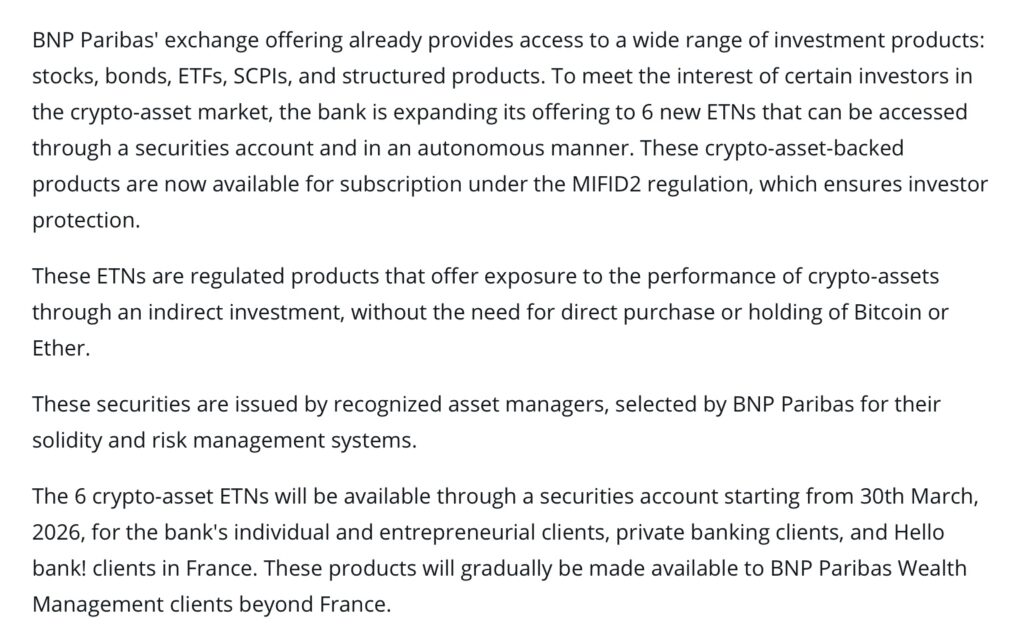
The main advantage lies in their regulation under MiFID2, offering increased security. Indeed, ETNs avoid the complexities of direct crypto holding, such as wallet management or hacking risks. They also allow clear taxation, integrated within existing securities accounts. An opportunity for investors to diversify their assets while benefiting from the credibility of a major financial institution like BNP Paribas.
Crypto: what should investors know before investing in ETNs?
Investing in Bitcoin and Ether ETNs carries specific risks and the main one is credit risk. Indeed, in the event of BNP Paribas’s failure, investors could lose their capital. Moreover, ETNs do not guarantee perfect tracking of the underlying asset, unlike some ETFs. Crypto volatility remains a challenge. While ETNs mitigate some risks, they remain sensitive to market fluctuations.
In the long term, BNP Paribas could extend these products to other markets, or even include other cryptocurrencies. This initiative is part of a broader European trend, with countries like Germany and the United Kingdom also adopting regulated crypto products. For investors, this opens the way to greater diversification but requires a clear understanding of the mechanisms and associated risks.
BNP Paribas Bitcoin and Ether ETNs mark a turning point for crypto investment in France. They offer a regulated and simplified entry point but require increased vigilance against risks. This innovation raises a question: will traditional banks become the new key players of crypto adoption?
