Yes, governments can ban Bitcoin activity inside their borders. They can close exchanges, stop mining and block bank transfers. Shutting down the Bitcoin network itself is far harder. Bitcoin
Yes, governments can ban Bitcoin activity inside their borders. They can close exchanges, stop mining and block bank transfers. Shutting down the Bitcoin network itself is far harder.
Bitcoin runs on thousands of computers around the world. No company, government or server can switch it off. That does not make it immune to national laws.
China offers the clearest test. It banned crypto services in 2021 and tightened the rules again on February 6, 2026. Yet Chainalysis estimates that China-linked crypto activity reached at least $176.3 billion between July 2025 and June 2026.
The United States has gone the other way. It approved spot Bitcoin investment products in 2024 and created a Strategic Bitcoin Reserve in 2025.
This article uses data from Cambridge University, Chainalysis, the IMF and others. It shows what bans change and what they do not.
Can a Government Actually Ban Bitcoin?
Governments can ban activities inside their borders. They cannot disable a network run by thousands of independent computers. Those computers check transactions and keep copies of the blockchain.
Miners compete to add new blocks. Network participants enforce the rules on their own. No central authority has administrative control.
Bitcoin.org describes the network as one that works without a central authority. That design resists technical control. It does not protect people from national laws.
Government action
Is it possible?
Possible result
Ban crypto exchanges
Yes
Limits access to regulated trading platforms
Prohibit Bitcoin payments
Yes
Businesses cannot legally accept BTC
Ban Bitcoin mining
Yes
Domestic miners must shut down or relocate
Restrict bank transfers to exchanges
Yes
Makes buying and selling harder
Ban crypto advertising
Yes
Limits promotion and new customers
Criminalize certain transactions
Yes
Individuals face possible penalties
Require disclosure of holdings
Potentially
More reporting and compliance duties
Confiscate Bitcoin through legal action
Yes, under applicable law
Authorities may seize accessible assets
Disable Bitcoin worldwide
Not by one country
Needs disruption far beyond one border
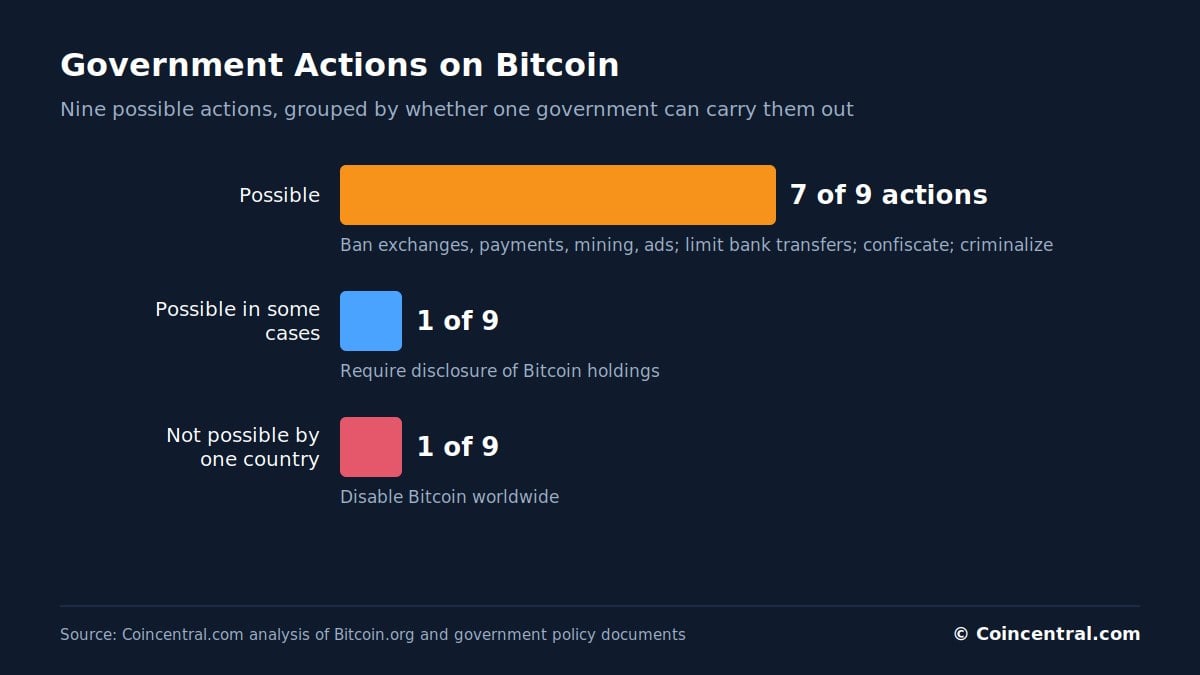
Figure 1: Seven of nine government actions on Bitcoin are possible, one is possible in some cases, and one is not.
Only one action on the list is out of reach for a single government. Disabling Bitcoin worldwide would need action far beyond one country.
A government could make Bitcoin hard to use legally at home. Transactions would still continue elsewhere.
Three questions guide the rest of this article. What can a government legally stop? What did past bans do to the network? And how could a future ban affect prices and holders?
Each section below pairs the numbers with a chart. All figures come from the sources listed at the end.
China’s Ban: Mining and Hashrate Statistics
China was a major crypto hub before 2021. Cambridge University estimated that Chinese miners supplied about 75.5% of global Bitcoin hashrate in September 2019.
Hashrate measures the computing power that supports Bitcoin’s proof-of-work network. A higher number means more machines are working to secure the network.
The 2021 Crackdown
In 2021, Chinese authorities launched a nationwide campaign against crypto mining and trading. Miners were ordered to stop work in several provinces. Banks and payment providers were told not to support crypto transactions.
In September 2021, China’s central bank and other agencies declared crypto-related business activities illegal. Cambridge reported that global hashrate fell about 38% in June 2021.
Mining companies moved equipment to other places, including the United States and Kazakhstan. Bitcoin kept running throughout.
Metric
Figure
Date
China’s share of global hashrate
About 75.5%
September 2019
Fall in global hashrate
About 38%
June 2021
Global hashrate after recovery
About 193.6 exahashes per second
December 21, 2021
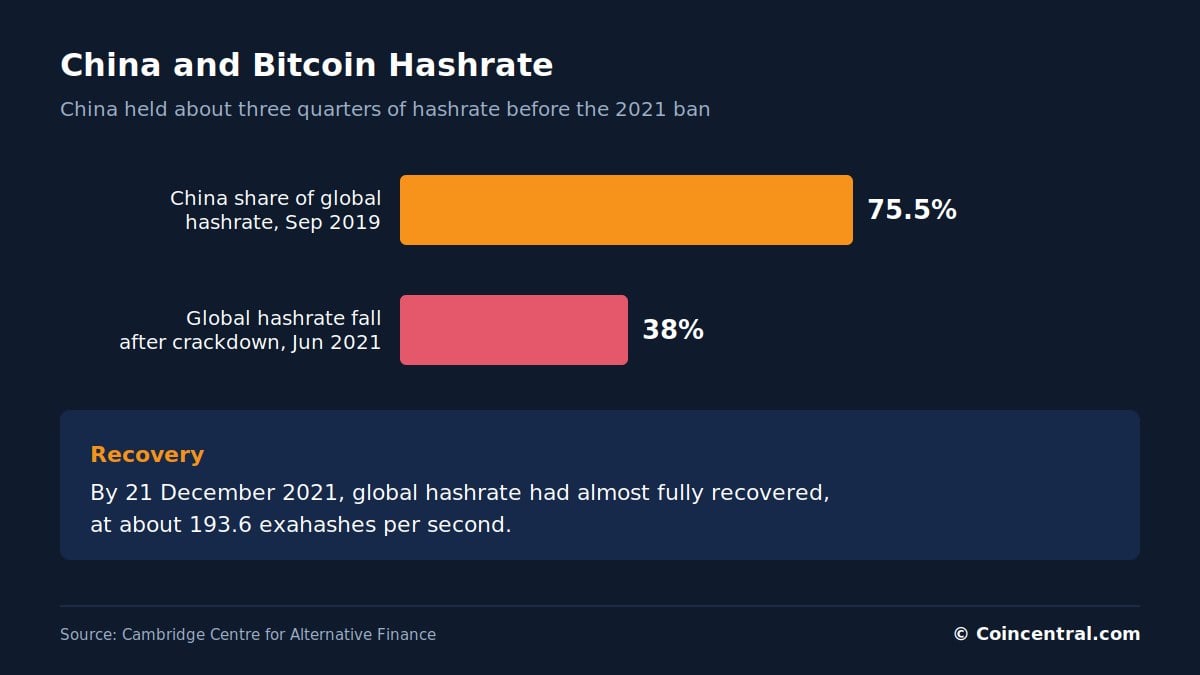
Figure 2: China held 75.5% of hashrate in 2019, and global hashrate fell 38% in June 2021.
By December 2021, global hashrate had almost fully recovered to its level before the crackdown. The network lost a large share of its capacity in one country and rebuilt within months.
Reuters reported in November 2025 that mining had returned to China despite the ban. That points to a gap between official rules and what happens on the ground.
China Tightened the Ban in 2026
China has not reversed its ban. On February 6, 2026, the People’s Bank of China and seven other agencies issued updated rules on virtual currencies. The rules replaced the original 2021 notice.
They confirmed that crypto trading services stay prohibited. They also covered stablecoins, real-world asset tokenization and continued action against mining.
Foreign businesses may not illegally provide virtual currency services to customers in mainland China. The rules focus on prohibited activities and related services. They should not be read as making every Bitcoin wallet a crime.
Crypto Activity in China After the Ban
Chainalysis published new figures in October 2026. They show that China’s crypto economy stayed active even though domestic exchanges remain off limits.
Indicator
Chainalysis estimate
China-linked crypto activity, July 2025 to June 2026
At least $176.3 billion
Share from domestic peer-to-peer activity
59.1%
Growth in unique wallets sending P2P stablecoin transactions, Q1 2024 to Q2 2026
43 times
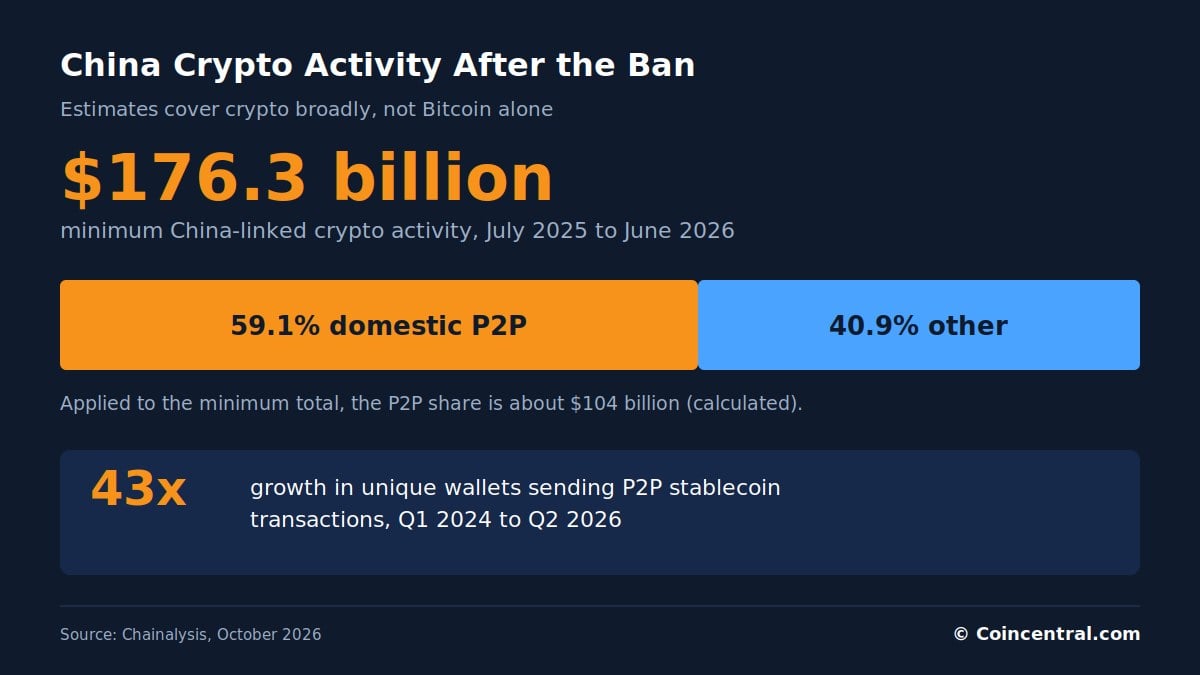
Figure 3: Chainalysis estimates at least $176.3 billion of China-linked crypto activity, with 59.1% domestic peer-to-peer.
Applied to the $176.3 billion minimum, the peer-to-peer share is about $104 billion. That figure is our own calculation from the Chainalysis numbers.
These are blockchain analytics estimates, not official government records. They also cover crypto broadly, not Bitcoin alone.
The data shows a limit of bans. Rules can shut conventional exchanges while some activity moves to peer-to-peer channels. That does not make the activity legal or safe, and it is not the same as trading on regulated platforms.
Bitcoin Mining Statistics: Location, Costs and Energy
Governments can ban mining inside their borders. They can limit electricity connections, bar commercial facilities or fine operators. Miners in other countries can still produce blocks.
The 2025 Cambridge Digital Mining Industry Report surveyed 49 mining companies in 23 countries. Together they represented about 48% of global Bitcoin hashrate when the data was collected.
The survey found that 75.4% of the surveyed mining activity was in the United States. Cambridge warned that strong response from American firms probably overstated the US share of global mining. The figure does not show that the US controls 75.4% of all mining.
Mining statistic
Figure
Companies surveyed
49
Countries covered
23
Share of global hashrate covered
About 48%
Surveyed mining located in the US
75.4%
Electricity share of cash operating expenses
More than 80%
Estimated yearly mining electricity use
About 138 terawatt-hours
Share of mining electricity from sustainable sources
52.4%
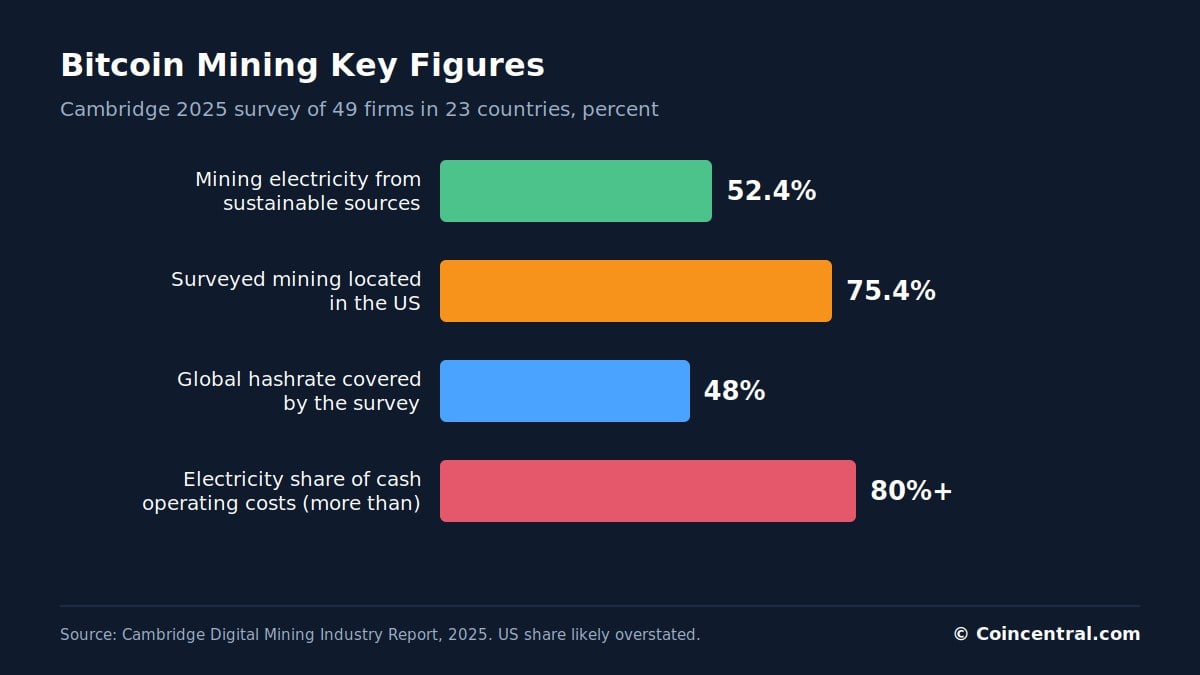
Figure 4: Key figures from the Cambridge 2025 Digital Mining Industry Report.
Electricity is the largest cost for miners. Moving machines after a ban can be expensive and hard to arrange. Mining can shift between countries, but the move has a price.
The energy estimates rely on modeling and carry uncertainty. Governments weigh grid capacity, power demand and environmental goals when they set mining rules.
What Happens When Miners Disappear
Bitcoin adjusts mining difficulty every 2,016 blocks. The goal is to keep the average time between blocks close to ten minutes.
If many miners leave at once, blocks take longer at first. The network then lowers difficulty if the remaining miners keep producing blocks. That can make mining more attractive for those who stay.
The change is not instant. A sudden and severe loss of hashrate could delay transactions until the next adjustment. Lower total hashrate can also reduce the cost of attacking the network.
Which Countries Ban Bitcoin? Rules in 2026
Countries take very different approaches. Some impose broad limits, while others allow ownership and trading through licensed providers. Several have changed course over time.
Country or region
Approach in 2026
China
Crypto business activities prohibited; mining restrictions kept
Algeria
Broad limits on crypto use, trading and mining introduced in 2025
United States
Bitcoin investment and trading allowed under applicable laws
European Union
Crypto services regulated under MiCA
United Kingdom
Ownership and trading allowed, subject to financial rules
India
Transactions taxed and restricted; no full ownership ban
Nigeria
Licensed providers can access banking under set conditions
El Salvador
Bitcoin use allowed; private-sector acceptance is voluntary
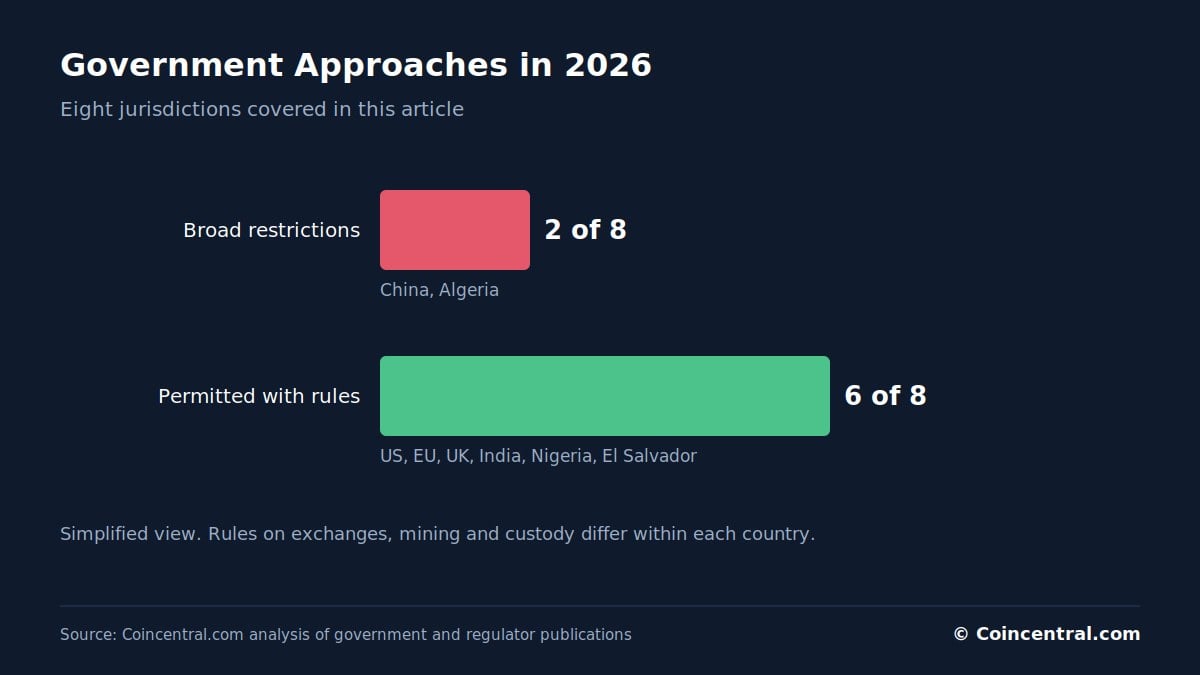
Figure 5: Two of eight jurisdictions have broad restrictions, and six permit Bitcoin with rules.
This view is simplified. Rules on exchanges, payments, derivatives, mining and custody can differ inside the same country.
Nigeria: From Bank Limits to Regulation
In February 2021, the Central Bank of Nigeria barred banks from serving crypto businesses. In December 2023, it issued guidelines that allow banking ties with qualifying virtual asset providers.
The central bank said changes in global standards created a need to regulate the industry. Banks are still barred from holding or trading crypto for their own accounts. The case shows that restrictions are not always permanent.
Why Some Governments Want Limits
Concerns go beyond price swings. The Financial Action Task Force published research in July 2026 on anti-money-laundering standards for crypto. It listed continuing risks from fraud networks, offshore service providers and peer-to-peer transactions.
Capital controls are another worry. Bitcoin lets people hold an asset that no national central bank issues. The IMF has warned that crypto adoption can create risks for monetary policy and financial stability.
Bitcoin Policy Timeline: Bans, Reversals and Rules
Government policy has moved in more than one direction since 2021. The timeline below shows bans, reversals and new rulebooks.
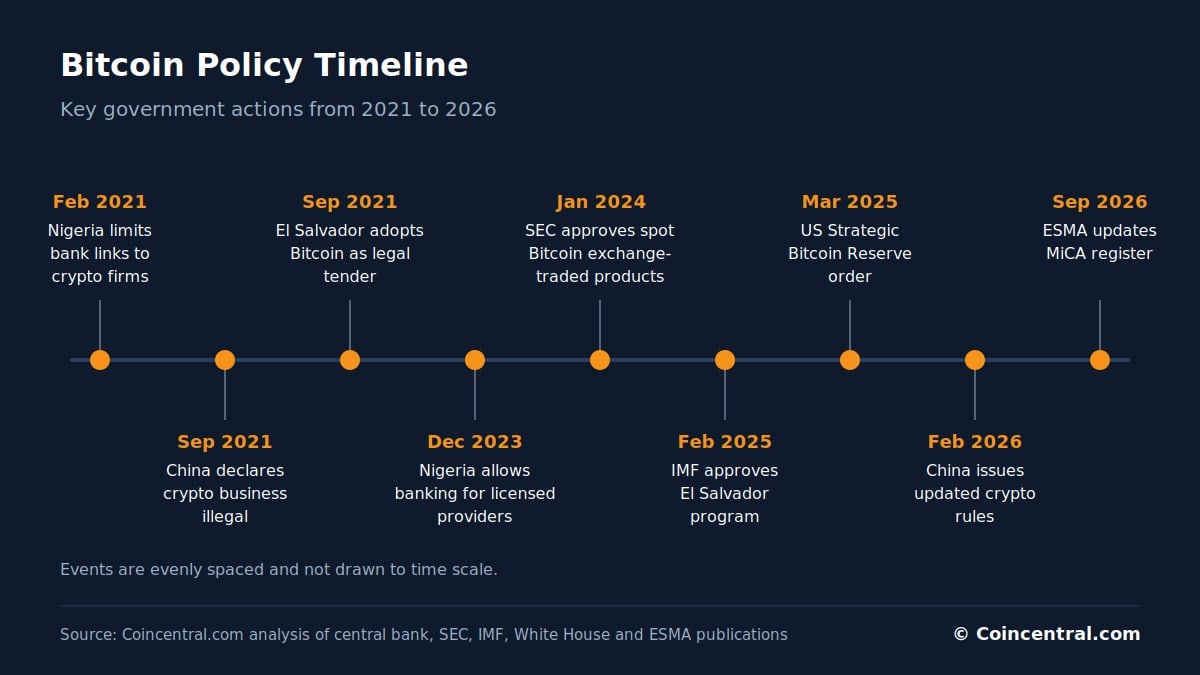
Figure 6: Timeline of key government actions on Bitcoin from 2021 to 2026.
United States: Support, Not a Ban
In January 2024, the Securities and Exchange Commission approved the listing and trading of spot Bitcoin exchange-traded products. These let investors gain Bitcoin exposure through regular brokerage accounts. The SEC said the approval was not an endorsement of Bitcoin itself.
On March 6, 2025, the White House issued an order creating a Strategic Bitcoin Reserve. It covers Bitcoin the federal government already holds, mostly from forfeiture cases. It also asks officials to study budget-neutral ways to acquire more.
The order did not create an unlimited buying program. A full US ban would reverse current federal policy.
El Salvador: Legal Tender, Then a Pullback
El Salvador made Bitcoin legal tender alongside the US dollar in September 2021. Talks with the IMF then led to changes. In 2025, the country removed the rule that private businesses must accept Bitcoin.
The government also limited public-sector Bitcoin activity and required tax payments in US dollars. Private Bitcoin transactions remained possible. A government can reduce Bitcoin’s official role without banning private ownership.
European Union: Rules Over Bans
The EU chose regulation. Its Markets in Crypto-Assets Regulation, known as MiCA, sets rules for issuers and service providers. It covers authorization, transparency, market integrity and consumer protection.
MiCA does not ban Bitcoin ownership or proof-of-work mining. In September 2026, ESMA updated its MiCA register of authorized providers. Future laws could add limits, but they are not current law.
What Would a Bitcoin Ban Do to Price and Markets?
A major ban would likely cause uncertainty in crypto markets. A precise price drop would be a guess. The result would depend on which country acted, whether the ban was expected, and how much trading or mining it touched.
Scenario
Possible effects
1. A smaller country bans Bitcoin
Local investors face disruption. Global prices may see little lasting change.
2. A major economy bans crypto trading
Higher volatility, selling before the deadline, exchange withdrawal surges and outflows from investment products.
3. Several major economies ban it together
Liquidity could shrink for a long period. Banking access, investment products and institutional demand could contract sharply.
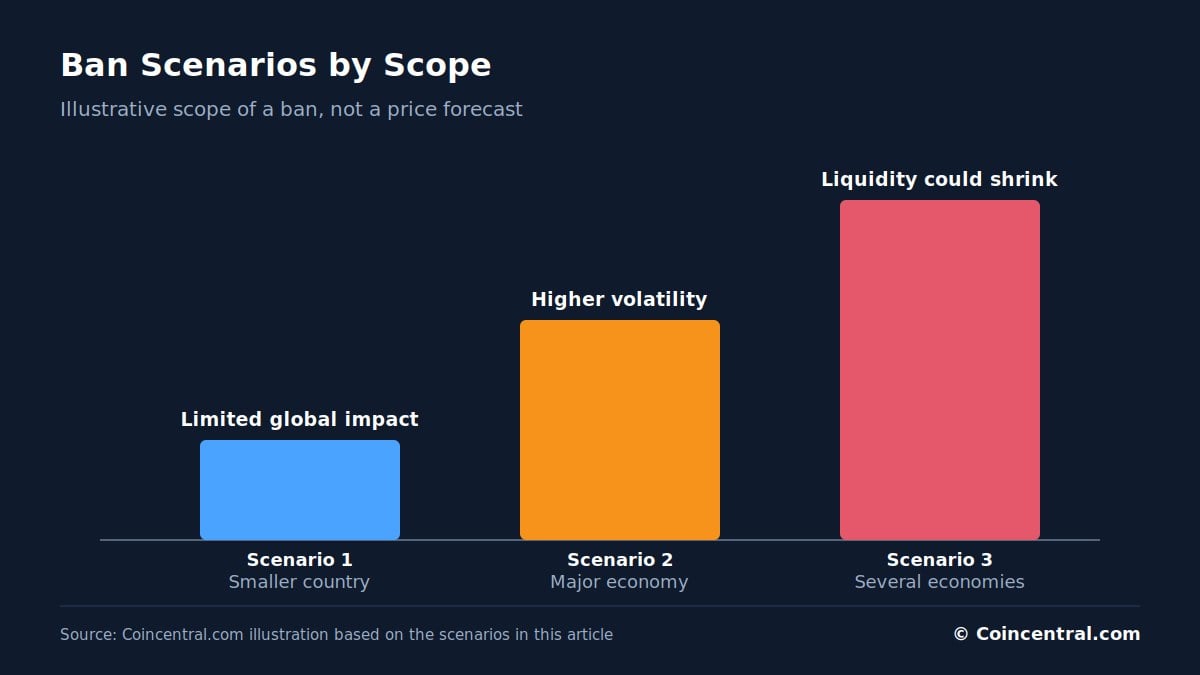
Figure 7: Illustrative scope of three ban scenarios. This is not a price forecast.
China shows that a major ban can sit alongside working global markets. A coordinated ban by the US, the EU and other financial centers would be a much larger threat.
In that case, Bitcoin could keep running technically while becoming far less useful as a mainstream financial asset. Surviving as software and holding economic value are two different things.
The IMF has said strict bans are generally not the preferred option, though targeted limits may fit some cases. Its advice stresses supervision, financial stability, consumer protection and international cooperation.
The Financial Stability Board also backs rules that match the risk of the activity. Regulation can still raise costs. Licensing, custody rules and reporting duties may favor larger exchanges over smaller firms.
What Happens to Bitcoin in Your Wallet?
The outcome depends on how the Bitcoin is held. An exchange account and a self-custody wallet face different risks.
Holding method
What a ban could mean
Exchange account
The exchange may pause services or limit withdrawals. A trading ban does not automatically mean customer assets are confiscated. The outcome depends on the law and customer agreements.
Self-custody wallet
Closing an exchange does not remove coins from a wallet you control. You could still face limits on selling or spending, disclosure rules or penalties for banned activity.
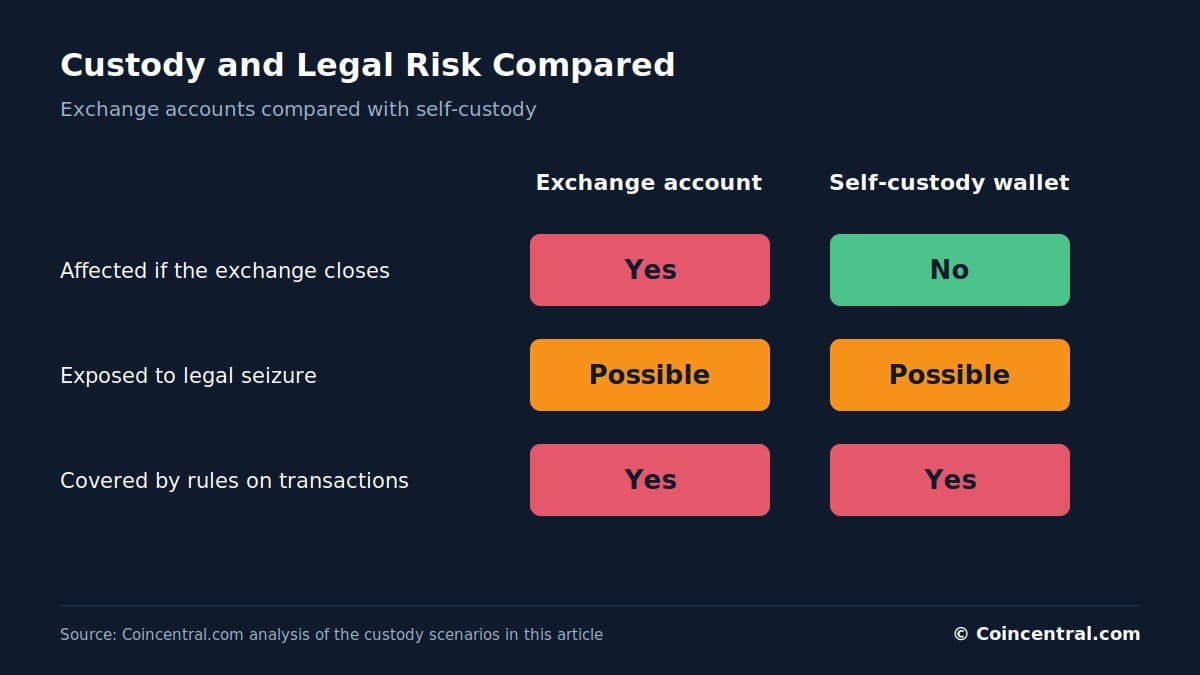
Figure 8: Exchange accounts and self-custody wallets face different risks.
Authorities can seize crypto through legal procedures. Taking self-custodied Bitcoin generally needs access to the private keys or other lawful cooperation.
Holding your own keys protects against some custody risks. It does not remove regulatory risk.
The two holding methods also differ in who carries the risk. With an exchange, the business holds your keys and follows the law of its home country. With self-custody, you hold the keys and carry the responsibility for keeping them safe.
Neither method removes the need to follow local rules. Tax, reporting and transaction limits can apply to both.
Practical Steps for Investors
Regulatory uncertainty is a real investment risk. Still, big decisions should not rest on rumors about future laws.
Start by knowing how your Bitcoin is held. Check the legal rules where you live. Keep cash outside crypto so you are not forced to sell during market stress.
If you use an exchange, read its withdrawal terms and find out which country’s law applies. Follow official government announcements instead of social media posts.
Bans also carry costs for the governments that use them. Enforcement takes money and staff. Activity that moves to private channels is harder to see, tax and supervise.
That is one reason many regulators favor licensing over prohibition. Licensed firms can be checked, while hidden activity cannot.
Frequently Asked Questions
Can the US government make Bitcoin illegal?
Lawmakers could try to ban specific Bitcoin activities through legislation. Broad limits would raise legal, political and enforcement questions. Current federal policy supports regulated Bitcoin activity.
Can governments shut down the Bitcoin network?
One government cannot normally shut down the whole network. Wide limits on miners, communications and financial services could still harm its operation and usefulness.
Has Bitcoin ever been completely banned?
Several countries have broad crypto bans. China is the main example. None of them has stopped the global network.
Would Bitcoin crash if the US banned it?
A broad US ban would likely bring heavy uncertainty and selling pressure. No reliable model can predict the size of the drop or the recovery.
Is Bitcoin legal in 2026?
Bitcoin is legal to own and trade in many places, including the United States and much of Europe. Rules differ by country and by activity.
Bottom Line
Governments can ban Bitcoin activities, but shutting down Bitcoin itself is much harder. China’s 2021 crackdown cut global hashrate by about 38% in June 2021. The network had almost fully recovered by December.
Chainalysis data from 2026 shows crypto activity continuing in China under a ban that was tightened in February. These facts do not mean bans are harmless.
A ban by a major economy could hit prices, exchange access, institutional investment and mining. Coordinated limits across several financial centers would be a larger test.
Bitcoin’s strength is its decentralized design. Its weak point is economic: it needs people who are willing and able to own, trade and use it.
As of October 2026, major governments are split between prohibition and regulation. That makes government policy one of Bitcoin’s largest long-term risks.
Sources
- Updated Cryptocurrency Restrictions (People’s Bank of China and China Securities Regulatory Commission, February 2026)
- China’s Expanded Cryptocurrency Ban (US Library of Congress, May 2026)
- East Asia Cryptocurrency Adoption Report (Chainalysis, October 2026)
- Bitcoin Mining Resurgence After China’s Ban (Cambridge Centre for Alternative Finance, 2022)
- Cambridge Digital Mining Industry Report (Cambridge Judge Business School, April 2025)
- Bitcoin Mining Returns to China Despite Ban (Reuters, November 2025)
- Establishment of the US Strategic Bitcoin Reserve (White House, March 2025)
- Approval of Spot Bitcoin Exchange-Traded Products (US Securities and Exchange Commission, January 2024)
- Markets in Crypto-Assets Regulation (European Securities and Markets Authority)
- El Salvador’s Bitcoin Policy Reforms (International Monetary Fund, February 2025)
- Elements of Effective Cryptocurrency Policies (International Monetary Fund, February 2023)
- 2026 Virtual Asset Regulatory Implementation Report (Financial Action Task Force, July 2026)
- Global Regulatory Framework for Cryptocurrency Activities (Financial Stability Board, July 2023)
- Bitcoin Network and Mining FAQ (Bitcoin.org)
- 2026 Global Cryptocurrency Adoption Index (Chainalysis, September 2026)
Disclaimer: This article gives general information, not legal or financial advice. Crypto laws vary by country and can change quickly. Scenarios describe possible outcomes, not forecasts.
The post Can Governments Ban Bitcoin? Key Statistics and Facts for 2026 appeared first on Blockonomi.