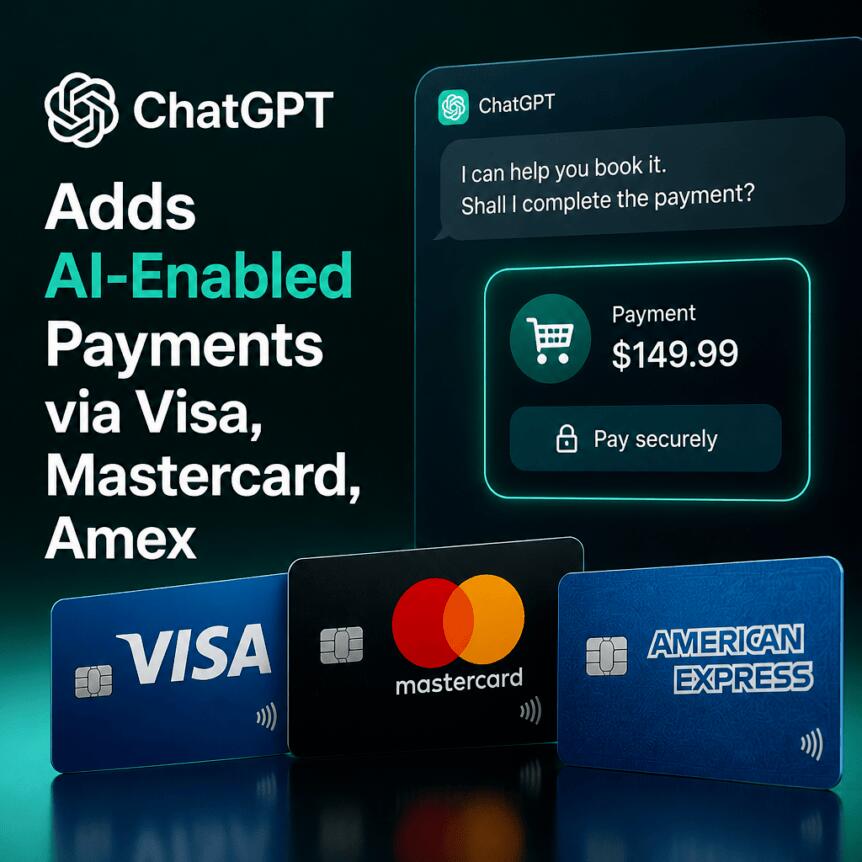
OpenAI has launched a new “ChatGPT Wallet” feature that enables AI agents to make purchases on users’ behalf directly inside ChatGPT, using major card payment networks. The release, announced
OpenAI has launched a new “ChatGPT Wallet” feature that enables AI agents to make purchases on users’ behalf directly inside ChatGPT, using major card payment networks. The release, announced Friday, is being built in collaboration with American Express, Mastercard, and Visa.
The core idea is to move from conversational recommendations to actual transaction execution—without exposing a user’s real card information to the merchant or the AI agent. According to OpenAI, the wallet relies on biometric authorization and tokenized credentials generated for each approved purchase.
Key takeaways
- ChatGPT Wallet lets eligible US ChatGPT Pro subscribers authorize AI-initiated purchases inside ChatGPT using existing card networks.
- Tokenized credentials are generated per transaction, reducing the need to share real card details with merchants or AI agents.
- Biometric verification is used to approve transactions, such as facial recognition or fingerprints.
- OpenAI plans staged automation, including limits and restrictions that would reduce the need for approval on every single purchase.
- The move aligns with “agentic commerce” trends and broader payments experimentation across the tech and crypto sectors.
How OpenAI’s wallet works inside ChatGPT
OpenAI says the ChatGPT Wallet allows users to authorize transactions through biometric checks within ChatGPT. Examples of supported biometric methods include facial recognition and fingerprint verification. Once a purchase is approved, payment networks generate tokenized card credentials for that specific transaction.
OpenAI emphasizes that this design helps keep users’ actual card details away from both merchants and the AI agents processing the request. For users, it changes the user experience from manual checkout steps to a conversational flow where the AI can initiate a payment—while still requiring explicit approval in the current rollout.
Rollout scope and what changes next
At launch, the wallet is rolling out to ChatGPT Pro subscribers in the United States, limited to users with eligible cards issued in the country. OpenAI also indicated that it intends to expand capabilities over time.
In particular, OpenAI said it plans to support purchases using preset spending limits and other restrictions, with the goal of enabling more autonomy—without requiring approval for every transaction. While OpenAI did not specify when those broader controls would arrive, the direction is clear: the company is moving from human confirmation per purchase toward rules-based automation.
Why this matters for consumers and merchants
This launch reflects a broader shift in AI product strategy. Instead of stopping at suggestions (“you might want to buy X”), AI systems are increasingly being designed to complete transactions—potentially shortening the path from discovery to purchase.
If wallet-based payments become common inside chat interfaces, consumers could manage buying journeys with fewer clicks, while merchants may gain access to a new channel for reaching customers. But there’s also an obvious tension: automation requires safeguards against fraud and misuse, and the wallet’s reliance on tokenized credentials and biometric verification shows how payment companies and AI platforms are trying to balance convenience with risk controls.
OpenAI said it is working with payment processors and fraud prevention firms to support AI purchases through existing checkout systems. The practical implication is that this approach is designed to fit into established payment rails rather than require merchants to rebuild their checkout flows for every new AI app.
Competition and the wider “agentic commerce” payments race
OpenAI is not operating in a vacuum. Several firms have been building payment-related infrastructure aimed at AI agents that can initiate transactions.
In the broader tech world, Google introduced its Agent Payments Protocol in 2025. Visa and Mastercard have also launched initiatives intended to enable AI-initiated transactions, suggesting that large payment networks see a long-term role for agent-driven payments within mainstream commerce.
Crypto-native players are pursuing similar goals, typically by combining stablecoins with automation and agent tooling. Coinbase introduced x402 in 2025, designed to enable autonomous stablecoin payments for digital services. Circle launched its Agent Stack in May, which allows agents to hold and spend USDC within predefined limits. Crossmint, according to the summary in OpenAI’s announcement coverage, has taken a different approach—combining stablecoin wallets with traditional card network capabilities.
These efforts all point to the same underlying demand: as AI agents become more capable of taking action, payments infrastructure has to support execution securely, with controllable permissions, spending limits, and fraud defenses.
Juniper Research expects this market to expand rapidly. According to a report from April, the value of agentic commerce transactions is projected to reach $1.5 trillion by 2030, rising from an estimated $8 billion in 2026 (as cited in the original report).
What to watch next
The immediate question for users and developers is how quickly OpenAI will broaden ChatGPT Wallet beyond the current US Pro-and-eligible-cards rollout, and how effectively its planned spending limits and restrictions will reduce the need for approval on every purchase without increasing fraud risk. As these wallet features mature, the winner may be less about which AI can “shop,” and more about which payments stack can make agent-driven checkout feel seamless while staying tightly controlled.
This article was originally published as ChatGPT Adds AI-Enabled Payments via Visa, Mastercard, Amex on Crypto Breaking News – your trusted source for crypto news, Bitcoin news, and blockchain updates.