Coinbase and Strategy, formerly MicroStrategy, fell about 8% in the opening minutes Friday as crypto-linked stocks sold off more sharply than the technology-heavy Nasdaq-100 fund. The decline
Coinbase and Strategy, formerly MicroStrategy, fell about 8% in the opening minutes Friday as crypto-linked stocks sold off more sharply than the technology-heavy Nasdaq-100 fund.
The declines followed Binance's disclosure of a security incident affecting about $6.3 billion, alongside fresh company earnings and selling across technology stocks.
The early trading does not isolate how much of each stock's decline came from the hack.
Related: Binance major shareholder cites $1B SpaceX stake after Elon Musk mocks hack
Crypto stocks in early trading
Yahoo Finance quoted the following regular-session prices on Oct. 30. Changes are its reported moves from Thursday's close, not changes since the opening trade.
The Invesco QQQ Trust, which tracks the Nasdaq-100, was down 2.65% at $696.38 at 9:30:55 a.m. ET, according to Yahoo.
Coinbase opened at $148.23, below its $160.59 prior close. Strategy opened at $131.52 versus a $141.62 prior close.
Bitcoin was quoted at $77,050.96, down 3.91% over the daily comparison, at 9:31:43 a.m. ET. Crypto trades around the clock.
 Early-session share-price declines on Oct. 30, compared with Thursday's close. Quotes span 9:30:55 to 9:31:21 a.m. ET. Source Yahoo Finance. Graphic by TheStreet and Roundtable.
Nasdaq-100 members with identified crypto exposure
Three of the four Nasdaq-100 companies identified with bitcoin or crypto exposure were lower at about 9:35 a.m. ET. Strategy fell the most.
We screened for index members that report bitcoin on their balance sheets or run a crypto product. That identified four, so at least four of the 100 qualify. We did not review every member's filings, so the true number could be higher.
QQQ was down 2.90% at $694.63 at 9:35:07 a.m. ET. Strategy, SpaceX and Tesla all fell more than the fund, while PayPal rose.
Tesla's 10-Q says the majority of its digital assets were 11,509 bitcoin at Sept. 30. SpaceX's 10-Q reports 18,712 bitcoin. PayPal runs a crypto buying and selling service and reports crypto assets held for investment.
Related: I'm with Elon Musk on Binance's hack
Coinbase, Robinhood, Circle and Riot do not appear in Invesco QQQ's Oct. 29 holdings, which track the index. Their declines above are not Nasdaq-100 moves.
The four are the members identified so far, not a complete count. The moves are a snapshot and do not show that Binance caused them.
Coinbase was already facing weaker trading
Coinbase released its third-quarter results Thursday, giving investors another reason to reassess the stock before Friday's open.
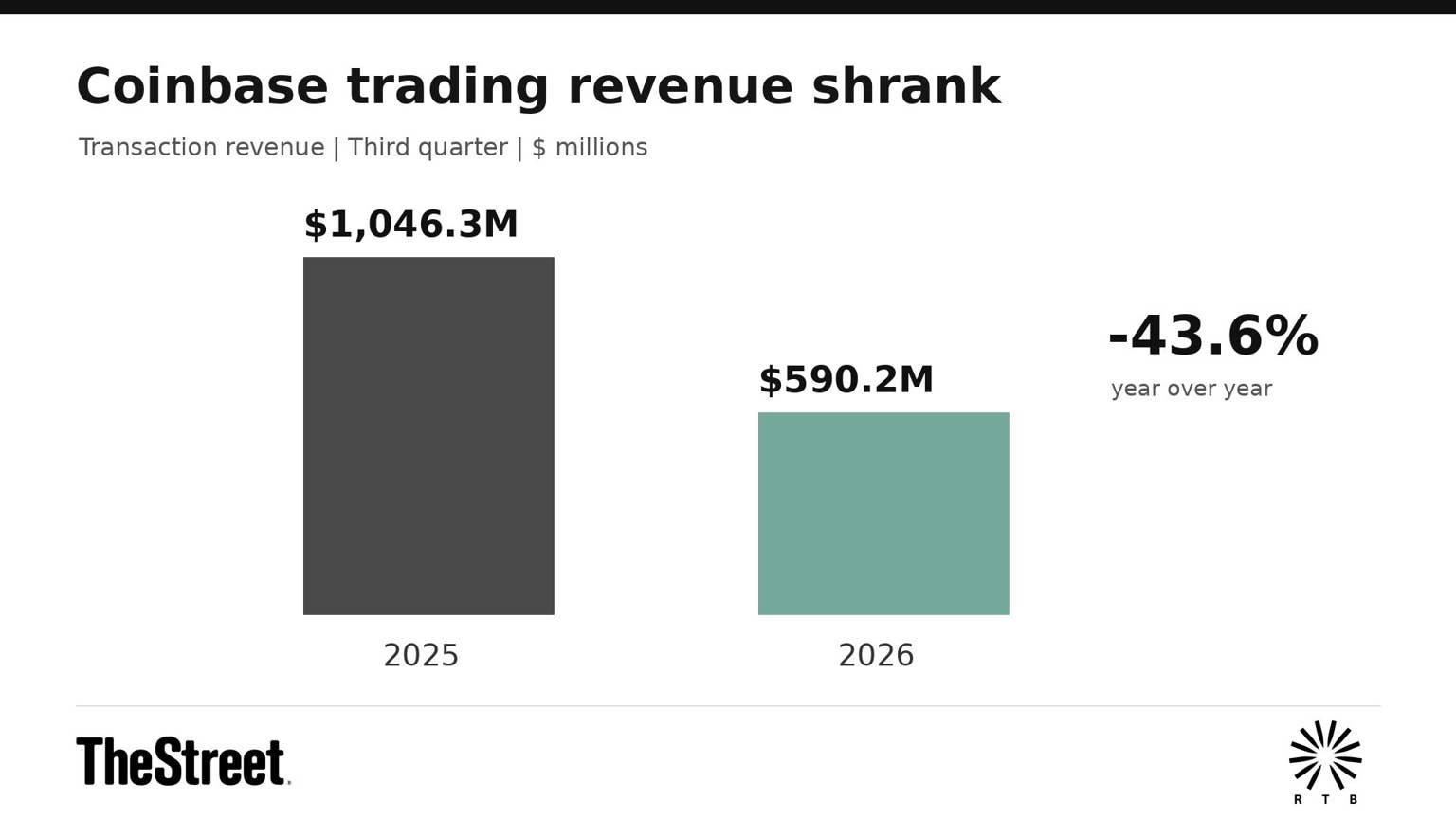
Its filing showed transaction revenue fell to $590.2 million from $1.046 billion a year earlier, a decline of about 44%.
Consumer trading revenue fell to $450.1 million from $843.5 million. Institutional transaction revenue declined to $91.7 million from $135 million.
Total revenue fell to $1.216 billion from $1.869 billion. These figures describe the September quarter, before the Binance incident.
Coinbase transaction revenue declined 43.6% year over year in the third quarter. Source SEC. Graphic by TheStreet and Roundtable.
The company nevertheless reported $719 million in net income and $78 million in adjusted net income, a nonstandard accounting measure.
It said its share of crypto trading volume reached 10.7%, marking a fourth consecutive quarter of market-share gains.
Average USDC held in Coinbase products reached $22 billion. Subscription and services revenue represented 49% of net revenue.
That leaves a mixed earnings picture, with market-share gains and expanding products alongside a sharp fall in trading revenue.
The numbers do not show that Binance customers have moved to Coinbase after the breach. That would require post-incident customer or volume data.
Related: LIVE: Coinbase Q3 2026 earnings call
Strategy has a different exposure to bitcoin
Strategy, formerly MicroStrategy, is a bitcoin-holding company rather than a competing cryptocurrency exchange.
Its Thursday results reported 848,517 bitcoin as of Oct. 25, acquired at an average cost of about $75,446 each.
That holding makes the value of its assets sensitive to bitcoin prices. A price decline does not establish that any coins were stolen.
Popular on TheStreet Roundtable:
The company reported $19.12 billion in quarterly net income attributable to common shareholders, with a $20.91 billion gain on digital assets.
Those quarterly accounting gains are not a measure of how its bitcoin holdings performed after the Binance incident began Thursday afternoon.
Strategy also announced that Chief Financial Officer Andrew Kang would step down Nov. 5, remaining an adviser through year-end.
Earnings, changes in bitcoin's value and the finance transition therefore formed part of the information investors were assessing alongside the breach.
Related: LIVE: MicroStrategy Q3 2026 earnings call
The other crypto stocks are different businesses
Robinhood's results this week showed crypto revenue fell 55% to $120 million, even as total revenue rose 12% to $1.42 billion.
Its options, equities and event-contract businesses grew. Treating Robinhood as a pure bitcoin investment would miss those other sources of revenue.
Circle's business is different again. Its filing says reserves backing its stablecoins earn interest and dividends.
A stablecoin is designed to track a reference currency, usually the dollar. Circle's stock is not designed to maintain a $1 price.
Circle reported $667.7 million of reserve income in the June quarter, compared with $701.3 million in total revenue and reserve income.
Trending on TheStreet Roundtable:
Riot's filing shows revenue from bitcoin mining, data centers and engineering. Those businesses carry different operating costs and earnings drivers.
A shared decline across these shares shows broad selling of crypto-linked companies. It does not prove identical losses or direct exposure to Binance.
Binance is part of a wider selloff
Bitcoin was down 3.91% by 9:31:43 a.m. ET, hours after funds began leaving Binance wallets Thursday afternoon, according to Chainalysis. The timing alone does not establish what drove each price move.
Binance CEO Richard Teng: U.S. clarity is key before North America push (2:55)
Chainalysis called the hack the largest in crypto history. Elliptic put the stolen total at $6.43 billion, against $1.46 billion for Bybit in 2025. Binance's own estimate is about $6.3 billion.
Binance said it would cover losses using its user-protection fund and company funds, and temporarily suspended withdrawals for security checks.
Its announcement said deposits remained unaffected. Frozen assets are not the same as funds already recovered and returned to users.
The equity selloff also had a separate technology catalyst. Amazon and Intel both reported third-quarter results Thursday.
Amazon reported a $42.4 billion free-cash outflow over the trailing year and maintained its approximately $220 billion capital-spending forecast for 2026.
Intel said the PC slowdown could continue through the first half of next year. Its fourth-quarter revenue forecast was $15 billion to $16 billion.
Those company disclosures give technology investors reasons for pressure independent of Binance. They do not provide a numerical split of Friday's selling.
The opening picture combines industry security concerns, lower cryptocurrency prices and company-specific financial results, rather than a single verified cause.
Related: Binance major shareholder says user funds are safe after $3B hack
Disclaimer: This article is for informational purposes only and does not constitute financial advice.
Cryptocurrency investments are highly volatile and risky. Always conduct your own research before making any investment decisions.