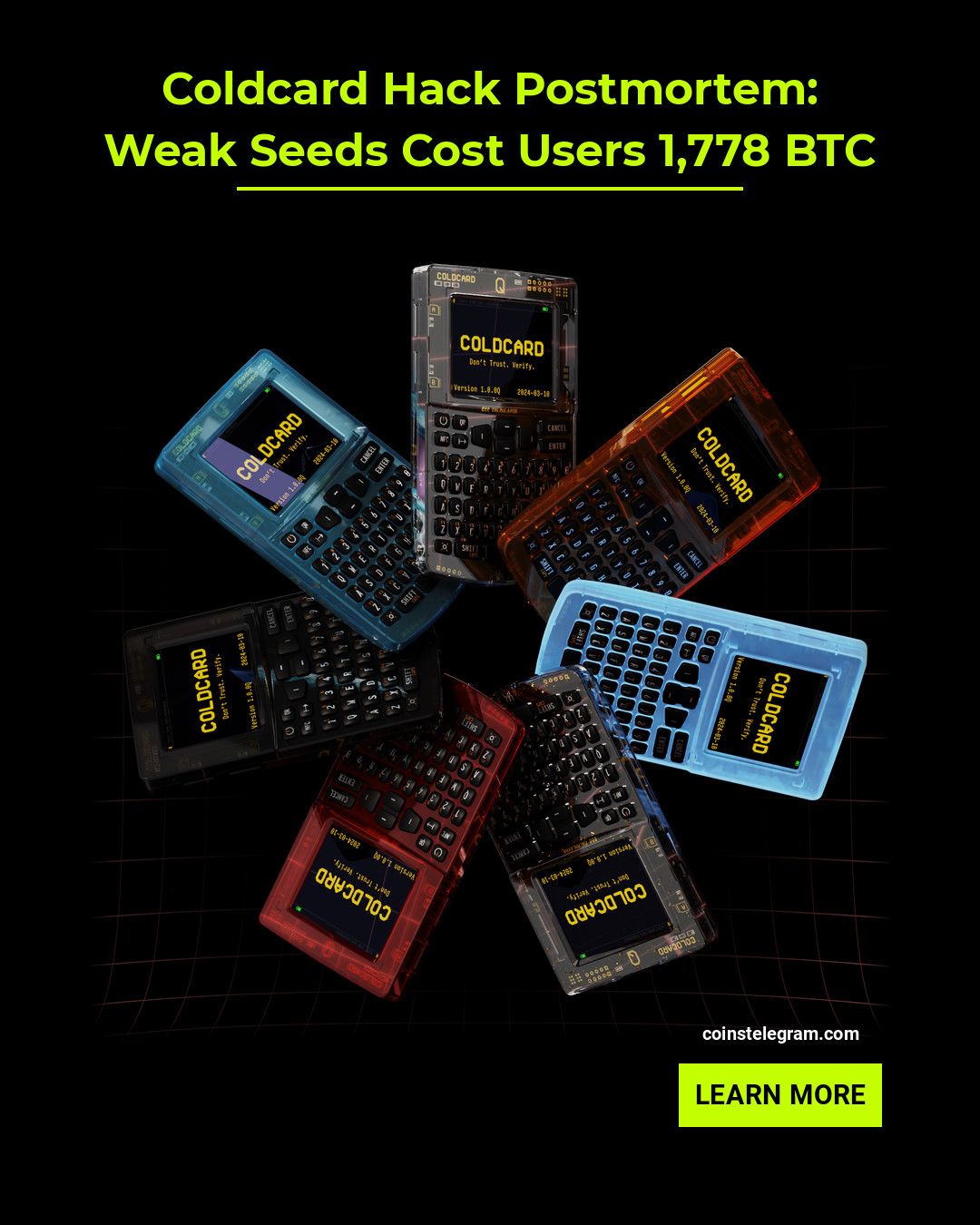
For five years, one of Bitcoin’s most trusted hardware wallets made recovery phrases with the wrong kind of randomness. Nobody noticed. Then, in late July, thieves did. On Tuesday, November 2
For five years, one of Bitcoin’s most trusted hardware wallets made recovery phrases with the wrong kind of randomness. Nobody noticed. Then, in late July, thieves did.
On Tuesday, November 24, Coinkite published its full postmortem on the Coldcard seed-generation flaw. The 18-page report, dated November 23 and structured like an NTSB accident report, confirms what Coldcard owners feared: no device was hacked. The attackers simply rebuilt private keys offline from seeds that were far weaker than advertised.
The damage is serious. Galaxy Research counted 1,778.84 BTC stolen from more than 8,600 addresses, which is roughly $105 million with Bitcoin trading near $59,200 on Wednesday. And there is a twist: Coinkite calls AI-assisted discovery of the bug “a plausible hypothesis.”
How the Coldcard Seed Bug Worked
A seed phrase is only as strong as the randomness behind it. Coldcard devices were built to pull that randomness from the hardware random number generator inside their STM32 chip.
They didn’t. From firmware 4.0.1, released on March 29, 2021, until July 30, 2026, a configuration setting switched the hardware source off. A safety check in libNgU, a code library written by Coinkite’s CTO Peter Gray, failed to catch it. Seed generation quietly fell back to Yasmarang, a simple software generator built into MicroPython.
Nothing crashed. The devices still showed normal-looking seed words. In Coinkite’s words, “the defect was a silent substitution, not a runtime failure.”
The numbers explain the theft. Coldcard seeds were meant to carry 128 bits of security. Coinkite now estimates affected seeds had about 40 bits on the older Mk2 and Mk3 and about 72 bits on the Mk4, Mk5 and Q. So the difference is simple: instead of guessing a key in an impossibly large universe, attackers could search a space small enough for powerful computers to grind through.
1,778 BTC Gone, and the Victim Count Is Still Open
The first unexpected transactions hit on July 29. Users raised the alarm on July 30, and Coinkite found the defect that same day and shipped fixed firmware on July 31.
As of November 18, Coinkite had received about 300 loss-related support tickets from 242 customer accounts, around 0.21% of its estimated user base. The company admits the real number is likely higher. Coldcard is self-custodial, so Coinkite only sees the losses people report.
Where did the coins go? Nobody knows who holds them. Law enforcement is investigating, the Canadian Centre for Cyber Security has its own open case, and blockchain analysis firms are watching the attackers’ addresses for any movement. Coinkite has asked whoever controls the funds to return them, without promising immunity or payment.
Did AI Find the Flaw First?
Coldcard firmware was public, and at least 15 independent review efforts looked at it between 2021 and 2026, including two paid audits. One of them was an AI review. From May 1 to June 26, 2026, researcher Rob Hamilton ran the firmware through the OpenAI Cybersecurity Harness. It produced 85 candidate findings and led to several fixes, but missed the seed bug.
Then came the timing. Moonshot AI released the full weights of its Kimi K3 model on July 27, 2026, meaning anyone could download and run it. The first thefts started two days later.
Coinkite stresses this is not an attribution. Still, once the bug was public, AI tools found it fast. One team reported that Claude Code spotted it in eight minutes. Developer Lloyd Fournier tested several models with the same audit prompt and reported hits for Kimi K3 and GPT-5.6 Sol. A group called Bitcoin Red Team then used Kimi K3 heavily in a 108-hour review that produced 7,958 candidate findings across 501 Bitcoin projects.
The message is clear: AI models that can read firmware in minutes are now available to attackers and defenders alike, and the defenders are not always first.
What Coinkite Changed and What Owners Must Do
Coinkite’s newer firmware no longer trusts a single source. Every new seed now mixes user input, such as 50 dice rolls or 65 random key presses, with the STM32 chip and two secure elements. The device also checks at startup that the hardware generator is really in use. An independent review by Keylabs, published October 15, found the defect fully closed in the four current standard releases it examined.
But here is the catch. Updating firmware does not fix an old seed. Anyone who created a seed on affected firmware needs to install verified fixed firmware, generate a brand-new seed and move their coins, including passphrase wallets. Seeds made with at least 50 private dice rolls were not weakened.
Compensation is still undecided. Coinkite says it is “evaluating all possible options” but has made no decision. Meanwhile, a proposed class action filed in Ontario on September 11 names Coinkite and co-founders Rodolfo Novak and Peter Gray, alleging more than $140 million in losses. It has not been certified.
Novak, the public face of Coldcard, stepped back from the spotlight in mid-November. “I dedicated 18 years of my life to bitcoin adoption. Bitcoin won,” he wrote on X. “My industry tenure is done.” The post drew a wave of angry replies from users who lost coins.
Background: Why Coldcard Mattered
Coinkite is a Toronto company founded in 2012, and Coldcard is its Bitcoin-only, air-gapped hardware wallet. Its slogan is “Don’t trust. Verify.” Public source code and reproducible builds were supposed to make bugs like this impossible to hide.
The postmortem shows the limit of that promise: the code was open to inspection for five years, yet nobody checked the one path that mattered.
It also lands in a rough month for “cold storage.” Ledger is still investigating tampered devices with hidden implants, and now Coldcard owners are moving funds to fresh seeds. The lesson for every holder is practical: add your own randomness, use a strong passphrase or multisig for big amounts, and treat any wallet as one layer, not a guarantee. With AI speeding up bug hunting on both sides, the next flaw may not wait five years to be found.