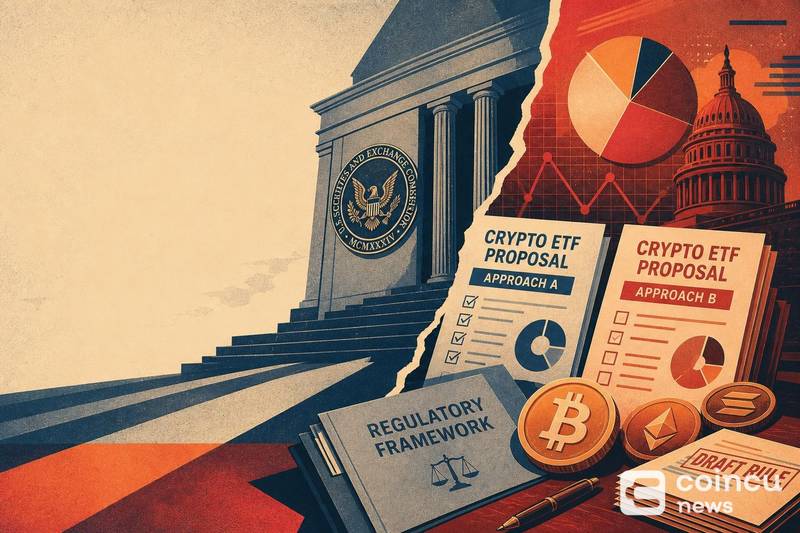
Crypto industry participants have submitted differing rule proposals to the U.S. Securities and Exchange Commission over how novel exchange-traded funds should be regulated, opening a public-
Crypto industry participants have submitted differing rule proposals to the U.S. Securities and Exchange Commission over how novel exchange-traded funds should be regulated, opening a public-comment fight that centers less on whether such products should exist than on the framework that will govern them.
The disagreement stems from an SEC request for public comment on novel exchange-traded funds, per the commission's announcement seeking input on the new ETF framework. The comment file, catalogued as S7-2026-24, is where market participants have lodged their competing positions, according to the SEC's public-comment docket.
This is a policy-development story, not an approval announcement. No product is being cleared or rejected here; the commission is collecting views on the rules that would later determine how a category of ETFs is evaluated. What makes it notable is that the split runs inside the industry itself, not only between industry and regulator. For related coverage, see Top Crypto Trading Platforms in 2026: 6 Exchanges and Apps Worth Comparing.
Where the submitted proposals diverge
One line of argument pushes back on the regulatory framing itself. In letters to the SEC, investors argued against applying a "novel ETF" label to the products in question, according to reporting on the comment letters. That position treats the products as fitting within existing ETF norms rather than warranting a separate, heavier regime. For related coverage, see Why Is Bitway (BTW) Price Surging Today? Key Drivers Behind the Move.
A contrasting view appears in the docket's individual filings, such as one comment letter submitted to file S7-2026-24. Because the letters reach different conclusions on how the rules should be designed, the record reflects competing preferences rather than a unified industry ask. For related coverage, see Why Is Filecoin (FIL) Price Surging Today? Key Drivers to Watch.
The brief does not specify every disputed clause, so the precise dividing lines remain a matter of inference. ETF rulemaking typically turns on listing standards, disclosure obligations, custody requirements, market surveillance, and issuer duties, and a "novel" classification would generally raise the compliance bar across several of those areas, which is what the label objection appears to target.
What the split means for issuers, investors, and approvals
For issuers, the classification question is consequential: a heavier "novel" designation would shape the disclosure and structural conditions any future product must meet before listing. Large asset managers active in crypto ETFs, including those that have accumulated significant spot Bitcoin exposure, have a direct stake in how strict that bar is set.
For investors, the framework governs the products they can access and the safeguards attached to them, which is why the comment letters frame investor protection and market access as central. For the SEC, conflicting input widens the tradeoffs it must weigh before settling final standards, since there is no single industry consensus to defer to.
The dispute also echoes a broader pattern of firms pressing regulators to fit crypto products into recognizable categories rather than build bespoke regimes, as seen when Ondo urged the SEC and CFTC to oversee U.S. stock perpetual contracts under existing oversight structures.
The balance the SEC has to strike
As the regulator receiving the proposals, the SEC must reconcile market access against oversight, and industry disagreement complicates that balancing act. When commenters split on the basic question of whether a product is "novel," the commission cannot adopt a position without effectively choosing sides on the compliance burden.
That is why the lack of consensus matters in rule design: a divided record forces the SEC to justify its framework choices against opposing submissions rather than ratify an agreed-upon standard, raising the odds that whatever it finalizes will be contested.
What are the proposals about? They are public comments responding to the SEC's request for input on how novel exchange-traded funds should be regulated, filed under comment file S7-2026-24.
Why do the proposals differ? Participants disagree on the framing, with some investors arguing against classifying the products as "novel" ETFs, a distinction that carries different regulatory obligations.
What happens next? The SEC continues collecting public comment before it can move toward a final rule; the next concrete milestone to watch is the close of the comment window and any commission action on file S7-2026-24.
Disclaimer: This article is for informational purposes only and does not constitute financial or investment advice. Cryptocurrency and digital asset markets carry significant risk. Always do your own research before making decisions.
The post Crypto Industry Offers Split SEC ETF Rule Proposals was initially published on Coincu.