The information provided in this article is for informational purposes only and does not constitute financial advice. Investing in cryptocurrencies carries a high level of risk. A virtual por
The information provided in this article is for informational purposes only and does not constitute financial advice. Investing in cryptocurrencies carries a high level of risk.
A virtual portfolio is a portfolio without money: you buy at real prices, the portfolio books quantity, price and fees, and after a few weeks you see what would have become of your selection. For equities and ETFs, many banks and financial portals offer this. For crypto the choice is narrower, and a crypto virtual portfolio works differently from a securities one in three respects: the market never sleeps, the swings are larger, and tax follows different rules. Here is what a virtual portfolio can do, where the line runs to a watchlist and a portfolio tracker, and how to set up a crypto virtual portfolio without registering.
Crypto virtual portfolio: the key points in brief
- A virtual portfolio is a simulated portfolio with real prices and play money. It books purchases and sales and shows the performance without any money moving.
- Virtual portfolios from banks and financial portals are built for securities: equities, ETFs, funds, bonds. Crypto mostly appears there only as a security, for instance as an ETN.
- A crypto virtual portfolio without registration is possible in CryptoTicker's trading simulator: 10,000 euros of play money, 50 coins, real prices, as of September 28, 2026.
- Crypto trades around the clock, 365 days a year. A virtual portfolio shows you on Monday what happened over the weekend.
- Watchlist, virtual portfolio and portfolio tracker are three different tools: observing, practising, managing real holdings.
- For tax purposes only real ownership counts: coins held privately are tax-free in Germany after a holding period of one year, and below that an exemption threshold of 1,000 euros a year applies (Section 23 of the Income Tax Act, as of 2026).
What is a virtual portfolio?
A virtual portfolio, also called a simulated or demo portfolio, replicates a real portfolio. You decide what you buy and how much of it, the virtual portfolio calculates at the current price, deducts the simulated fees and tracks the performance from then on. If you sell, the gain or loss is booked. There is no real money, no deposit and no withdrawal.
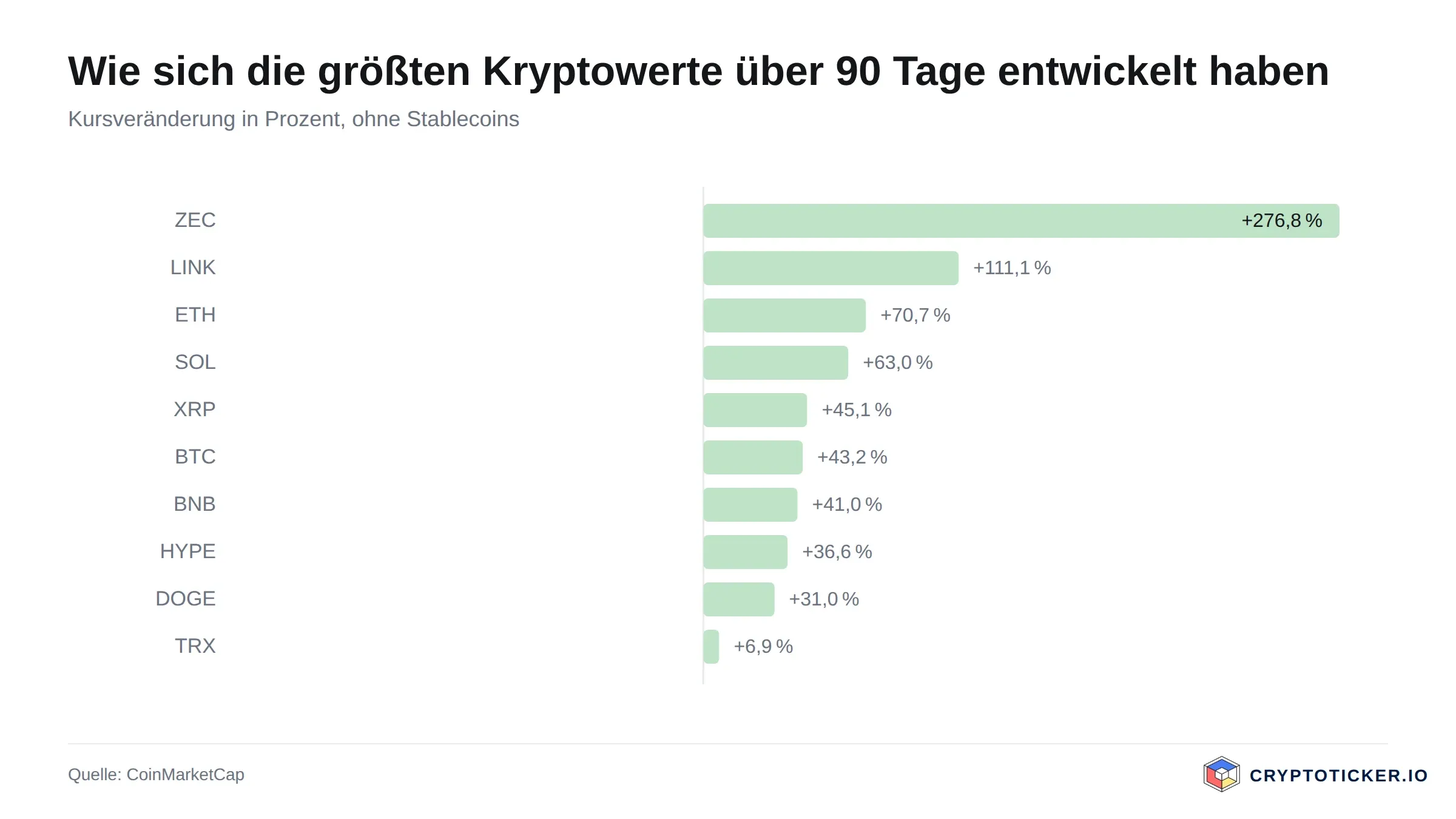
The largest crypto assets over 90 days, based on CoinMarketCap data
The benefit lies not in the result but in the process: you learn how an order feels, how fees change the outcome and how you react to a decline, without it costing anything. Anyone who later wants to open a real account will find providers, fees and licences for crypto in the exchange comparison.
How is a virtual portfolio structured?
A virtual portfolio looks like a bank's portfolio overview. Each line is a position, and the columns are almost everywhere the same:
- Quantity: how many shares, ETF units or coins you have bought. With crypto, fractions are usual, for instance 0.015 Bitcoin.
- Entry price: the price at which you bought, including the simulated fee.
- Current price: the price now. Some virtual portfolios show real-time prices, others prices delayed by 15 minutes; for practice either will do, for short-term trades it will not.
- Gain or loss: the difference between entry and current value, in euros and in percent.
- Share of the portfolio: what percentage of the total value this position accounts for. That column shows you when a single position has grown too large.
Added to that is the balance, the play money not yet invested. Anyone setting up a virtual portfolio should choose starting capital that matches their later stake, otherwise they practise with sums they will never move.
Watchlist, virtual portfolio, portfolio tracker, demo account: the difference
The four terms are often used interchangeably. They answer different questions:
Tool
Question it answers
Real money
Books purchases with quantity and price
Watchlist
How are the prices I am interested in developing?
no
no
Virtual portfolio
How would my selection have developed?
no
yes
Demo account
How do I trade on a platform, including short-term and with leverage?
no
yes
Portfolio tracker
What are my real holdings worth, and what do I owe the tax office?
yes, it reads real holdings
yes, from real transactions
The watchlist remembers prices, the virtual portfolio remembers decisions. A demo account is a virtual portfolio with the full toolkit of a trading account, that is, with stop loss, shorting and leverage; more on that in the guide to the trading demo account. A portfolio tracker, by contrast, is not a practice tool: it collects your real transactions from exchanges and wallets and calculates holdings and tax from them. Which trackers do that well is shown by the comparison of crypto tax tools and portfolio trackers.
Why a crypto virtual portfolio works differently
The market never sleeps
Equities are traded on weekdays during exchange hours. Bitcoin and the other large coins trade around the clock, including on public holidays. A crypto virtual portfolio therefore often only shows you on Monday that something happened on Saturday. For practice that means: decide in advance at which times you will look, and stick to it.
The swings are larger
Daily moves of ten percent are no exception among smaller coins. A virtual portfolio holding five small coins can halve or double within a week without your having done anything right or wrong. That is why the result of a single month serves poorly as evidence for a selection.
Security or coin
The virtual portfolios of banks and financial portals hold securities. Crypto appears there as a rule as an exchange-traded product, for instance as an ETN or ETP. That is not the same as the coin: an ETN is a debt instrument issued by an issuer, and it is treated differently for tax than a coin held privately. What you should check with such products is explained in the guide crypto ETNs in your portfolio. Anyone wanting to practise with the coin itself needs a virtual portfolio with coin prices.
Setting up a free crypto virtual portfolio: in three steps
The trading simulator in CryptoTicker's Trading Hub works as a crypto virtual portfolio without registration, as of September 28, 2026:
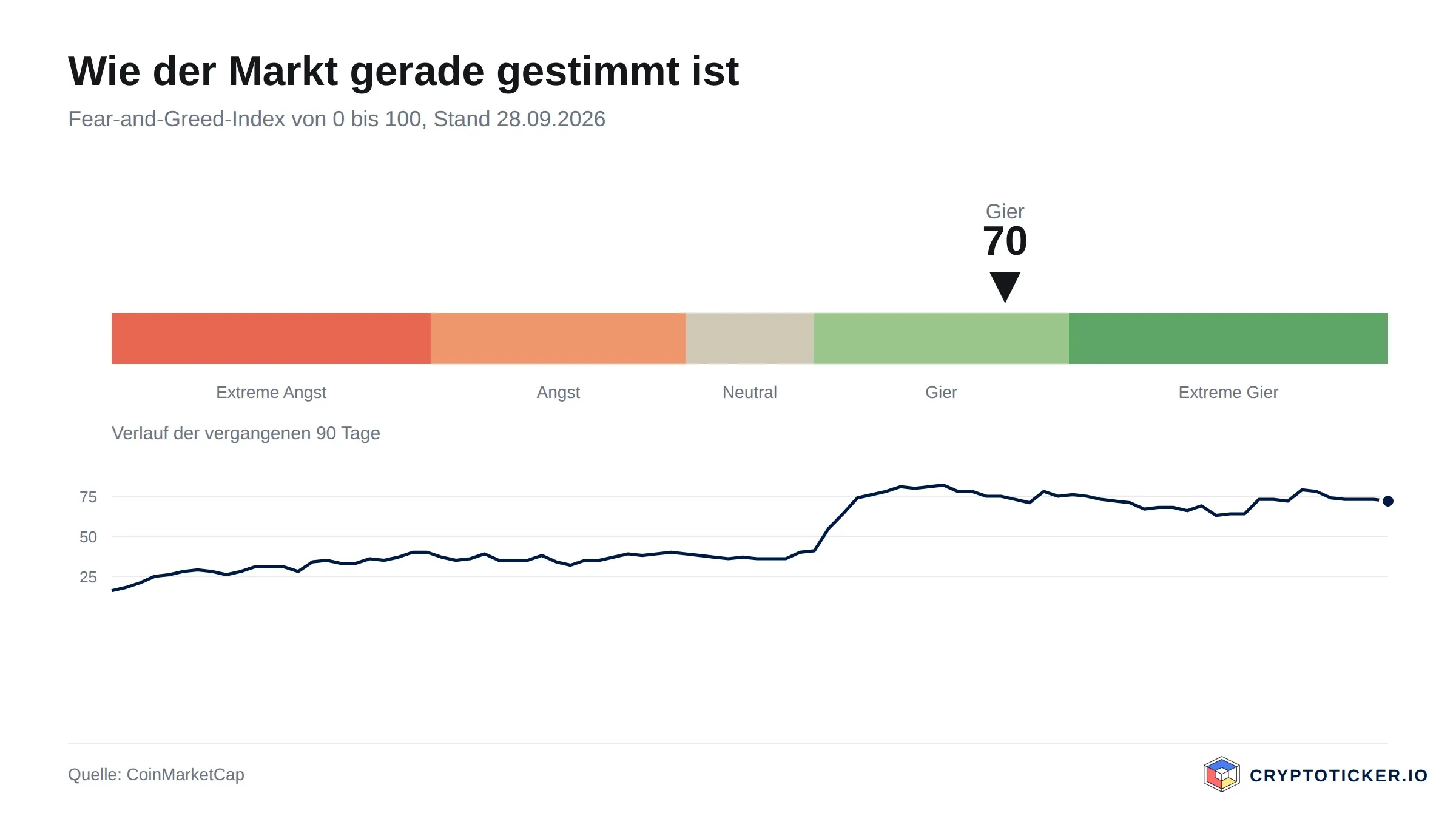
The Fear and Greed Index places market sentiment between extreme fear and extreme greed
- Open the page. No account, no email address, no credit card. 10,000 euros of play money are ready, and your state stays saved in the browser.
- Select coins and buy. The 50 largest coins with more than 50 million US dollars of daily volume are available, at real prices. For a classic virtual portfolio you buy without leverage and hold.
- Follow the performance. The portfolio shows the balance, open positions and result. You only need an account once you want to continue on a second device; you can reset at any time.
One exercise: two virtual portfolios, one question
A virtual portfolio becomes valuable when it answers a question. One suggestion, expressly as an exercise with play money and not as investment advice:
- Portfolio A weights three large coins by their market capitalisation.
- Portfolio B spreads the same amount equally across the same three coins.
- Rule for both: look once a week at the same time, reset to the original weighting once a month, and book every reallocation with a fee.
After four weeks you compare not only the result but also the largest drawdown along the way. The question is not which portfolio won, but which one you would have endured. Anyone wanting to do the same exercise with short-term trades will find the fundamentals in the Learn Trading pillar.
Where to find the best virtual portfolio?
That depends on what you want to practise:
- Equities, ETFs and funds: virtual portfolios from direct banks and financial portals. They are mostly free but require registration with an email address.
- Coins at real prices, without registration: a crypto simulator such as CryptoTicker's.
- Active trades with stops, shorts and leverage: a demo account or paper trading on a charting platform.
- Your real holdings: not a virtual portfolio but a portfolio tracker.
You recognise a good virtual portfolio by three things: real or only slightly delayed prices, calculated fees, and starting capital that matches your later stake. Anyone practising with 100,000 euros and later investing 2,000 euros has learned position sizes they will never need.
The way from the virtual portfolio to your first own trade runs through the Learn Trading pillar, with order types, position sizing and a practice plan. Anyone who already owns real coins and needs an overview for tax will find the right tools in the comparison of crypto tax tools and portfolio trackers.
Sources