DBS and Citi have completed a tokenized deposit transaction through Swift's digital ledger, with DBS reporting a single live US dollar payment between Singapore and Citi's New York office set
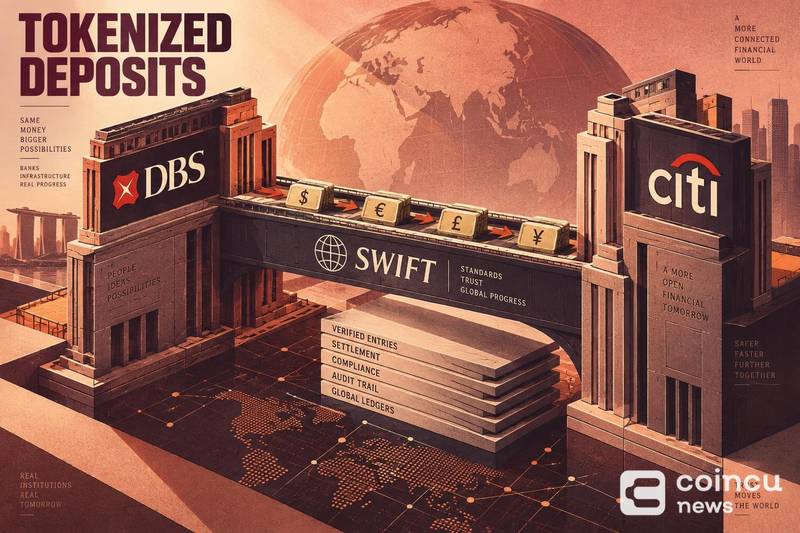
DBS and Citi have completed a tokenized deposit transaction through Swift's digital ledger, with DBS reporting a single live US dollar payment between Singapore and Citi's New York office settled over a weekend, an institutional milestone that pushes always-on cross-border settlement from proof-of-concept toward interbank reality even as key operational details remain undisclosed.
DBS announced the tokenized-deposit payment with Citi on September 7, 2026, identifying one successful USD transfer completed on September 5, 2026, a weekend, according to the bank's official newsroom announcement. The payment moved value between Singapore and the United States using tokenised bank deposits routed via the Swift Digital Ledger. For related coverage, see PolyNext Awards & Conference Dubai 2026: Advancing the Global Dialogue on Plastic Recycling and Circularity.
The development lands amid intensifying competition among global banks to build 24/7 settlement rails, and it follows an earlier DBS-Citi disclosure covered in this reporting on the two banks' weekend USD payment work. What separates this event from a launch is that DBS frames it as a single completed transaction, not a commercial service. For related coverage, see Plattsburgh Proposes 12-Month AI Data Center, Crypto Mining Pause.
What the DBS announcement confirms, and what it leaves open
The confirmed core is narrow but concrete: DBS and Citi's New York office completed one live USD payment on a weekend, using tokenised deposits through the Swift Digital Ledger, per the September 7 announcement. Citi's Mridula Iyer, Head of Services for Asia South, described the weekend transaction as live.
Processing a live transaction over a weekend demonstrates that always-on cross-border payments are already a reality. Mridula Iyer, Head of Services for Asia South, Citi, in the DBS announcement
Live weekend USD payment
5 September 2026
DBS reports one live USD payment between Singapore and the United States with Citi’s New York office, using tokenised deposits via the Swift Digital Ledger. Source: DBS announcement, 7 September 2026.
What the announcement does not establish is equally important for readers assessing scale: no transaction amount, no exact elapsed time, no public transaction hash, and no sender or recipient addresses are disclosed. This is an institutional bank-payment disclosure, not a publicly identified wallet transfer traceable on a block explorer.
DBS also positions itself as the only Asian-headquartered bank in the Swift digital ledger core design group, which it describes as comprising 12 banks. That governance detail signals influence over how the ledger's standards evolve, though it does not by itself confirm production readiness.
Where Swift's ledger fits in the payment flow
DBS describes the transfer as running through the Swift Digital Ledger, but the announcement supplies no architecture, messaging, or settlement schematics, so the precise mechanics rest on secondary reporting. Ledger Insights reports that the Swift Ledger orchestrates instructions and commitments between participating bank ledgers, with netted obligations settled later through conventional methods, according to its public coverage.
That orchestration-versus-settlement distinction matters: the ledger appears to coordinate obligations between DBS's and Citi's own deposit ledgers rather than move tokens directly between the two banks on a shared public chain. Nothing in the fetched evidence indicates a public blockchain or a named network underpinning the September 5 payment.
The nuance also reframes how readers should read the speed claim. DBS says the payment completed in minutes, but completion of the payment does not by itself establish when final interbank settlement occurred, a point the specialist reporting flags by separating orchestration from subsequent conventional settlement.
Minutes versus days: the speed claim in context
DBS states the transaction took minutes, against an industry norm of up to two business days for cross-border payments, though it supplies no exact numeric duration for the September 5 transfer. The comparison is directional rather than benchmarked, and it describes payment completion, not verified settlement finality.
Payment completion time, according to DBS
Minutes vs. up to 2 business days
DBS says the payment took minutes, compared with its stated industry norm of up to two business days for cross-border payments. No exact duration is supplied; payment completion does not establish the timing of final interbank settlement. Source: DBS announcement, 7 September 2026.
Some earlier third-party headlines framed the news with plurals, implying multiple completed transactions across multiple Swift ledgers, but the official announcement identifies one payment via the singular Swift Digital Ledger. Treat any plural framing as unconfirmed against the primary source.
Test, pilot, or live service? What the milestone establishes
Iyer's on-record characterization of the weekend transfer as live is the strongest signal that this moved beyond a sandbox, yet DBS stops short of announcing a generally available, customer-facing product. The evidence supports a completed live interbank transaction, not open commercial availability or broad adoption.
The trajectory becomes clearer against DBS's own history. On August 13, 2024, DBS launched a blockchain-powered Treasury Tokens pilot with Ant International targeting instant multi-currency treasury and liquidity management across Ant entities, using DBS's permissioned, EVM-compatible blockchain, per that 2024 announcement. That was an intragroup liquidity use case; the September 2026 event is an interbank USD payment with an external counterparty, Citi New York.
The 2024 infrastructure detail does not, however, establish the execution chain behind the 2026 payment. DBS's permissioned chain integrated with its core payments engine and Ant International's Whale platform, but the current announcement does not confirm that same stack carried the Citi transfer.
For policy watchers, DBS's 2024 work linked Treasury Tokens to learnings from MAS-led Project Orchid and Project Guardian, situating its tokenisation efforts within Singapore's regulatory sandboxes. The current announcement reports no new license, exemption, retail-access policy, or deposit-insurance determination tied to the September payment.
Tokenized deposits: the terminology readers need
Tokenized deposits are digital representations of commercial bank deposits recorded on a ledger, and they differ structurally from stablecoins and central bank digital currencies. A tokenized deposit remains a claim on the issuing commercial bank, whereas a stablecoin is typically a claim on a separate issuer's reserve assets, and a CBDC is a direct liability of the central bank.
The fetched evidence does not define the specific legal or product terms of the DBS-Citi instrument, so readers should not assume deposit insurance, redemption rights, retail access, or any particular issuer structure for these transactions. The distinction is relevant because banks pursuing tokenized deposits argue the model keeps digital money inside the regulated banking perimeter, unlike some stablecoin designs now drawing scrutiny elsewhere; DBS's move sits alongside broader institutional tokenization steps such as ARK's SEC-approved tokenized venture fund share class.
The banking-perimeter argument connects to a wider TradFi shift, where regulated institutions are seeking bank charters and custody roles rather than ceding digital-money infrastructure to non-banks, a pattern visible in moves like Block's trust bank license application for Bitcoin custody.
FAQ: DBS, Citi, and Swift tokenized deposit transactions
What did DBS and Citi complete? DBS reports one live USD payment, completed September 5, 2026, between Singapore and Citi's New York office, using tokenised deposits via the Swift Digital Ledger, announced September 7, 2026.
What role did Swift digital ledgers play? The payment ran through the Swift Digital Ledger, which secondary reporting from Ledger Insights describes as orchestrating instructions and commitments between bank ledgers, with settlement handled later through conventional means. DBS's announcement itself does not detail the mechanics.
Were the transactions cross-border? The corridor runs between Singapore and the United States, which is cross-border, though DBS discloses a single payment rather than a series of transactions.
Can customers use this service now? The evidence supports a completed live interbank transaction, not a generally available customer-facing product. DBS announced no retail access or commercial rollout tied to the September 5 payment.
What to watch next
The concrete triggers ahead are disclosure-driven: watch for DBS or Swift to confirm transaction volumes beyond the single September 5 payment, publish settlement-finality timing, or expand the corridor beyond the Singapore-US USD lane. Any move from one live transfer to a repeatable, multi-counterparty service would mark the real shift from milestone to infrastructure.
Also worth tracking is the composition and output of the Swift digital ledger core design group of 12 banks, where DBS's seat as the only Asian-headquartered member gives Singapore outsized influence over standards that will shape how tokenized deposits move across the next generation of cross-border rails.
Disclaimer: This article is for informational purposes only and does not constitute financial or investment advice. Cryptocurrency and digital asset markets carry significant risk. Always do your own research before making decisions.
The post DBS and Citi Complete Tokenized Deposits via Swift Ledgers was initially published on Coincu.