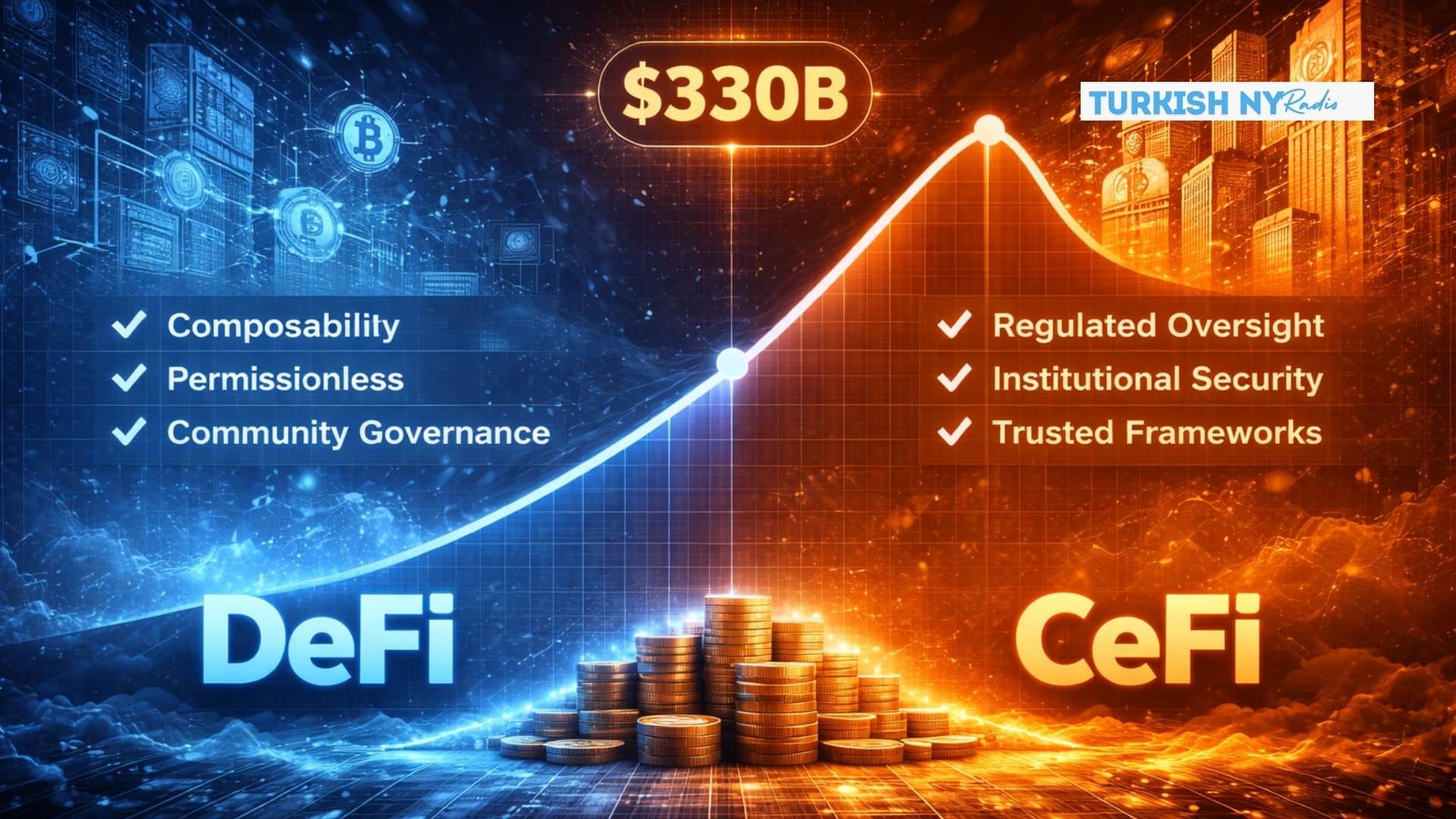
DeFi vs CeFi Heats Up as $330 Billion Moves Into Tokenized Assets
 DEFI
DEFI
 WHEN
WHEN
 BILL
BILL
As the enterprise continues its transition to a digital currency, the ongoing conflict over DeFi vs CeFi reaches a watershed moment. Having over $330 billion in tokens that represent assets and stablecoins floating on public and private systems, traditional financial services is increasingly embracing on-chain technology that was previously controlled by decentralized protocols.
This move presents an important question: can open, unfettered systems achieve the trust and governance criteria necessary to remain viable with regulated banking platforms? The debate over DeFi vs CeFi has never been more important, or fierce.
Institutional Capital Moves On-Chain
In the past few months, prominent financial organizations have introduced blockchain-powered systems for trading tokenized securities, which settle transactions in seconds rather than days. These developments demonstrate that conventional finance is not opposing decentralized management, but rather adopting it.
This institutional pivot has intensified the battle of DeFi vs CeFi, as regulated entities begin offering blockchain features once exclusive to decentralized ecosystems.

Composability Under Scrutiny
Composability, the ibility for protocols to interact seamlessly, has always been at the heart of the DeFi vs CeFi debate. While it encourages innovation, it also introduces interconnected risk across various uses. Several recent attacks have shown weaknesses in permissionless systems, forcing institutional investors to seek more transparent, predictable risk-management frameworks.
A cybersecurity specialist stated that “DeFi’s effectiveness is also its weakness.” The same accessibility that drives innovation may also lead to failures.”
These incidents exacerbate the current DeFi versus CeFi debate, as centralized networks prioritize stronger supervision and operational management.
Governance Challenges and the Trust Gap
Permissionless systems are primarily dependent on written rules and community leadership. However, when billions of dollars are at stake, accountability suggestions, administrative key handling, and quick protocol updates all pose risks. Companies, on the other hand, like well-defined regulatory structures and accountability structures.
This administrative difference is now essential to the DeFi vs CeFi debate, with conventional platforms guaranteeing consistent conformity and decentralized systems prioritizing adaptability over centralized control.
A Market Divided, but Not Disconnected
Despite the tension, the relationship between decentralized finance and institutional finance is becoming increasingly symbiotic. Tokenized government bonds, stablecoins, and on-chain funds are connecting both sides of the DeFi vs CeFi equation.
An industry researcher commented, “Institutions are not choosing CeFi over DeFi, they’re choosing reliability. The future likely blends both worlds.”