Dogeball Presale: Token Supply, Game Rewards, and Launch Plans The Dogeball Presale is over, yet the questions haven't stopped. What is $DOGEBALL? How is the supply split? And what does the p
Dogeball Presale: Token Supply, Game Rewards, and Launch Plans
The Dogeball Presale is over, yet the questions haven't stopped. What is $DOGEBALL? How is the supply split? And what does the project say comes next?
The project calls itself a meme coin with a built-in arcade game, running on its own Ethereum Layer 2 network. That pitch drew buyers during the sale. Now the focus has moved to delivery.
What Does Dogeball Actually Mean?
The name plays on dodgeball. Players throw balls at game characters, level up, and climb a leaderboard. The official site puts the prize pool at $1 million, with $500,000 for the top player. Those figures are project claims.
The $DOGEBALL token powers DOGECHAIN. The official project whitepaper describes it as a custom Ethereum Layer 2 chain.
A Layer 2 is a separate network that sits on top of Ethereum to cut fees and speed up transactions. The project says it's EVM-compatible, so Ethereum wallets and tools work with it.
A second product, DOGEPAY, is planned as a crypto-to-fiat payments app. The whitepaper says it will reach app stores after the sale ends. It also describes its licenses as provisional and still being finalized. No launch date is published.
Mostgaming crypto presales focus on one game or one token use. Phina Network stands apart by mixing a game economy with mining, payments, and wallet tools. A wide scope can draw users, yet it raises delivery risk.
How Did the Dogeball Presale Work?
Buyers connected a wallet on the official site. The site lists ETH, USDT, USDC, BNB, BTC, and SOL as payment options, plus bank cards. Each purchase was recorded on-chain and shown in a dashboard.
Staking was part of the Dogeball Presale too. The project advertised up to 80% APY, with rewards released after a seven-day minimum vesting period. APY is the yearly reward rate. It's a project claim, not a promised return.
Claiming is now live. Buyers connect the same wallet they used in the sale. A little ETH is needed for gas, the network fee.
How Much Did the Dogeball Presale Raise?
Here's the catch. The official website and whitepaper don't publish a final funds-raised figure or a closing price. Sale activity ran through a widget, not a fixed page.
So any raised total circulating online stays unconfirmed. What the project does publish is the allocation. The Dogeball Presale set aside 20 billion tokens, or 25% of the total supply.
That's the only verified presale number available.
What Does the Dogeball Tokenomics Model Look Like?
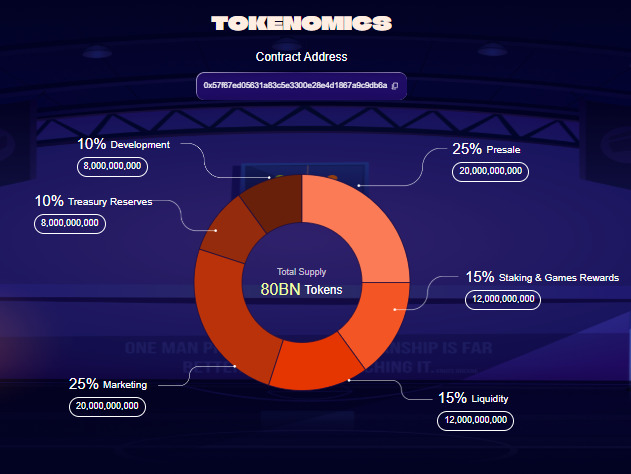
Total supply is 80 billion $DOGEBALL. The contract address is 0x57f67ed05631a83c5e3300e28e4d1867a9c9db6a. The published tokenomics section lists six allocations.
Allocation
Percentage
Tokens
Presale
25%
20,000,000,000
Marketing
25%
20,000,000,000
Liquidity
15%
12,000,000,000
Staking and game rewards
15%
12,000,000,000
Development
10%
8,000,000,000
Treasury reserves
10%
8,000,000,000
The Dogeball Presale allocation and marketing each take a quarter. Together, that's half of all tokens. A 25% marketing share is large for a project still building its game. It can lift visibility, but it also puts weight on how the budget gets spent.
Liquidity is the pool that lets people trade the token. Staking and game rewards hold another 15%.
Now the gap. No official page shows a vesting schedule, which is the timetable controlling when tokens become available.
Without it, nobody can tell how much of the 80 billion could reach the market at once. Circulating supply, market cap, and FDV aren't published either. Remember, FDV values all 80 billion tokens, while market cap counts only those in circulation.
What Does the Audit Say About $DOGEBALL?
The project posts a smart contract audit dated 29 September 2025. There are no open issues listed, and all weakness checks are passed. It also states the owner can't mint tokens, blacklist addresses, or pause the contract.
The same report marks the team as not KYC verified through that process. KYC means identity verification.
An audit reviews code at one moment. It isn't a safety guarantee. Anyone looking at Dogeball Presale tokens should match the contract address against the one above.
What Is on the Dogeball Roadmap?
The roadmap on the official site has four phases:
Phase 1: token creation, game plan, website, and contract audit
Phase 2: game development, DOGECHAIN deployment, community growth, and presale launch
Phase 3: global marketing, corporate gaming partnerships, and exchange listings
Phase 4: a V2 game, more listings, a global L2 release, and future tokens
Phases 1 and 2 match what's visible today: an audited contract, a finished Dogeball presale, and a live claim process.
Phase 3 is the real test. The site says partnerships with large gaming organizations are in progress, but it names none. No exchange names or listing dates appear on official pages either.
What Are the Main Risks After the Dogeball Presale?
Delivery: Dogeball roadmap items are plans, not results.
Fundraising: no official final total exists.
Vesting: unlock timing is unpublished.
Licensing: DOGEPAY licenses are described as provisional.
Volatility: the project's own disclaimer warns that crypto markets swing sharply.
Compared with other gaming presale projects, a custom Layer 2 plus a payments app is a wide scope for one team. That doesn't make it impossible. It makes execution the thing to watch.
What Should Readers Check Next?
The Dogeball Presale closed with a clear pitch: a meme coin, an arcade game, and a custom Layer 2. Tokenomics are published, and an audit is public.
What stands out is how much remains unconfirmed. Final funds raised, vesting, listings, and partners all lack official detail. Readers following the project can watch for updates on those four points and verify claims on the official website.
Disclaimer:
This article is for information only and isn't financial advice. Crypto assets are volatile, and presale tokens carry high risk. Readers should do their own research and consult a qualified adviser before making decisions.