A draft Ethereum Improvement Proposal from a group of six researchers and developers—including Ethereum Foundation’s Justin Drake—would change how new ETH is issued to validators. The “Tapere
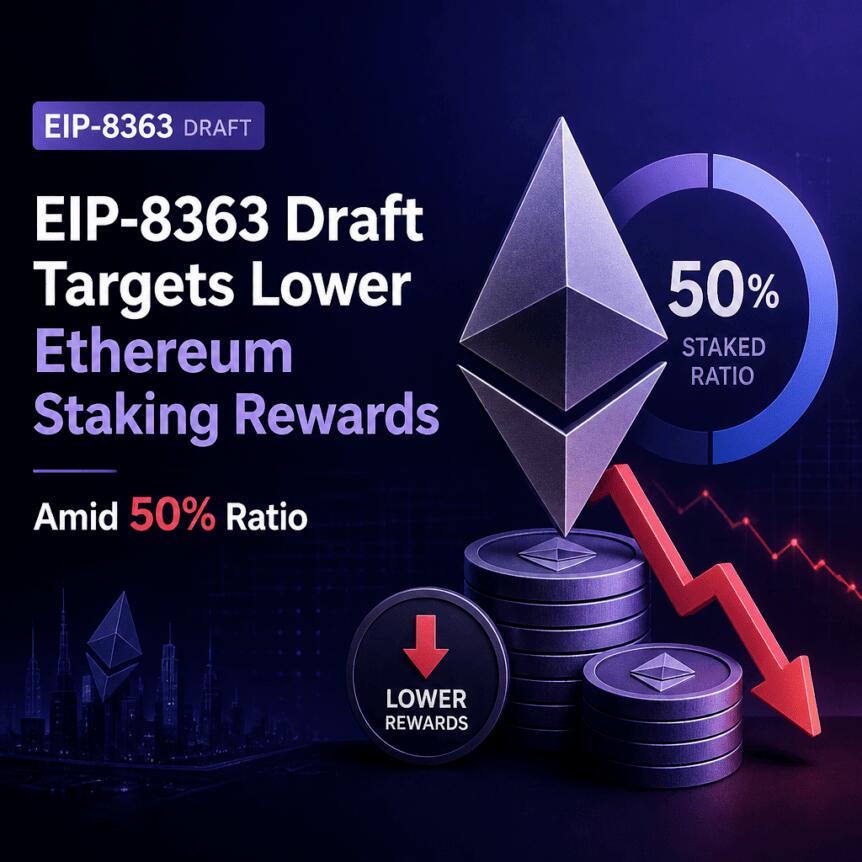
A draft Ethereum Improvement Proposal from a group of six researchers and developers—including Ethereum Foundation’s Justin Drake—would change how new ETH is issued to validators. The “Tapered Issuance Burn” proposal, provisionally numbered EIP-8363, aims to reduce validator rewards more aggressively as more ETH is staked, with an increasing portion of consensus rewards burned to curb long-term inflation.
The proposal targets a fixed staked-ETH threshold of 60.25 million ETH (about 50% of the current ETH supply). As the staking ratio approaches that level, the burn mechanism would intensify, reaching 100% deduction once the threshold is met. The changes are designed to phase in over roughly 18 months. The draft is published on GitHub as an EIP draft.
Key takeaways
- EIP-8363 would “taper” validator issuance by burning an increasing fraction of consensus rewards as staking grows.
- The mechanism is tied to a threshold of 60.25 million staked ETH, at which point the deduction would reach 100%.
- Critics argue the proposal could disadvantage solo validators and reduce DeFi borrowing and yield tied to staking rewards.
- Some developers and community members also question whether there is enough time for careful review, given its proximity to proposal deadlines around Ethereum’s Hegotá upgrade.
- The draft has not been approved or scheduled and is not currently included in Hegotá.
A proposed monetary lever tied to staking saturation
The authors’ central concern is the trajectory of staking. According to the draft’s advocates, under the current issuance and incentive curve, staking rewards would not meaningfully “turn off,” even if nearly all ETH were staked. One of the proposal’s authors, Jérôme de Tychey, argued that this creates a persistent incentive to stake, raising the question of what ultimately stops the process.
In the proposal discussion, de Tychey also highlighted the potential for growing concentration of ETH held through large custodians and staking derivatives. The thesis is not only about dilution from issuance, but about the role of ETH as “a neutral, trustless store of value.” He warned that unchecked issuance could increasingly shift the ecosystem’s “working money” from raw ETH to intermediated staking claims.
As described in the draft’s framing, EIP-8363 would bound and make issuance more predictable. The proposal sketches a scenario in which issuance would peak at roughly 0.5% of ETH supply per year at its highest point (with about 20% of ETH staked), then decline toward zero as the staking ratio reaches the 60.25 million ETH threshold.
Supporters also position the change as complementary to existing Ethereum supply-reduction mechanics, including EIP-1559 and the protocol’s Blob burn structure. De Tychey argued that, with these in place, Ethereum’s net supply trend could more often decrease, while the network maintains a “sustainable security budget.”
Why the timing is drawing fire
Even though EIP-8363 is still an early draft, its publication came shortly before a deadline being discussed in relation to Ethereum’s Hegotá upgrade. Some community members see the schedule pressure as a process risk, especially for a change that would affect monetary policy.
Community developer Greg Koumoutsos said the proposal “clearly doesn’t leave adequate time for community review” of a monetary-policy change of this magnitude. In response to some confusion around the timetable, the article’s reporting indicates that the relevant Aug. 6 deadline is for pull requests proposing additional EIPs for Hegotá, rather than a deadline for deciding which proposals will ultimately be included.
Ethereum community organizer Trent Van Epps indicated that the selection process could continue until Nov. 8. According to the reporting, Hegotá is likely to reach mainnet in the second quarter of 2027, based on the project schedule referenced in the coverage.
Developer and DeFi concerns: solo validators, institutions, and yield markets
While the proposal’s goals are framed as reducing dilution and strengthening neutrality, it has met backlash from parts of the Ethereum development ecosystem, including stakers and DeFi builders.
One line of criticism is that lowering staking rewards could reduce institutional demand for ETH. The article notes concerns about whether reward cuts could affect how institutions interpret yield and exposure, and it points to linked coverage about institutional staking interest.
Another major critique centers on validator structure. The argument from some quarters is that solo validators would be hit harder because they generally face higher relative costs than larger operators. According to the reporting, Mike Silagadze, CEO of Ether.Fi, said the mechanism would push out solo stakers not subsidized by entities such as the Ethereum Foundation. His view is that the staking landscape would become dominated by large centralized organizations, leaving users to hold ETH indirectly while those operators capture the remaining incentive structure.
De Tychey disputed the “guaranteed solo exit” framing. In a response on the Ethereum Magicians forum, he argued that users of large staking providers must pay fees, which could make such services less attractive as rewards fall. However, the reporting also emphasizes that related research is “contested,” leaving the economic second-order effects uncertain.
Beyond validator economics, critics warn that staking reward changes could ripple into DeFi markets that depend on staking yield. Stani Kulechov, founder of Aave, characterized the proposal as harmful—arguing it could weaken institutional demand for ETH and reduce borrowing activity across DeFi. His critique is that the proposal does not achieve its intended outcome and could negatively affect Ethereum’s broader ecosystem incentives.
Backers see bounded inflation and potentially long-run upside
Support for EIP-8363’s direction is not confined to the proposal’s authors. The coverage also points to Grayscale research leadership. In May, Grayscale head of research Zach Pandl said limiting staking incentives would be “positive for the price of Ether over time,” framing the idea as part of improving Ethereum’s long-run economic profile.
In the proposal’s own narrative, the change is designed to address a specific economic tension: a world where staking keeps expanding, issuance continues unabated, and more of the ecosystem’s exposure becomes mediated through staking derivatives. Supporters argue that burning an increasing share of rewards as staking rises can cap issuance growth and reduce dilution, while still maintaining security incentives early in the process.
Yet, with the draft at an early stage and schedule constraints under debate, the most immediate takeaway is that the proposal is not yet a policy. It is one part of a larger, contested set of considerations about Ethereum’s monetary future as staking participation rises and as staking derivatives evolve.
As Ethereum approaches the Hegotá selection window, readers should watch for how the community evaluates EIP-8363’s economic modeling—especially the projected impact on solo validators, liquid staking incentives, and DeFi borrowing flows—and whether the proposal is revised, delayed, or replaced by alternatives before any formal inclusion.
This article was originally published as EIP-8363 Draft Targets Lower Ethereum Staking Rewards Amid 50% Ratio on Crypto Breaking News – your trusted source for crypto news, Bitcoin news, and blockchain updates.