While financial bodies have adopted several pioneering technologies over the past decades to keep money secure, the breakthrough achieved by cryptography in recent years has been unbelievable
While financial bodies have adopted several pioneering technologies over the past decades to keep money secure, the breakthrough achieved by cryptography in recent years has been unbelievable.
Its most successful model is the cryptocurrency ecosystem, which deploys cryptographic functions to encrypt financial details to ensure fund security. But the fast pace of the development of quantum computers has worried the community about the safety of crypto funds.
Recently, tech tycoon Elon Musk shared his blunt take on the quantum computing race, and the statement has implications for the crypto industry.
Related: Elon Musk reveals 'plus side' of quantum computing breaking Bitcoin
Cryptocurrencies are digital currencies that exist only virtually and deploy cryptographic functions to encrypt financial details to keep the funds safe. It ensures that no third-party except the sender and receiver of funds has access to any sensitive financial data.
But the crypto community fears that advanced quantum computers will be so powerful that they will be able to encrypt data and steal cryptocurrencies within seconds. It is not an unfounded fear.
It was the Massachusetts Institute of Technology (MIT) mathematician Peter Shor who developed the first well-known quantum algorithm for breaking encryption in the 1990s.
The computers in everyday use rely on binary electrical signals to represent ones or zeros. On the other hand, quantum computers use quantum bits or qubits, which are subatomic particles.
Optimized qubits can simultaneously represent combinations of both ones and zeros, making quantum computers faster, smarter, and more powerful.
The ongoing research suggests that in a few years, quantum computers could hack cryptographic functions protecting virtual assets.
As reported earlier, Google warned that a quantum computer could crack a Bitcoin (BTC) transaction in about nine minutes. It won't happen today, but 2029 could be that year, the tech giant warned.
Coinbase, the largest crypto exchange in the U.S., echoed the same warning.
Related: Expert warns crypto faces industry-wide quantum threat
Musk responds to physicist Tim Palmer's argument
The Institute of Art and Ideas, a British philosophy organization, recently shared the physicist Tim Palmer's argument that quantum mechanics works with irrational numbers like √2 which have no basis in physical reality.
When researchers in the field of quantum mechanics work on real solutions, they will face a challenge of working within the limits of physical reality.
Palmer predicts quantum computers will therefore fail beyond 400 qubits due to the fundamental limit set by the discrete structure of nature itself.
"The coming quantum computing race will determine whether our most successful physical theory contains a basic mistake."
Musk, being the tech geek that he is, couldn't resist sharing his blunt response to the X post and echoed Palmer's theory. "The universe is integer in units of Planck cubes," he wrote.
Palmer's argument is that physical reality itself may not contain infinitely precise, irrational quantities. Irrational numbers exist theoretically to address philosophical questions regarding mathematics and physics but they don't literally exist in nature.
Musk echoed the idea in terms of space. Nature could be made up of discrete, countable chunks (Planck cubes) rather than being infinitely divisible, he suggested.
Trending on TheStreet Roundtable:
What Palmer's argument implies for Bitcoin's security
Musk has often talked favorably of cryptocurrencies like Bitcoin, and his companies hold the leading cryptocurrency in their coffers. While Tesla (Nasdaq: TSLA) holds 11,509 BTC, SpaceX (Nasdaq: SPCX) holds 18,712 BTC. Musk's father once revealed that Elon also holds some Bitcoin.
In its whitepaper, Google researchers found that it could take fewer than 500,000 qubits to crack the cryptography used by cryptocurrencies like Bitcoin.
It is against this argument that Palmer's prediction of quantum computers failing beyond 400 qubits is worth paying attention to. No researcher has so far claimed that even 400 qubits can crack Bitcoin.
Quantum computers are still getting developed and there is no certainty yet regarding their threat to cryptocurrencies.
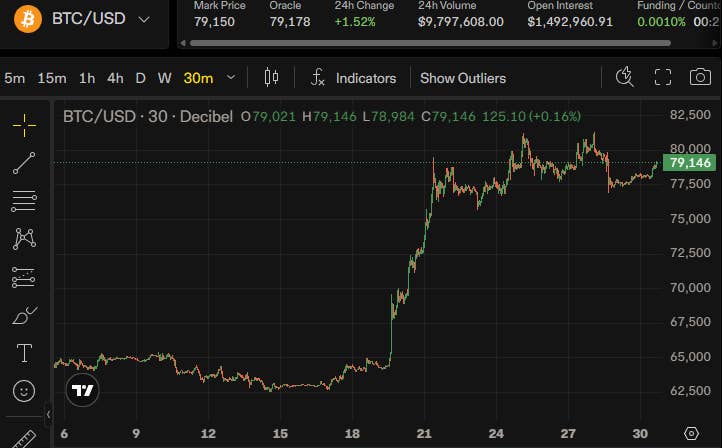
BTC/USD, Source: Decibel
Bitcoin was trading at $79,146 at the time of writing, as per Decibel.
Related: Elon Musk warns America will 1,000% go bankrupt and fail as a country