Is Ethereum's Next Big Upgrade Finally Ready for Real Users? The Ethereum Glamsterdam Upgrade is still in testing, and the mainnet has no confirmed date. Developers designed it to speed up bl
Is Ethereum's Next Big Upgrade Finally Ready for Real Users?
The Ethereum Glamsterdam Upgrade is still in testing, and the mainnet has no confirmed date.
Developers designed it to speed up block handling and widen Layer 1 capacity, yet its effect on fees is less simple than headlines suggest.
Readers want three answers: what changes, when it arrives, and whether ETH holders must act. Status checked on 27 November 2026. Newcomers can start with how Ethereum works.
What Is the Ethereum Glamsterdam Upgrade and Why Does It Matter?
It is Ethereum's next planned hard fork, meaning a coordinated rule change that every node must adopt. It follows the Fusaka upgrade, which added data space for Layer 2 networks.
Inside each block, transactions run in a defined order, and clients have largely processed them in sequence. Meanwhile, the growing database of accounts and contracts makes nodes heavier to run.
The Ethereum Glamsterdam Upgrade targets both by reorganizing block building, enabling parallel processing, and repricing database work.
What Does the Glamsterdam Hard Fork Actually Change on Ethereum?
Two headline changes lead the package, according to the official Ethereum roadmap:
Enshrined proposer-builder separation (ePBS), defined in the EIP-7732 specification, moves the hand-off between block proposers and builders into the protocol. As of 27 November 2026, the roadmap lists the data propagation window growing from about 2 seconds to about 9 seconds.
Block-Level Access Lists (BALs), defined in the EIP-7928 specification, record the accounts and storage locations accessed by transactions in a block, along with their resulting state changes. Clients can run independent transactions in parallel and sync faster, though transactions touching the same data still follow the block's order.
Where Does Testing Stand, and Why Did the Hoodi Rollout Stall?
Public testing of the Ethereum Glamsterdam Upgrade began on Sepolia, but a Hoodi rollout was postponed. The official postponement notice set no replacement date and says mainnet users and ETH holders need to take no action.
In a 6 November update, the Ethereum Foundation asked developers and auditors to check eight gas assumptions that EIP-8037 and EIP-8038 would break, such as hardcoded gas amounts in calls. Hoodi would not fork until those risks were resolved.
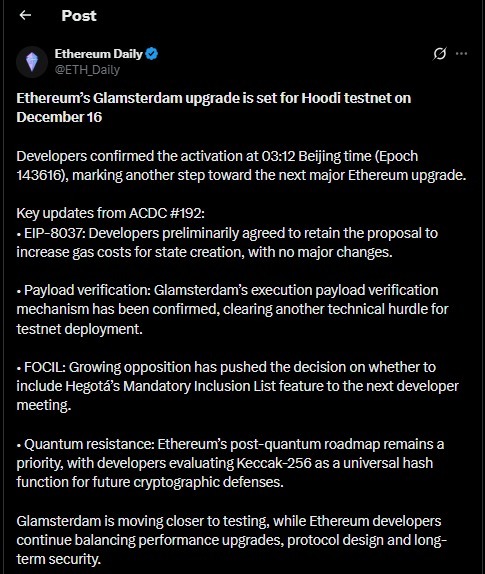
For the latest Hoodi testnet schedule and key updates from ACDC #192, see the Ethereum Daily update on X.
Status as of 27 November 2026:
Milestone
Date
Status
Sepolia activation
6 October 2026
Activated
First Hoodi date
26 October 2026
Postponed 22 October
Gas assumptions update
6 November 2026
Hoodi held pending review
New Hoodi date
15 December 2026, 19:12 UTC
Agreed at ACDC #192, awaiting official network configuration
Mainnet
Activation date not announced
Pending
At the November 26 ACDC #192 call, core developers agreed on a Hoodi schedule of 15 December 2026 at 19:12 UTC (epoch 143616), and execution-layer teams agreed to proceed with the current EIP-8037 specification, pending official client releases.
Will Ethereum Gas Fees Drop After the Glamsterdam Changes Land?
No fee cut is promised. The Ethereum Glamsterdam Upgrade prices resources more accurately, so some actions on Ethereum smart contracts may cost less and others more.
TheEIP-8037 proposal increases the cost of creating new states, including new accounts, storage slots, and deployed bytecode. It meters these costs separately as state gas, and transactions pay for both execution gas and state gas.
TheEIP-8038 proposal reprices state access and write operations, including SLOAD, SSTORE, and cold account access, to better reflect processing costs. SLOAD reads contract storage, and SSTORE writes to it.
TheEIP-2780 proposal splits the flat intrinsic transaction charge into resource-based parts. As of 27 November 2026, a plain ETH transfer to an existing account remains at 21,000 execution gas under the current proposal.
Demand matters too: a crowded network can lift Ethereum gas fees regardless of design.
A short explainer on how gas works clarifies the pricing difference.
What Should Regular ETH Holders and App Users Expect to See?
Most users will notice little at first. After the Ethereum Glamsterdam Upgrade, ETH balances, addresses, and wallets stay as they are, and no migration is needed.
Change
What it does
Possible user effect
ePBS
Moves the proposer-builder hand-off into the protocol
Less dependence on third-party relays for the proposer-builder hand-off.
BALs
Maps state access for each block.
Enables parallel data access and supports faster syncing.
Gas repricing
Prices are state creation and access separately
Mixed fee effects, and some contracts may need fixes.
The Ethereum Foundation's August 2026 impact assessment says the repricings could affect a small number of contracts, and some may need gas-limit changes or code fixes.
Wallets and RPC services also have to update how they estimate gas. Cached gas values can run lower than the real cost, so a fee estimate may end up short of what a transaction actually needs.
How Could Validators and Stakers Be Affected by This Update?
Validators get extra time under the Ethereum Glamsterdam Upgrade. Right now, data has about 2 seconds to travel across the network.
With ePBS, that window stretches to roughly 9 seconds. Validators can use the gap to handle execution data without rushing.
Validators attest to the consensus block, while Payload Timeliness Committee (PTC) members separately attest whether the payload arrived on time.
Operators must run updated clients before activation. The core job of Ethereum validators stays the same.
Staking pools and liquid staking providers run large validator fleets, so holders who stake through them depend on provider upgrades. A guide to Ethereum staking covers the options.
Final Take: What Readers Should Watch Before Mainnet Arrives
The stronger signal is progress: Sepolia has been active since 6 October 2026, and developers have agreed to a Hoodi schedule of 15 December 2026, pending official client releases.
The main concern is gas repricing, since deployed contracts are the real test. The biggest unknown remains the mainnet date, unannounced as of 27 November 2026.
In short, the Ethereum Glamsterdam Upgrade aims for sustainable Layer 1 growth, but benefits depend on final specifications and demand.
Disclaimer: This article only shares general information and does not count as financial advice. Crypto prices can swing sharply, and money put into them can be lost. Readers should check official sources and do their own homework before deciding anything.