Fundstrat co-founder Tom Lee has warned that South Korea’s stock market crash could trigger further selling pressure on Ethereum, as the country’s benchmark KOSPI plunged more than 6% on Octo
Fundstrat co-founder Tom Lee has warned that South Korea’s stock market crash could trigger further selling pressure on Ethereum, as the country’s benchmark KOSPI plunged more than 6% on October 13, 2026.
Summary
- Tom Lee warned South Korea’s stock market selloff could spread into cryptocurrency markets through liquidations.
- South Korea’s KOSPI plunged over 6% intraday, prompting emergency trading controls during Tuesday’s market session.
- Ethereum traded near $2,530 after losing 6.16% over seven days, according to CoinGecko data.
- BitMine acquired 12,532 ETH, raising its reported holdings to 6,028,946 tokens, representing approximately 4.9% ownership.
- Ethereum’s technical indicators showed weakening momentum, with $2,400 support and $2,600 resistance under close observation.
Fundstrat shared Lee’s warning on X, where he raised concerns about forced stock sales among South Korean investors and the possibility of those losses spreading to cryptocurrencies. Lee pointed to the country’s high participation in digital assets and warned that brokerage margin liquidations could create additional selling pressure.
He described the potential effect on Ethereum as “short-term pain,” without providing a specific price target or estimating possible crypto liquidations.
You might also like: Ethereum price meets resistance: Can $2,575 unlock a rally?
Tom Lee warns Ethereum could face more selling pressure
The warning followed a sharp decline in South Korean equities, led by major technology and semiconductor companies. Samsung Electronics and SK Hynix recorded steep losses as investors responded to concerns about competition in memory chips and the financial outlook for artificial intelligence infrastructure.
According to the Korea Exchange, program trading on the KOSPI was suspended for five minutes at approximately 9:48 a.m. local time. The exchange activated a sell-side sidecar after KOSPI 200 futures fell more than 5%, meeting the threshold for the market control. The benchmark had opened 3.1% lower before extending its decline during the session.
At one point, the KOSPI fell more than 6%, while Samsung and SK Hynix experienced losses approaching or exceeding 8%. The pressure followed declines in U.S. technology stocks, with the Philadelphia Semiconductor Index falling approximately 2.7% during Monday’s trading.
Lee’s concern centered on leveraged investors who could face forced sales after sharp declines in their stock holdings. South Korean brokerages can liquidate positions when customers fail to maintain required collateral levels. The Fundstrat co-founder suggested that investors facing those demands might sell other assets, including cryptocurrencies, to obtain cash.
However, Lee’s comments were a warning about potential financial contagion, not confirmation that South Korean margin liquidations had already caused measurable Ethereum sales. He did not identify specific cryptocurrency exchanges, liquidation amounts or transactions directly connected to the stock market decline.
The risk comes after earlier episodes of Ethereum selling pressure during Asian market declines, when changes in technology shares and investor sentiment coincided with volatility across cryptocurrency markets. Previous market movements do not establish that the October 13 selloff will produce the same result.
Ethereum price struggles near $2,500 support
Following the renewed market pressure, Ethereum remained near $2,500, with its price fluctuating as traders assessed the stock market decline. According to CoinGecko, ETH was trading near $2,526.74 at press time, with a 24-hour range between $2,411.24 and $2,557.96.
The earlier price reading supplied for October 13 placed Ethereum at $2,529.79, down 0.96% over 24 hours and 6.16% over seven days. Daily trading volume stood at approximately $15.79 billion, while its market capitalization was estimated at $308.94 billion. CoinGecko’s subsequent snapshot showed trading volume near $15.91 billion and a market capitalization of approximately $308.61 billion.
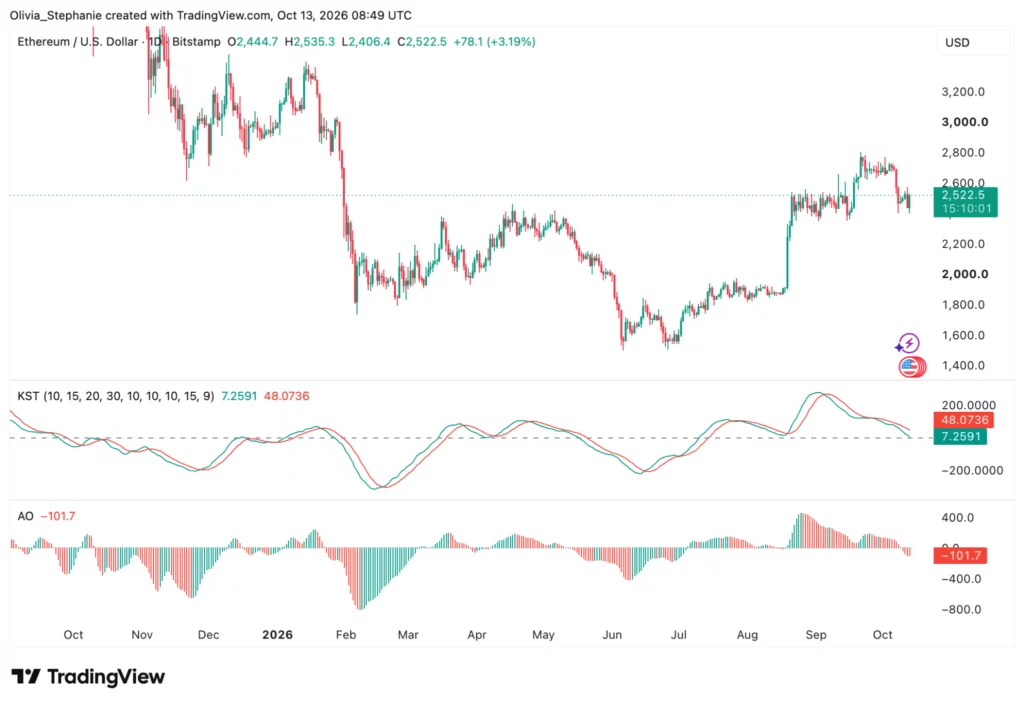
The token had previously rebounded from June lows near $1,550 but remained below its late-September highs around $2,800. The supplied chart identified immediate support between $2,400 and $2,450, with another potential support level at $2,200.
Resistance remained near $2,600, followed by the 2,750–2,800 region. A move above $2,600 would improve the recovery setup described in the chart, while losing $2,400 could expose Ethereum to another test of lower support.
Meanwhile, crypto analyst Iko observed that Ethereum was defending the $2,500 level following the previous session’s decline. The analyst identified $2,550 as the next price level to monitor but cautioned that the recovery had not yet produced a confirmed breakout.
Another analyst, Ash Crypto, suggested that Ethereum had spent nearly five years trading within a long-term range. He outlined a possible major rally if ETH breaks above its multiyear resistance, although the assessment did not establish when such a breakout might occur.
BitMine adds 12,532 ETH but signals slower buying
While Lee warned about possible short-term losses, Ethereum treasury company BitMine Immersion Technologies reported another purchase of 12,532 ETH during the week ending October 11. The company said its total holdings had reached 6,028,946 ETH, equivalent to approximately 4.9% of Ethereum’s stated 122.1 million token supply.
BitMine reported that it was approximately 99% of the way toward its target of holding 5% of Ethereum’s supply. Based on the company’s reference price of $2,544 per ETH, its cryptocurrency holdings were worth approximately $15.3 billion. The company reported combined cryptocurrency, cash, marketable securities and other investments of $16.2 billion as of October 11.
According to the company’s October 12 update, approximately 5.07 million ETH was staked, representing most of its reported Ethereum holdings. BitMine describes its treasury strategy as focused on accumulating ETH and earning rewards through Ethereum staking. The company’s reported balances include assets committed to staking operations.
Management indicated that the company was “largely finished buying ETH,” suggesting that its accumulation rate could slow as it approaches the 5% threshold. The statement does not confirm that BitMine has permanently stopped purchasing Ethereum, and any future transactions remain subject to management decisions.
Earlier BitMine Ethereum accumulation plans had identified the 5% supply target as the company’s main treasury objective. In June, Lee indicated that the business might not need to continue accumulating ETH once it reached that threshold.
Ethereum indicators show weakening buying momentum
Despite the recent price recovery, Ethereum’s technical indicators continued to show signs of weakening momentum. The supplied daily chart placed the Know Sure Thing indicator at 7.3727, below its signal line of 48.0863. The gap between the two readings indicated that the earlier upward momentum had weakened, although both values remained positive.
Ethereum (ETH) price chart, source: TradingView
The Awesome Oscillator presented a more bearish reading. At -101.7, the indicator remained below zero, with negative histogram bars showing weaker short-term momentum compared with the longer-term trend. The reading was consistent with the selling pressure recorded during Ethereum’s recent decline.
For a recovery, the chart identified $2,550 as the first price level requiring attention, followed by resistance near $2,600. A sustained move beyond that region would bring the September trading area between $2,750 and $2,800 into focus. These levels are technical reference points from the supplied chart, not guaranteed targets.
On the downside, the analysis identified 2,400–2,450 as the nearest support range. A sustained decline below $2,400 would weaken the recovery setup and leave $2,200 as the next identified support level.
South Korea’s financial authorities have previously examined risks associated with leveraged stock investing. Reports from July 2026 showed margin loan balances reaching 38.63 trillion won in June, while total investor debt exceeded 60 trillion won in May. The figures describe the earlier state of the country’s leveraged investing market and do not establish the amount of forced selling during the October 13 session.
Disclosure: This article does not represent investment advice. The content and materials featured on this page are for educational purposes only.
Read more: Ledger reveals how hidden chips stole wallet recovery keys