
Markets8 min read
Why Bitcoin’s Order Book Can Fool You
The short version Depth shows quantity, not how fast it changes. Book Churn counts price-level updates every ten minutes. Volatility hit rate: 63% against a 50% baseline. A simple price-range
Ethereum’s EIP-7983: The Gas Cap That Changes Everything We’ve seen Ethereum evolve through countless proposals, but EIP-7983 feels different. Authored by Vitalik Buterin and Toni Wahrstätter
Ethereum’s EIP-7983: The Gas Cap That Changes Everything
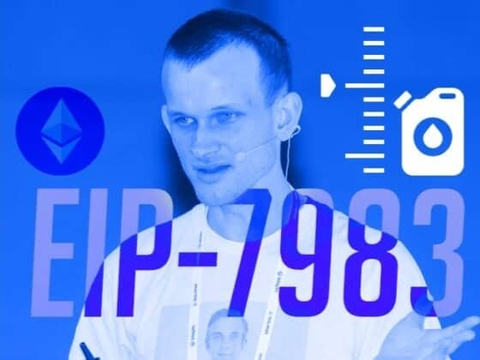
We’ve seen Ethereum evolve through countless proposals, but EIP-7983 feels different. Authored by Vitalik Buterin and Toni Wahrstätter, this isn’t just another tweak—it’s a protocol-level hard cap on individual transaction gas usage. The magic number? 16,777,216 gas (2^24). Why does this matter? Because it directly tackles network stability, DoS vectors, and the messy reality of zkVM compatibility.
The Core Problem: Why Cap Gas Now?
Under current Ethereum architecture, a single transaction can theoretically consume an entire block’s gas limit. This creates uneven load distribution, unpredictable behavior, and opens doors to quadratic attacks—a threat we’ve faced since the 2016 DoS era. EIP-7983 fixes this by enforcing a strict per-transaction ceiling, independent of the block gas limit. The result? More predictable execution, better load balancing, and a cleaner path for parallel processing.
How It Works: Txpool and Block Validation
The specification is brutally simple. During txpool validation, any transaction exceeding 16.7M gas is rejected outright. During block validation, any block containing such a transaction is deemed invalid. No exceptions. This dual-layer enforcement ensures the cap is unbreakable at the network level. For most users, this is invisible—current transactions rarely approach this limit. But for complex DeFi interactions or smart contract deployments, it forces a rethink.
The zkVM Angle: A Hidden Game-Changer
Here’s where it gets interesting. EIP-7983 isn’t just about security—it’s a strategic move for zkVM adoption. Large transactions are inherently hostile to distributed proving systems. By forcing them to be broken into smaller units, the proposal aligns Ethereum with the needs of zero-knowledge virtual machines. Current zkVM implementations struggle with parallelization inside a single massive transaction. Smaller chunks? They thrive. This is a quiet but powerful nudge toward scalability.
Backwards Compatibility: Minimal Pain, Maximum Gain
Is this backward-compatible? No. Transactions exceeding 16.7M gas will need splitting. But the authors argue—and we agree—that the impact is minimal. Most dApps and users operate well below this threshold. The real adjustment falls on advanced protocols deploying gas-heavy contracts. For them, it’s a small price for a more stable network.
Security Benefits: Beyond the Obvious
The cap directly mitigates quadratic attacks by limiting resource consumption per transaction. It also stabilizes block verification, making validation more uniform across nodes. This isn’t just theoretical—it’s a practical defense against DoS vectors that exploit excessive gas. The 2^24 value was chosen to balance current use cases with future-proofing, simplifying downstream engineering for subdividing operations.
Crynet’s Executive Take
EIP-7983 is a masterclass in protocol-level optimization. For crypto projects, this means rethinking gas-heavy smart contracts to avoid future incompatibility. The real ROI? Enhanced network reliability and smoother zkVM integration, which directly reduces operational risks for DeFi and scaling solutions. Ignore this at your own peril—it’s a silent upgrade that reshapes Ethereum’s backbone.
So, here’s the question: Is your project ready for a 16.7M gas cap? We’d love to hear your thoughts on how this impacts your deployment strategy.
Disclaimer: This content is for informational purposes only and does not constitute financial or investment advice. Always conduct your own research before making decisions related to cryptocurrency or blockchain technology.