EU AML Rules 2027 Introduce €10,000 Cash and Crypto KYC Requirements The EU has proposed a regulation that will impact crypto transfers worth millions of euros from July 2027 onwards. The new
EU AML Rules 2027 Introduce €10,000 Cash and Crypto KYC Requirements
The EU has proposed a regulation that will impact crypto transfers worth millions of euros from July 2027 onwards.
The new crypto regulations could impact traders and investors in several ways, including access to exchanges, KYC procedures, and the treatment of certain assets. The key number is not the price; it's the one that's coming on July 10, 2027.
The EU AML Rules 2027: What does it imply for crypto and cash?
The European Union has agreed that Regulation (EU) 2024/1624 will enter into force on 10 July 2027 and become one of the most comprehensive anti-money laundering frameworks ever adopted in the EU.
The regulation establishes a bloc-wide €10,000 limit on commercial cash payments for goods and services. EU member states will be able to set even lower limits, but not lower than the new limit.
The goal is to establish a common AML framework in Europe and to minimise the opportunities for money laundering, fundraising for terrorist purposes and illicit financial activity.
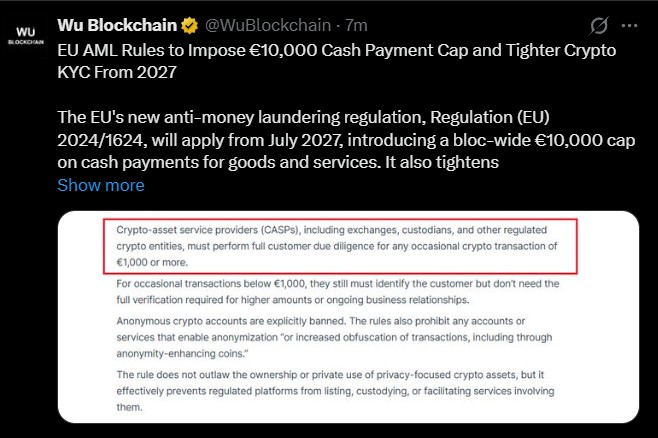
Source: Wu Blockchain X
New Cash Transaction Restrictions – Explanation.
As part of the new system, businesses will no longer be able to receive cash payments for commercial transactions exceeding €10,000. Further, there will be customer due diligence and identity verification procedures for transactions exceeding €3,000.
But the cash payment restriction does not apply to private transactions between people. The €10,000 limit will not apply to bank deposits and transfers, but will be subject to existing AML rules.
Why the New Crypto KYC Requirements Matter
The most significant impact for the crypto market is the increased requirements for Crypto-Asset Service Providers (CASPs), such as exchanges, custodians, and regulated crypto companies.
The EU AML Rules 2027 require CASPs to perform full customer due diligence for occasional crypto transactions of €1,000 or more. The platforms are required to identify the users, but without enhanced verification requirements for transactions under €1 000.
This marks another significant milestone in Europe's broader cryptocurrency regulatory efforts aimed at harmonizing regulations with the existing financial compliance landscape.
Anonymous Accounts and Privacy Coin Services are restricted.
The rule clearly bans anonymous cryptocurrency accounts on regulated platforms. It also bans services that enable transaction anonymity or greater transaction obfuscation, such as services linked to anonymity-enhancing cryptocurrencies.
Importantly, the rule does not prohibit holding of privacy-oriented cryptocurrencies. Rather, it restricts the trading, custody, or other regulated services of regulated service providers regarding these assets.

Source: Wu Blockchain
Will Private Wallet Transfers be impacted?
One of the major concerns of Bitcoin users is that not all transactions will be identity verified. These obligations do not apply to peer-to-peer transactions among self-hosted wallets. The requirements primarily affect users' interaction with regulated service providers, like exchanges and custodians.
The expansion of AML goes beyond the crypto sector.
The EU AML Rules 2027 are not limited to the banking and cryptocurrency sectors. The compliance requirements for several industries deemed to be vulnerable to financial crime will be strengthened. These sectors include:
Professional football clubs and agents.
Luxury goods dealers
Crowdfunding platforms
Investment migration providers
Deals in high-value vehicles, yachts and aircraft.
Institutions in these industries will need to step up their customer verification and transaction monitoring processes.
Beneficial Ownership Transparency Gets Stronger
Transparency of beneficial ownership is another crucial part of the regulation. EU companies will have to be registered in the national register of their ultimate beneficial owners.
The ownership threshold is typically 25%, but can be lowered to 15% for more complex corporate structures. Other entities, such as trusts, foundations and some non-EU entities carrying on business in the EU, will also be subject to tougher disclosure obligations.
Before July 2027, Traders should watch out for:
The rule doesn't come into effect until July 2027, but cryptocurrency exchanges are likely to start preparing in advance. Investors should monitor:
KYC Updates: Announcements will be made on the exchange.
Potential privacy coin delistings.
Increased onboarding changes
Additional compliance measures required by MiCA regulations
Travel Rule implementation updates
Over the next year, these developments may have an impact on the way digital assets are utilized and traded by European users.
Conclusion
The EU AML Rules 2027 are one of the most profound compliance changes in the traditional finance sector in recent years. The regulation introduces a €10,000 cap on cash payments, introduces new crypto KYC requirements, enforces limits on anonymous accounts, and extends AML coverage to various industries, indicating Europe's ongoing efforts to strengthen financial transparency. The next 12 months will be crucial as exchanges and market participants get ready for implementation.
Disclaimer: Cryptocurrency investments are speculative and subject to market risks and regulations. The information contained in this article is for educational purposes only and should not be interpreted as financial, legal, or investment advice. Investors are advised to do their own research before any investment.