Key Takeaways Grayscale argues revenue-generating crypto protocols are trading at unusually low multiples. Several names with hundreds of millions in revenue trade at roughly 1x that figure.
Key Takeaways
- Grayscale argues revenue-generating crypto protocols are trading at unusually low multiples.
- Several names with hundreds of millions in revenue trade at roughly 1x that figure.
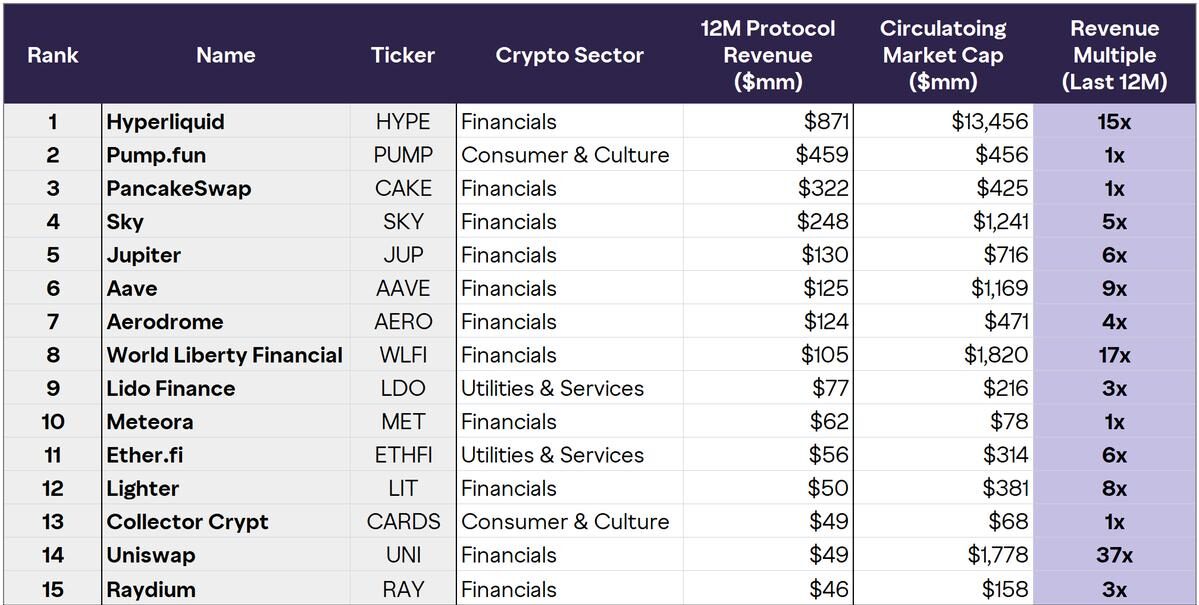
- Hyperliquid leads on revenue at $871M; Uniswap is the priciest at 37x.
- Grayscale ties the thesis to the Clarity Act, a catalyst it sees weeks away.
- Grayscale is an asset manager, so the bullish framing carries that context.
It’s a fundamentals-over-sentiment case, and it’s worth examining closely, including what cuts against it.
The Valuation Anomaly
The core of Grayscale’s argument is a mismatch between revenue and price. When you set 12-month protocol revenue against market capitalization, a striking gap appears between protocols priced for their governance potential and those priced barely above their actual cash flow.
Data as of June 24, 2026. Sources: Grayscale Research, The Stack, DefiLlama, Artemis.
Why the “1x Club” Is the Real Story
The protocols trading at roughly 1x revenue are what make Grayscale’s case. Pump.fun generated $459 million and carries a $456 million market cap, valued at essentially one year of revenue. PancakeSwap shows the same pattern at $322 million. In traditional markets, a software business with low overhead throwing off hundreds of millions a year at 1x revenue would draw immediate attention from value investors.
Here’s the honest other side, though, the side a careful reader should weigh. A 1x multiple isn’t automatically a gift; sometimes the market prices something that low for a reason. Much of this revenue comes from activity that may not be durable: Pump.fun’s figures lean on memecoin speculation that can evaporate when sentiment turns, and several of these protocols face open questions about whether their fee revenue actually accrues to token holders. So the 1x readings could mean the market is overlooking real cash flow, as Grayscale argues, or that it’s correctly discounting revenue it doesn’t expect to last. Both readings fit the same number.
Governance and Political Premiums
The expensive end of the table illustrates the flip side. Uniswap earns just $49 million in protocol revenue but commands a $1.778 billion market cap, a 37x multiple. That gap reflects a long-running structural quirk: UNI holders are largely paying for governance and the potential of an eventual “fee switch” that would route revenue to the token, rather than for current cash flow. The market is pricing what UNI could become, not what it currently earns.
World Liberty Financial sits in a similar premium zone at 17x on $105 million in revenue, a valuation tied more to its political connectivity and visibility than to its fundamental output. Both are reminders that crypto valuations often track narrative and optionality as much as earnings, which is exactly the inefficiency Grayscale says fundamental investors can exploit.
READ MORE:
 ETH’s Bearish Price vs. Bullish Activity: The 2026 Mystery
The Clarity Act Catalyst
Grayscale’s thesis isn’t only that these protocols are cheap, it’s that they’re cheap right before a regulatory event that would land squarely on this category. Most of the names in its table, 12 of 15, are financial protocols: decentralized exchanges, lending platforms, liquid staking, and yield infrastructure. The Clarity Act, which would bring a clearer rulebook to digital assets, would most directly affect exactly these use cases. The logic chain is straightforward: clearer rules could reduce the compliance friction keeping institutions on the sidelines, which could lift on-chain activity and total value locked, which would flow through to these protocols’ revenue.
That’s the heart of the timing argument, bear-market multiples on revenue-producing protocols, with a legislative catalyst Grayscale believes could be weeks away. If the activity materializes, today’s 1x readings could look low in hindsight.
How to Read This
The setup Grayscale describes is genuinely interesting: high-margin protocols trading at depressed multiples, sitting in the path of a possible regulatory tailwind, while the broader market stays in risk-off mode. It’s a real fundamental argument in a market usually driven by sentiment.
Two things keep it honest, though. First, the catalyst is conditional, the Clarity Act’s timing and final shape aren’t guaranteed, and a thesis built on a legislative event carries the risk that the event slips or disappoints. Second, and worth stating plainly, Grayscale is a crypto asset manager whose business is built on investors gaining exposure to these assets, so its conclusion that this is “an attractive entry point” should be read with that interest in mind, not as neutral analysis.
The valuation data is verifiable and the anomaly is real; whether it marks a bottom or simply reflects risks the market is pricing correctly is the question each investor has to answer for themselves. For anyone tracking the Clarity Act, the signal to watch isn’t only whether the bill passes, but whether institutional capital actually flows into these protocols in the weeks right after, because that, more than the legislation itself, would be the real test of Grayscale’s thesis.
This article is for informational purposes only and does not constitute financial advice. Consult a professional before making investment decisions.The post Grayscale Flags 15 Crypto Assets With Attractive Entry Points appeared first on Coindoo.