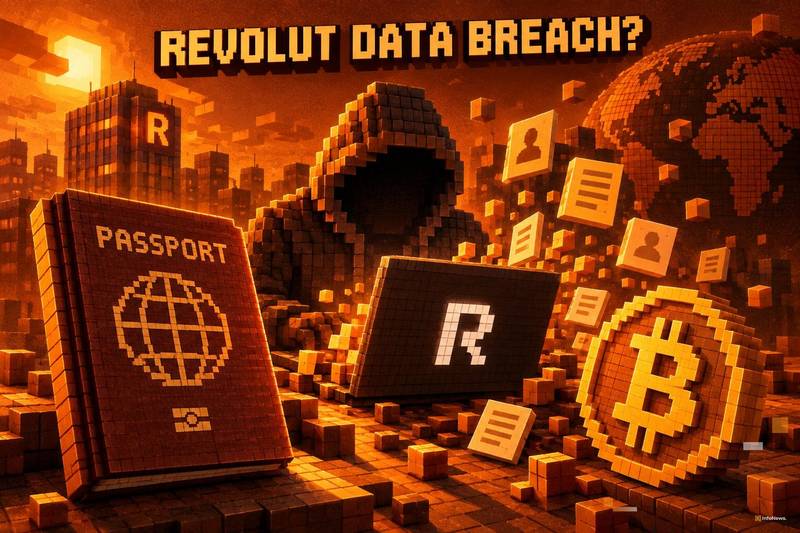
Hackers reportedly obtained Revolut customers' passports and Bitcoin histories, according to the headline circulating around the incident, an allegation that raises immediate questions about
Hackers reportedly obtained Revolut customers' passports and Bitcoin histories, according to the headline circulating around the incident, an allegation that raises immediate questions about customer data exposure at one of Europe's largest fintech firms and the privacy of the on-chain activity tied to those accounts.
WHAT TO KNOW
- Hackers reportedly obtained Revolut customers' passports and Bitcoin transaction histories.
- The available material does not establish the scope of the exposure, the method of access, or any company response.
What hackers reportedly obtained from Revolut customers
The reported allegation names two categories of customer information: passports and Bitcoin histories. Both are described as having been obtained by hackers, but the claim is reported rather than independently confirmed here. For related coverage, see Grant Cardone Lists Private Jet for 1,025 Bitcoin.
No source report, incident date, affected-customer count, or attack method has been established in the material available for this story. The nature of the passport information, whether scans, copies, numbers, or another form, is not specified and should not be assumed. For related coverage, see Liquid Recovers 3,400 BTC: Bitcoin Recovery Details.
Equally, the available material does not establish that Revolut's own systems were breached, nor does it identify a third party as responsible. Distinguishing reported access to customer information from a confirmed breach of a company's infrastructure matters, because the two carry very different implications for how any exposure occurred.
What the Bitcoin-history claim could mean for customer privacy
The phrase "Bitcoin histories" is undefined in the available context. It is not clear whether this refers to transaction records, account activity within the app, or some other set of records, and no wallet addresses, balances, or credentials have been described.
If identity documents were linked to a customer's Bitcoin activity, the potential privacy implication is the deanonymization of on-chain behavior, tying a real name and passport to financial movements. That remains a potential consequence, not an established outcome, given the absence of verified detail.
Access to historical information is not the same as control of funds. Nothing in the available material indicates that private keys, wallets, or Bitcoin holdings were compromised, and the reported acquisition of records should not be read as evidence of theft. Past incidents show that data exposure and fund loss are separate events; even in cases like the Liquid Network hack where attackers reportedly returned 3,400 BTC, the movement of coins was distinct from any exposure of personal records.
What remains to be verified about the reported exposure
The primary verification need is the original report itself and the evidence behind it. Without the source, the incident timing, the number of affected customers, the precise data types, and the route of access all remain unresolved in the available material.
These gaps reflect what is absent from the context provided, not proof that Revolut has stayed silent or that no public confirmation exists elsewhere. A company response or customer guidance should be added only once verified material becomes available.
Readers assessing the story should treat unattributed data-breach claims with the same caution applied to on-chain incident reports. Whether attackers return assets, as in the case where hackers returned 85% of Bitcoin stolen in a bridge attack, or post demands publicly, as when 4,000 BTC was stolen and demands were posted on chain, verification rests on traceable evidence rather than headlines.
For any Bitcoin-related exposure, the network's own properties offer a measure of resilience: holdings secured by self-custodied private keys are not accessible through a data breach of a service provider, however that ownership metadata, once linked to identity, can permanently undermine the pseudonymity that Bitcoin's public ledger otherwise affords.
Additional source references: source document 1, source document 2.
Disclaimer: This article is for informational purposes only and does not constitute financial or investment advice. Cryptocurrency and digital asset markets carry significant risk. Always do your own research before making decisions.
Bitcoininfonews first published the article titled Hackers Reportedly Obtained Revolut Passports, Bitcoin Data.