More than half of the wallets that qualified for Donald Trump’s second memecoin dinner appear to have received the TRUMP token via crypto exchanges that do not serve U.S. customers, according
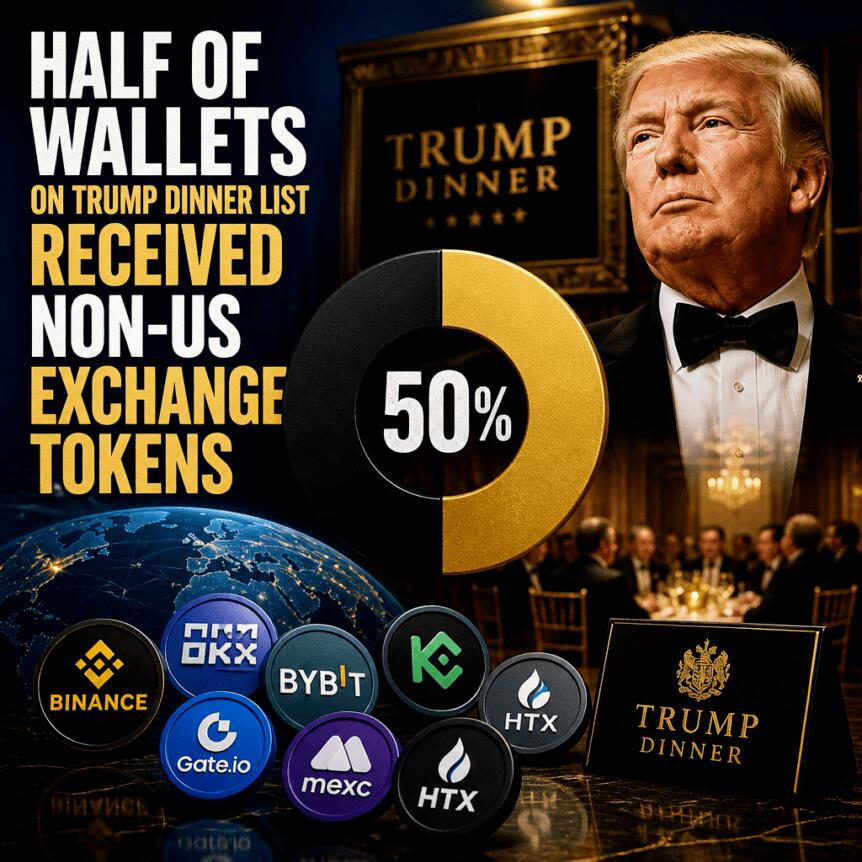
More than half of the wallets that qualified for Donald Trump’s second memecoin dinner appear to have received the TRUMP token via crypto exchanges that do not serve U.S. customers, according to an analysis released by consumer advocacy group Public Citizen. The findings raise fresh questions about who can effectively obtain access to the president’s crypto-related events—particularly if exchange access restrictions are enforced.
Trump is hosting the second event for top TRUMP holders at Trump National Golf Club in Sterling, Virginia. The dinner is reportedly set to offer up to 185 seats based on time-weighted TRUMP holdings, using a snapshot taken on Nov. 16.
Key takeaways
- Public Citizen says it traced 66 of 130 qualifying wallets on the public leaderboard to exchanges that bar U.S. users.
- The analysis includes 15 of 29 wallets that qualified for a VIP reception with the president.
- Public Citizen identified a wallet with $1.65 million in time-weighted TRUMP holdings at the Nov. 16 snapshot.
- The group also flagged 14 wallets it suspects were controlled by the same actor or group, describing a pattern of receiving TRUMP and then emptying wallets ahead of the cutoff.
- TRUMP is reported to be trading roughly 99% below its all-time high, underscoring how the event is drawing attention amid deep token drawdowns.
Public Citizen links qualifying wallets to non-U.S.-accessible exchanges
Public Citizen stated that it traced 66 of the 130 wallets on the public leaderboard to crypto exchanges that are not permitted to serve U.S. customers. The group cited exchanges including Binance (global), Bybit, and BloFin as part of the wallets’ token origination paths.
The advocacy organization’s analysis goes further by noting that the pattern extends into the VIP tier. It said 15 of the 29 wallets that met the criteria for a VIP reception also received TRUMP through the same types of non-U.S.-serving exchanges.
“If those bans are enforced, many of the people vying for a seat at the president’s table don’t live in the United States,” said Public Citizen research director Zach Everson.
The underlying implication for investors and market participants is straightforward: if the pool of qualifying holders relies heavily on trading venues that restrict U.S. access, then the event’s “who gets in” mechanics may not align with U.S. residency expectations. For traders, the finding also highlights the extent to which token distribution pathways—onramps and custody routes—can matter as much as headline wallet balances.
How wallets qualified: top holders, VIP tier, and suspected clustering
Public Citizen identified FastX, described as a Singapore-linked trading platform, as the top-ranked wallet on its ranking list. The group said the wallet held $1.65 million in TRUMP at the time of the Nov. 16 snapshot.
The analysis also pointed to a wallet it described as linked to Unitas, a stablecoin issuer operated by a British Virgin Islands company. According to Public Citizen, that wallet ranked third on the list.
Separately, crypto entrepreneur Morten Christensen—identified as being based in the Netherlands and the founder and CEO of AirdropAlert—shared a picture from the Trump gala dinner on X. Public Citizen reported that he placed 26th, with $45,351 in time-weighted TRUMP holdings.
Beyond individual rankings, the advocacy group said it detected wallet grouping consistent with shared control. It identified 14 wallets it suspects were controlled by the same person or group, and claimed that each received approximately 3,700 TRUMP tokens from Binance in October, before being emptied weeks ahead of the cutoff.
If accurate, that sort of behavior would suggest that some participation may have depended on temporary balance management rather than long-term accumulation. That can influence how observers interpret “top holder” lists—particularly when qualification uses time-weighted measures that can reward strategic holdings within a defined window.
Political scrutiny returns as token value keeps sliding
Public Citizen’s report arrives amid continuing controversy over Trump’s memecoin dinners. Earlier, Democratic lawmakers asked the White House to release the guest list for the first dinner held in May 2025. The scrutiny included protests outside the golf club, and renewed calls for transparency in October.
Those questions matter because the events are positioned as exclusive gatherings for top TRUMP holders, effectively linking token holdings to access. Observers have focused on whether individuals outside the U.S. can obtain entry through trading accounts on exchanges that restrict American users—precisely the concern Public Citizen is now flagging via its wallet-tracing work.
At the same time, the TRUMP token’s market performance has been sharply negative since its peak. The article notes that TRUMP is down 98.8% from its all-time high of $75.35. Public Citizen’s timeline context is that the first dinner in May 2025 occurred when TRUMP reportedly traded at $14.43, and by the time Trump held a second related memecoin event at Mar-a-Lago in Florida, the token was already down to $2.88.
As of the time of writing, TRUMP was reported to be trading at $0.89. For market participants, the juxtaposition is significant: the dinners draw sustained attention even as token value collapses, implying that the social and political angle may be driving participation as much as price appreciation.
Coverage also indicates that Tron founder Justin Sun—described as the top-ranked holder at the May 2025 dinner—was expected to skip the second event, according to The Wall Street Journal.
Who is attending and why the exchange angle matters now
The dinner is expected to feature Trump as a featured speaker. The event’s guest list, as reported in the source coverage, includes Floyd Mayweather, “Shark Tank” investor Kevin O’Leary, former NBA player Tristan Thompson, and mentalist Lior Suchard.
The newly highlighted exchange access issue could become a focal point for further scrutiny, especially because it involves a practical question: if U.S. exchange restrictions are enforced, how many qualifying holders are likely to be U.S. residents versus participants reachable through non-U.S.-serving platforms?
For readers trying to understand the broader crypto implications, the case is also a reminder that token ecosystems increasingly intersect with real-world gatekeeping mechanisms. When qualification criteria are based on holdings and wallets tracked on public leaderboards, the next layer for investigators—and for policymakers—often becomes the custody and onramp paths behind those wallets.
Going forward, the most important developments to watch are whether Public Citizen’s tracing results prompt renewed demands for transparency around event access and whether any confirmation emerges regarding how qualification enforcement works across geographic and exchange restrictions. Even without changes to token economics, scrutiny of the “who qualifies and from where” question could remain a persistent risk to the reputational narrative surrounding memecoin-based political events.
This article was originally published as Half of Wallets on Trump Dinner List Received Non‑US Exchange Tokens on Crypto Breaking News – your trusted source for crypto news, Bitcoin news, and blockchain updates.