






Here’s Why XRP Will be Priced at 3-4 Digits Soon: Analyst Explains
 FTR
FTR
 MAJOR
MAJOR
 DRIFT
DRIFT
 DEFI
DEFI
 XRP
XRP
What to know:
- Analyst argues higher XRP prices reduce slippage, making large institutional transactions more efficient and viable.
- At low prices, huge token volumes are needed (causing major price impact), while higher prices require fewer tokens and lower slippage.
- Suggests a potential feedback loop where adoption drives price up, improving liquidity and attracting even more institutional use.
Crypto analyst Future XRP has outlined a controversial argument for why XRP could eventually require significantly higher prices, potentially reaching three or even four digits, to support institutional adoption. The core of the argument revolves around slippage, a trading phenomenon where large orders impact market price due to insufficient liquidity.
Why Price Matters for Institutional Transactions
According to the analyst, large-scale financial transactions, such as a $3 billion cross-border transfer, require deep liquidity to execute efficiently. Institutions typically aim to keep price impact within a narrow range, often around 2% or less.
At lower XRP prices, executing such large transactions would require moving a massive number of tokens. This, in turn, could overwhelm order books and lead to significant price slippage, making the transaction economically unviable.
Breaking Down the Math
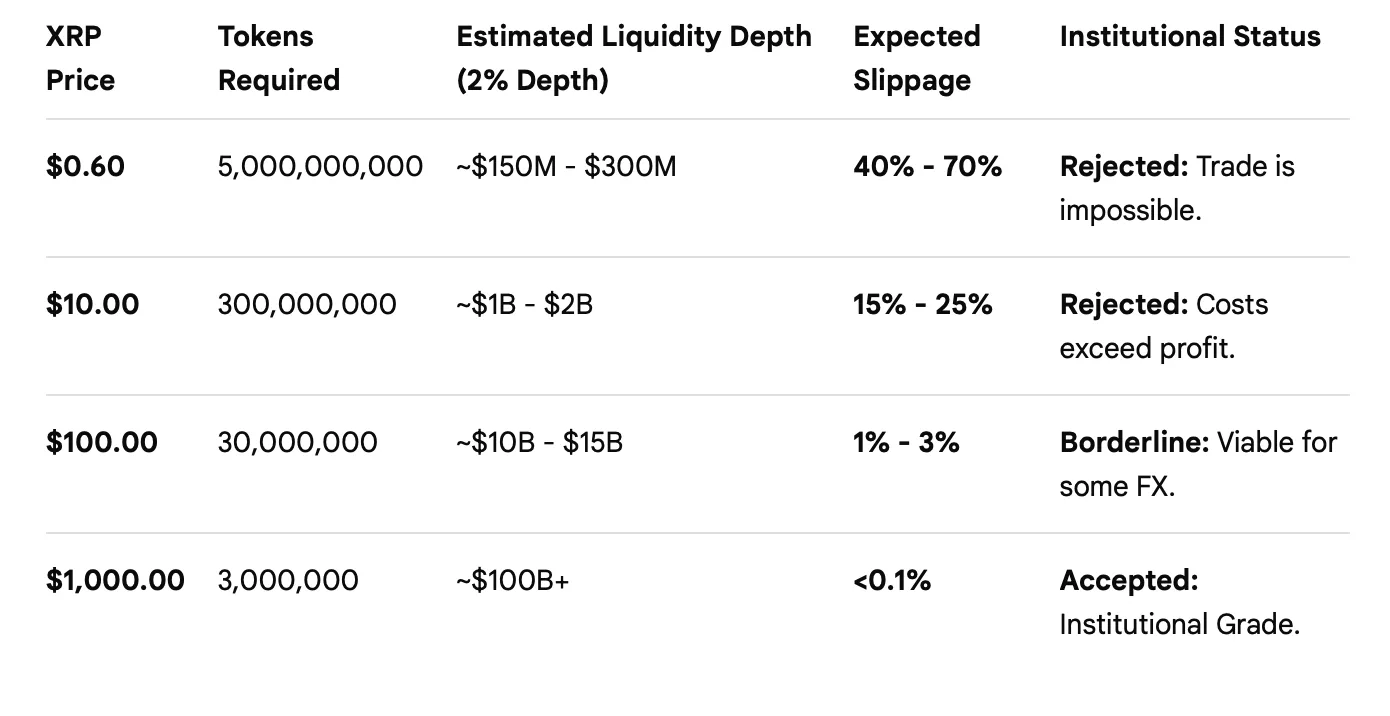
The analysis compares how XRP’s price level affects transaction efficiency. At a price of $0.60, a $3 billion transfer would require roughly 5 billion XRP tokens. This level of volume would likely cause severe slippage, estimated between 40% and 70%, rendering the transaction impractical.
Also Read: DeFi Shock: Drift Hack Drains $280M Through Advanced Multisig Takeover
At $10, the required volume drops to 300 million tokens, but slippage could still range from 15% to 25%, which remains too high for institutional standards. At $100, the transaction would involve around 30 million tokens, reducing slippage to approximately 1% to 3%, making it borderline viable for certain use cases.
However, at $1,000, only 3 million tokens would be needed, with slippage falling below 0.1%. At this level, the analyst argues, XRP could meet institutional-grade requirements for efficiency and cost.
Source: Future XRP/X
Liquidity and Market Depth Dynamics
The argument highlights a key concept: higher asset prices can improve effective liquidity by reducing the number of units required per transaction. With fewer tokens needing to be moved, order books are less strained, leading to tighter spreads and lower execution costs. This dynamic could make XRP more attractive for large-scale financial operations, including cross-border payments.
The analyst suggests that banks and institutions will not scale solutions like on-demand liquidity until execution becomes consistently fast, predictable, and cost-effective, comparable to or better than traditional systems. In this view, price appreciation is not merely speculative but could become a functional requirement for XRP to handle institutional-level flows.
A Feedback Loop of Utility and Price
Ultimately, the analyst concludes with a potential feedback loop: increased real-world usage could drive buying pressure, which raises price and improves liquidity conditions. This, in turn, could attract more institutional adoption, reinforcing the cycle. While the theory remains debated, it underscores how market structure and liquidity mechanics could play a critical role in XRP’s long-term valuation.
Also Read: XRP News: Ripple Treasury Just Got a Major Upgrade – Here’s What’s New
The post Here’s Why XRP Will be Priced at 3-4 Digits Soon: Analyst Explains appeared first on 36Crypto.
