Bitget, one of the largest centralized derivatives exchanges by open interest, confirmed on September 25, 2026 that approximately $387.5 million in customer assets was transferred to attacker
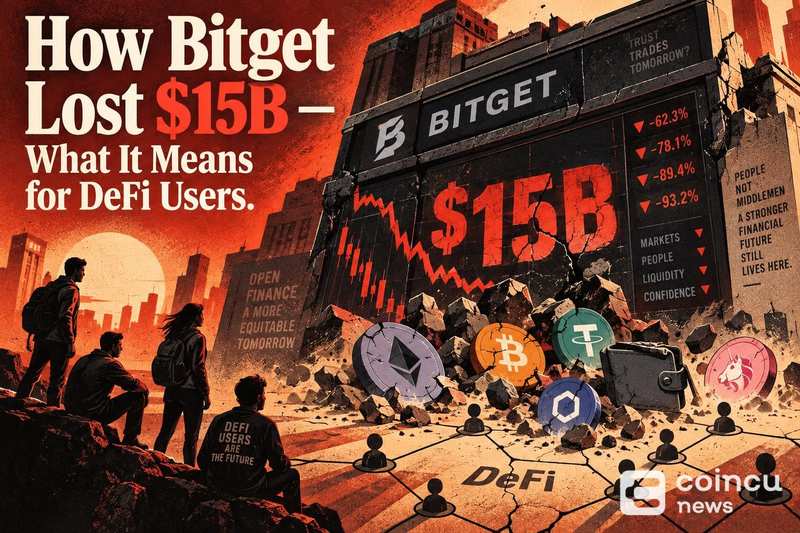
Bitget, one of the largest centralized derivatives exchanges by open interest, confirmed on September 25, 2026 that approximately $387.5 million in customer assets was transferred to attacker-controlled addresses following a hot wallet breach identified the previous day, while circulating claims of a $15 billion loss remain unsupported by any primary source, on-chain record, or independent forensic report reviewed at publication time.
Did Bitget Really Lose $15 Billion? Start With the Evidence
The $15 billion figure circulating across social media does not correspond to any confirmed loss, balance-sheet shortfall, or customer deposit gap identified in Bitget's official incident disclosures or in blockchain-analysis reports from TRM Labs, SlowMist, or Mandiant. Bitget's September 25 update places the confirmed transfer total at $387.5 million, a figure revised upward from an initial $351.6 million estimate after Zcash and TRON assets were incorporated into the assessment. For related coverage, see How UST Lost $5.7M: DeFi Risks and Lessons for Users.
The $15 billion figure more likely reflects a conflation of Bitget's reported assets under custody, estimated exchange trading volume, or unverified social commentary, none of which constitute exchange losses. According to Decrypt's independent reporting on the revised total, attackers spoofed transaction data within Bitget's wallet infrastructure rather than obtaining private keys directly, a distinction CEO Gracy Chen drew publicly. The $15 billion claim should be treated as unverified until a primary source establishes it. For related coverage, see Coinbase's $1.76M Loss: Lessons for Every DeFi User.
What has been confirmed
Bitget identified anomalous activity on September 24, 2026 and published its first incident update the following day. The company confirmed assets spanning at least seven blockchains were moved to attacker-controlled wallets, with the EVM recipient address 0x770b10b273fc44fe9197d6bf20f145c2e98463ee labeled "Bitget Exploiter 1" by Etherscan. Bitget stated the incident was contained as of the September 25 update; no post-incident primary report establishing a final recovered amount or concluded user-compensation outcome had been published at the time this article was written. For related coverage, see Mesh Announces Acquisition of Bluvo: What It Means for Crypto Payments.
Bitget's revised incident total
$387.5 million
Bitget said this was transferred to attacker-controlled addresses after including Zcash and TRON assets.
How the Reported Bitget Incident Unfolded
The trigger
Bitget's incident account describes a transaction-data spoofing attack against its hot wallet infrastructure rather than a direct private-key compromise. That mechanism, if confirmed, means the attacker manipulated the exchange's signing layer to authorize outbound transfers to addresses it controlled, without ever obtaining the cryptographic keys themselves. No completed forensic report had publicly established a definitive attack vector at publication time; Bitget said it engaged Mandiant and SlowMist for investigation.
TRM Labs traced the earlier $351.6 million figure across seven blockchains, noting that funds moved into round-number wallets and were partially converted into Bitcoin, a laundering pattern TRM Labs described as consistent with a likely North Korea-linked actor. That attribution is a probabilistic assessment, not a concluded finding; no government agency or court had formally attributed the breach to a named actor or state as of this writing.
The estimate rose from $351.6 million to $387.5 million after Bitget's team incorporated Zcash and TRON assets into its accounting, an upward revision of roughly $35.9 million.
Initial Bitget estimate
$351.6 million
The earlier total was later revised after Bitget included Zcash and TRON assets.
Who was exposed
Hot wallet breaches at centralized exchanges expose users who hold assets on the platform at the time of the incident. Unlike cold-storage failures, hot wallet compromises are bounded by whatever portion of total reserves an exchange keeps liquid for daily withdrawals; Bitget has not published a breakdown of what share of total custodied assets the $387.5 million represents. The exchange's stated containment of the incident suggests cold reserves were not directly accessed, though no independent proof-of-reserves audit confirming that claim has been published.
What the Incident Means for DeFi Users
CEX risk is not DeFi risk
Centralized exchange risk is counterparty risk: the user trusts the exchange to custody assets, execute withdrawals, and maintain solvency. When an exchange is breached, users with balances on that platform bear direct exposure regardless of whether underlying blockchain networks function correctly. DeFi protocols, by contrast, expose users to smart-contract risk, oracle manipulation, and governance attacks, but assets remain in on-chain addresses the user controls, provided seed phrases are secured. The Bitget breach illustrates the former category, as explored in depth in the Bitget Collapse Explained analysis published alongside this article.
That distinction does not make DeFi categorically safer. A user who bridges assets from a Bitget account into a DeFi protocol using an exchange-issued wrapped token, or who uses Bitget as a fiat on-ramp and then deposits into a lending protocol, carries layered risk: the CEX custody risk until withdrawal, the bridge smart-contract risk during transfer, and the protocol liquidation risk once deposited. Bitcoin trades at $83,331 as of October 14, 2026, with the crypto Fear and Greed Index at 62 (Greed), meaning current market conditions may be suppressing users' risk awareness at exactly the moment a major breach demands heightened caution.
Where the risks overlap
Exchange-issued assets, such as wrapped tokens or exchange-native stablecoins, introduce a direct dependency between a CEX's solvency and the DeFi liquidity pools that accept those assets as collateral. If Bitget had issued a widely circulated wrapped asset, a confirmed insolvency, rather than a contained breach, could have triggered oracle price dislocations and liquidation cascades across every protocol holding that asset. That dependency is why a prior UST-type collapse propagated so rapidly through DeFi: the failure was at the issuer level, not the protocol level, yet protocol users bore losses.
A DeFi User's Risk-Reduction Checklist
The following guidance reflects general security best practices and does not constitute individualized investment or legal advice.
Before depositing
Limit exchange balances to amounts needed for near-term trading; treat a centralized exchange as a venue, not a vault. Verify that any wrapped or exchange-native token you intend to use in a DeFi protocol has audited smart contracts and on-chain proof of reserves, not just marketing claims. Before bridging, check the bridge's auditor, total value secured, and historical incident record; most bridge exploits targeted contracts with less than 12 months of mainnet history.
Hardware wallets remain the baseline for self-custody: a seed phrase stored on a device that never touches the internet is not accessible via a transaction-spoofing attack of the type Bitget described. For users who keep a significant share of holdings in self-custody USDT wallets, the Bitget breach is not a direct threat, but it underlines why that separation exists. Verify contract addresses on Etherscan before approving any token interaction; a single approval granted to a malicious contract can drain a wallet without any further user action.
While positions are live
Monitor collateral health ratios in lending protocols weekly, not monthly; liquidation thresholds can be breached inside a single trading session during high-volatility events. Use a token approval revocation tool to audit and revoke stale allowances quarterly; protocols you no longer use retain the ability to move tokens until those approvals are explicitly cancelled. Set withdrawal address whitelists on any exchange that supports them, so that even a compromised account login cannot redirect funds to an unrecognized wallet.
FAQ: Bitget, Exchange Losses, and DeFi Safety
Did Bitget lose $15 billion? No primary source, on-chain record, or independent forensic report reviewed supports the $15 billion figure. Bitget's confirmed total, per its September 25, 2026 update, is approximately $387.5 million transferred to attacker-controlled addresses.
Are customer funds affected? Bitget stated the incident was contained and did not publish a confirmed user-compensation outcome at the time this article was written. Users with balances on the platform at the time of the breach should monitor Bitget's official support channel for updates.
Is DeFi safer than a centralized exchange? DeFi and CEX exposure involve different risk categories. CEX risk is counterparty and custody risk; DeFi risk is smart-contract, oracle, and liquidation risk. Neither is categorically safer; the appropriate comparison depends on the specific protocol, bridge, and user behavior involved.
What should users do with assets currently held on an exchange? Users should assess how much of their total holdings they need on any single exchange for active trading purposes and move the remainder to a self-custody wallet secured by a hardware device. This is a personal risk-management decision, not financial advice.
Can proof of reserves guarantee safety? Proof-of-reserves snapshots confirm that an exchange held sufficient assets at a specific moment but do not guarantee that those reserves were not subsequently moved or that off-balance-sheet liabilities do not exist. Attestations by a named auditor, published on a regular schedule, carry more weight than self-reported snapshots, but neither eliminates counterparty risk entirely. The next concrete milestone to watch is whether Bitget publishes an independent forensic report attributing the breach vector and confirming the scope of recovered or compensated assets, which would either validate the current $387.5 million figure or revise it further.
Disclaimer: This article is for informational purposes only and does not constitute financial or investment advice. Cryptocurrency and digital asset markets carry significant risk. Always do your own research before making decisions.
The post How Bitget Lost $15B: What It Means for DeFi Users was initially published on Coincu.