Gold is not protecting investors in this crash. While the US stock market had its worst day since June on Friday, 30 October 2026, gold futures fell 3.6 percent to $3,884.90 per ounce, accord
Gold is not protecting investors in this crash. While the US stock market had its worst day since June on Friday, 30 October 2026, gold futures fell 3.6 percent to $3,884.90 per ounce, according to daily closes on Yahoo Finance. In October the gold price lost 7.2 percent, its second monthly decline in a row. Since its record close of $5,318.40 on 29 January 2026, gold is down 27 percent. Our analysis of six market crises since 2007 shows that this is not unusual: in the acute phase of a crash, gold often falls together with stocks. It only proved its value as a safe haven later, when central banks started to cut rates.
Gold price in the crisis: the key facts
- Friday, 30 October: gold futures −3.6 % to $3,884.90, Nasdaq −2.86 %, S&P 500 −1.82 %.
- October 2026: gold −7.2 %, Bitcoin −7.6 %, Nasdaq −5.3 %, S&P 500 −0.9 %.
- Since the record: −27.0 % from the close of $5,318.40 on 29 January 2026; year to date −10.5 %.
- Main driver: expectations of further rate hikes by the Fed, fuelled by higher oil prices.
- History: in the Covid crash of March 2020 gold fell 11.7 percent in ten days, then set a record in August.
- Long view: over the full financial crisis from 2007 to 2009 gold gained 24.5 percent while the S&P 500 lost 56.8 percent.
The stock market sell-off itself is covered in our analysis why US stocks now swing like meme tokens. Here we look at the other side: where investors could have hidden, and why gold did not help this time.
Why is the gold price falling? Three reasons
1. Rate hikes instead of rate cuts. Gold pays no interest. When rates rise, holding it becomes more expensive compared with bonds. The Fed kept its key rate at 3.75 to 4.00 percent on 28 October, but two officials voted for a hike, and futures markets price a hike in December at around 80 percent according to the CME FedWatch tool. That is the opposite of the environment in which gold rallied in 2025.
2. Oil drives inflation fears. On Friday, renewed attacks on commercial shipping in the Strait of Hormuz pushed crude oil higher and reinforced inflation concerns, Kitco reported. Normally geopolitical tension supports gold. This time it strengthens the case for higher rates, and that weighs more. Silver fell to its lowest level of the year at around $50.
3. Selling for liquidity. When stocks fall sharply, investors sell what they can sell quickly and at a profit, and gold had more than doubled in the two years before the record. Analysts at XTB ask exactly that question: the end of the safe-haven myth, or a search for liquidity?
The break in the trend came earlier. Gold crashed 10.8 percent on 30 January 2026, its worst day in our data series since 2005, after the nomination of Kevin Warsh as Fed chair; we analysed that day in why gold plunged $600 in 24 hours.
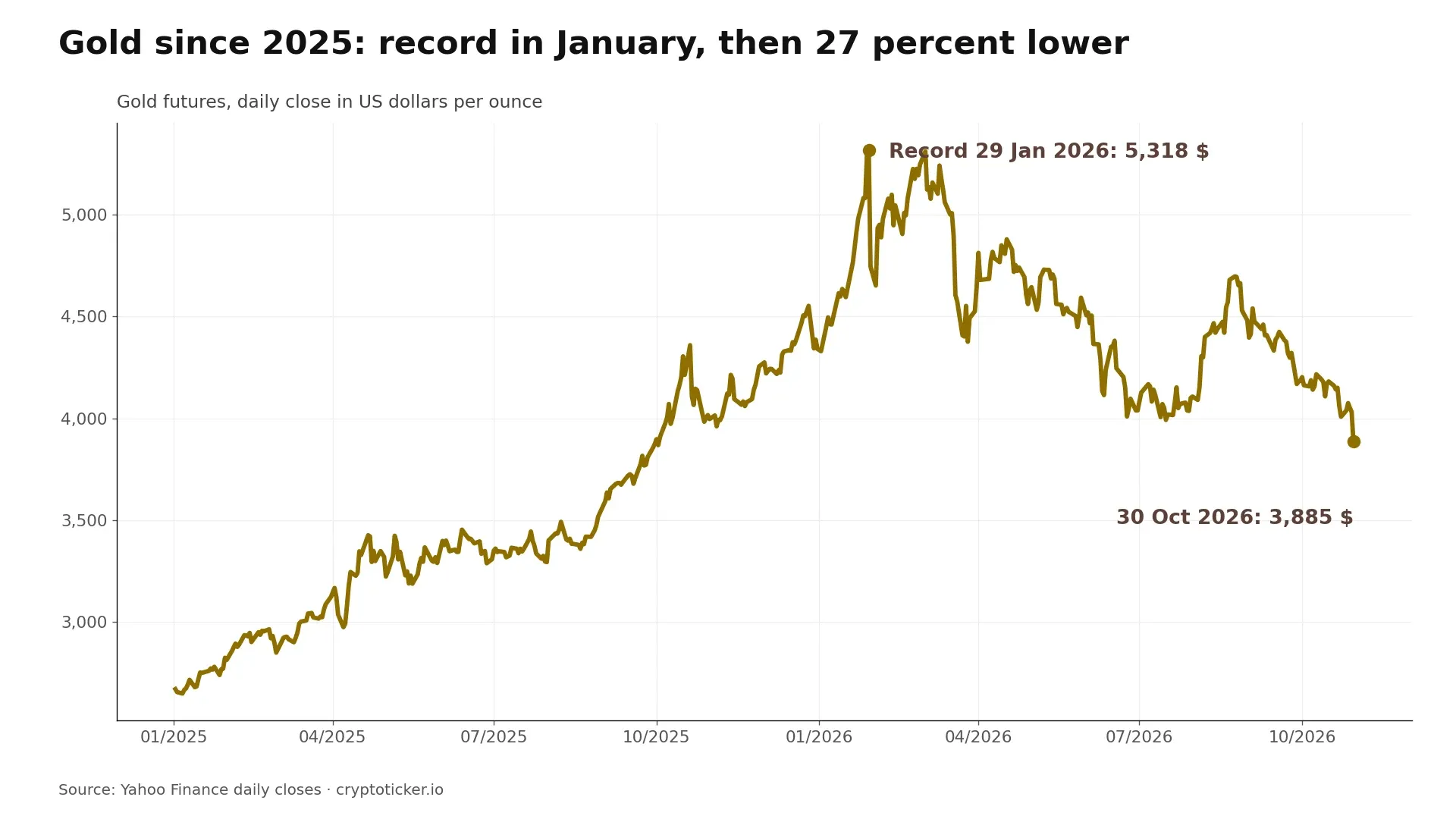
Source: Yahoo Finance, gold futures daily closes, as of 30 October 2026
Is gold a safe haven? What six crises show
Gold is a safe haven over years, but rarely in the first weeks of a crash. That is the result of our comparison of gold futures, the S&P 500 and Bitcoin in six crisis windows, each measured from the market peak to the low or over the acute phase.
Crisis
Window
Gold
S&P 500
Bitcoin
Financial crisis
9 Oct 2007 to 9 Mar 2009
+24.5 %
−56.8 %
not traded yet
Lehman phase
12 Sep to 20 Nov 2008
−1.5 %
−39.9 %
not traded yet
Covid crash
19 Feb to 23 Mar 2020
−2.5 %
−33.9 %
−33.4 %
Rate shock
3 Jan to 12 Oct 2022
−6.8 %
−25.4 %
−58.8 %
Tariff shock
2 to 8 Apr 2025
−5.6 %
−12.1 %
−7.5 %
October 2026
30 Sep to 30 Oct 2026
−7.2 %
−0.9 %
−7.6 %
Three patterns stand out:
- Gold loses less, but it often loses. In all five shorter windows gold fell, and in four of them far less than the S&P 500. In 2008 and 2020 it was a cushion, not a winner.
- The first wave hits gold too. In March 2020 gold fell 11.7 percent between 9 and 19 March, from $1,674 to $1,479, because investors needed cash. In 2008 gold lost 27 percent between March and October, from about $1,001 to $729. Today's 27 percent drop from the record is therefore not without precedent.
- The rebound comes with rate cuts. After both crashes, central banks cut rates to zero and printed money. Gold then set new records: $2,069 in August 2020, and a gain of 24.5 percent over the full financial crisis. In 2022, when the Fed hiked aggressively, gold lost, and this is the situation markets are now pricing again.
October 2026 is a special case: gold and Bitcoin fell further than the S&P 500. Both suffer from the same factor, expected rate hikes, while the broad stock index was still close to its record at the start of the month.
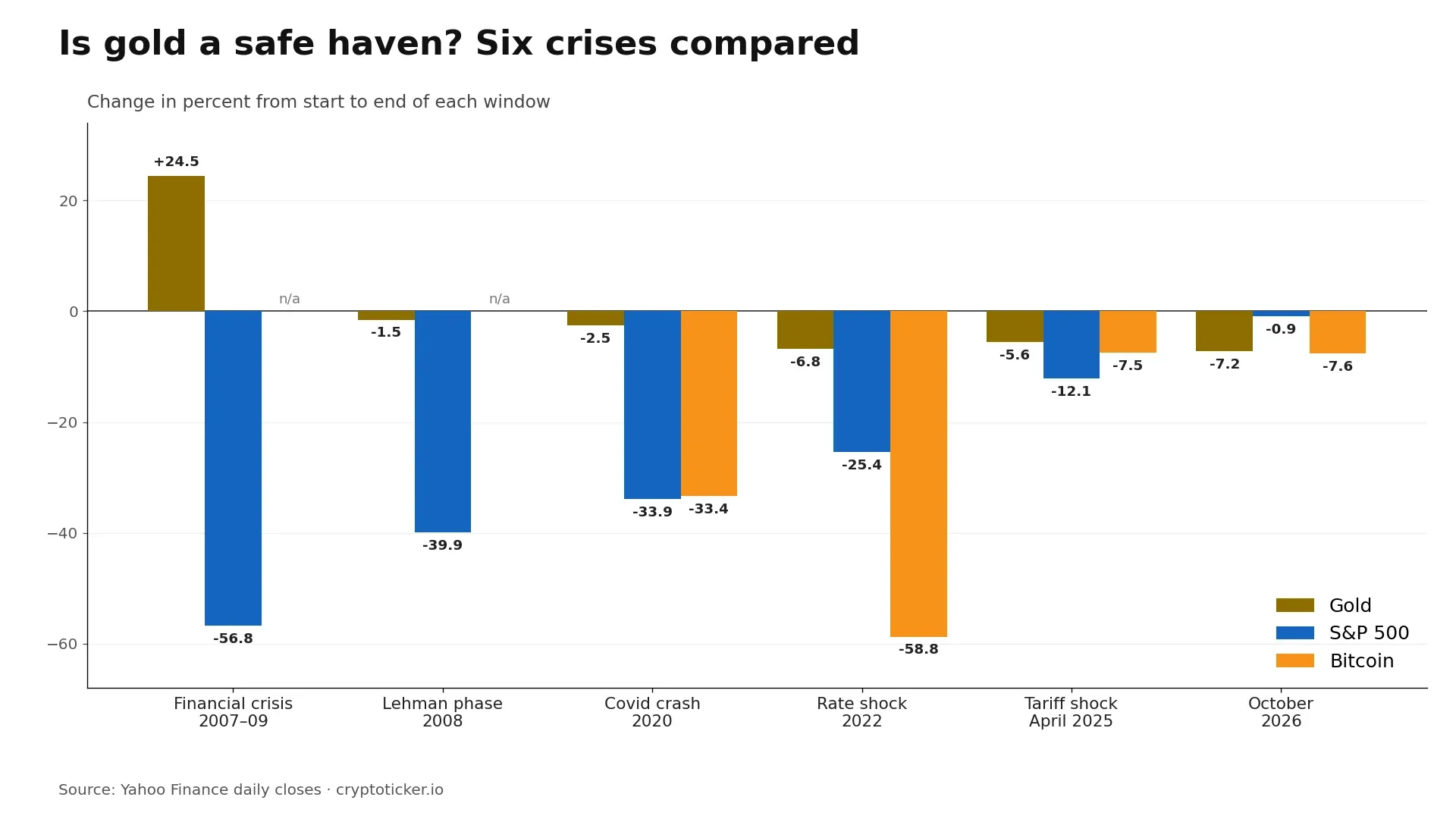
Source: Yahoo Finance daily closes, as of 30 October 2026
Gold vs Bitcoin in 2026: neither was a safe haven
Since the start of the year gold has lost 10.5 percent and Bitcoin 11.8 percent, while the S&P 500 is still up 10.7 percent, measured from the closes on 31 December 2025 to 30 October 2026. The two assets that are sold as protection against inflation and money printing are both under water in a year of rising rate expectations. For Bitcoin, the Binance hack on 29 October came on top; we explain the case in North Korea behind the Binance hack.
Our view: gold and Bitcoin are bets on falling real rates and on doubts about paper money. As long as the Fed is expected to hike, both lack their most important tailwind. That says nothing about the long term, as 2008 shows, but it explains why neither helped in October. A longer comparison of both assets is in our analysis Bitcoin vs gold.
What would make gold a safe haven again
History points to three signals that preceded the big gold rallies after crises:
- The Fed stops hiking. The next data points are the US jobs report on 6 November and the Fed meeting on 9 December.
- The economy weakens noticeably. September brought only 29,000 new jobs; a weaker October would shift expectations from hikes to cuts.
- The oil price calms down. As long as the Strait of Hormuz drives inflation fears, gold reacts to rates rather than to fear.
None of these signals is visible yet. The midterm elections on 3 November add uncertainty, but historically elections have moved gold less than interest rates.
How investors can hold gold
There are four common ways: physical bars and coins, exchange-traded products backed by gold, gold futures for professionals, and tokenised gold such as PAX Gold (PAXG) or Tether Gold (XAUT), which trade on crypto exchanges around the clock. Tokenised gold combines the price of gold with the trading hours of crypto, but it depends on the issuer that holds the bars. Anyone who wants to buy gold or Bitcoin through an exchange should compare costs and regulation first; our crypto exchange comparison lists the providers. This article is not investment advice; gold, like Bitcoin, can fall sharply.