Toncoin changes hands at 1.3260 USD, roughly 62.5 percent below the twelve-month high of 3.5328 USD reached on 14 August 2025. A discount of that size is what keeps the question alive: is Ton
Toncoin changes hands at 1.3260 USD, roughly 62.5 percent below the twelve-month high of 3.5328 USD reached on 14 August 2025. A discount of that size is what keeps the question alive: is Toncoin a good buy at current prices, or has the market marked the asset down for reasons that have not gone away?
One point needs clearing up first. The listing formerly known as Toncoin now trades as Gram, ticker GRAM, and the project's own site at ton.org uses the new name throughout. It is the same listing under a new label rather than a fork or a token swap. We keep the familiar name here because that is what readers search for.
cryptoticker.io collected the price data for this analysis on 14 August 2026. Market data comes from CoinMarketCap, and every indicator quoted here was calculated in house from 365 daily closing prices using standard formulas: exponential moving averages for the trend, Wilder's method for the relative strength index.
Toncoin price analysis: where the TON price stands and which levels matter
At 1.3260 USD the Toncoin price sits below both reference lines that medium-term investors watch. The 50-day exponential moving average stands at 1.4925 USD, which puts the current price 11.2 percent underneath it. The 200-day exponential moving average, the slower of the two, sits at 1.6695 USD, a further step up and 20.6 percent above the current quote. In chart terms, Toncoin is trading in the lower third of its own annual range.
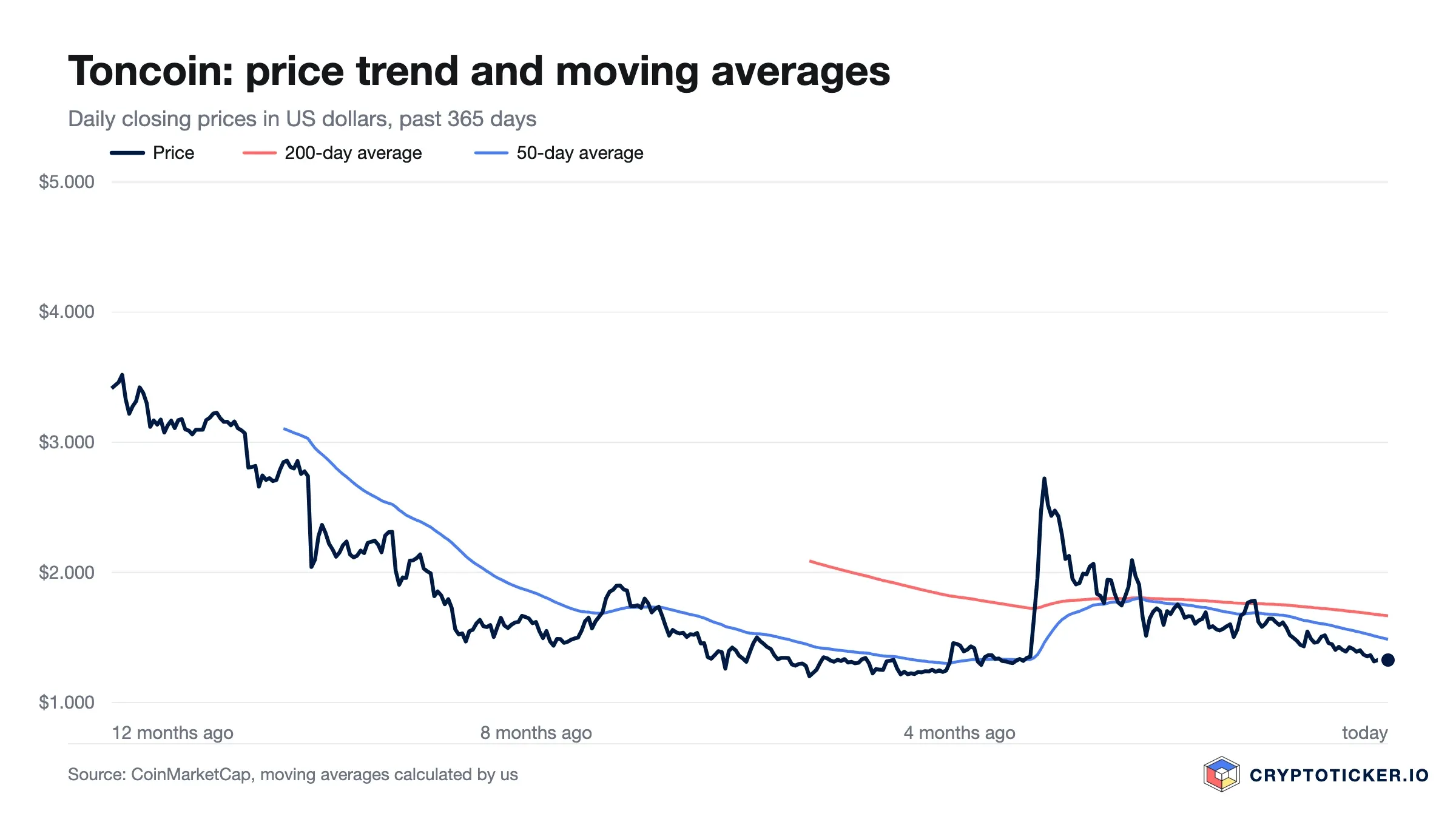
Toncoin price and moving averages, calculated by us from CoinMarketCap daily closing prices
The floor of that range is well defined. The twelve-month low of 1.2022 USD dates from 2 March 2026, and the current price is only 10.3 percent above it, a narrow cushion. The ceiling is far away: the 3.5328 USD high from August 2025 would require the price to more than double.
Three levels therefore frame any decision at current prices. The March low near 1.20 USD is the zone buyers defended once before. The 50-day line at 1.4925 USD is the first hurdle a recovery would need to clear. The 200-day line at 1.6695 USD separates a bounce from a trend change.
Is the Toncoin downtrend broken or only interrupted?
The data says interrupted rather than broken. Over 30 days Toncoin is down 16.7 percent, over 90 days down 30.6 percent, and over twelve months down 62.5 percent. Each window points the same way, and the sequence of lower highs behind them has not been reversed.
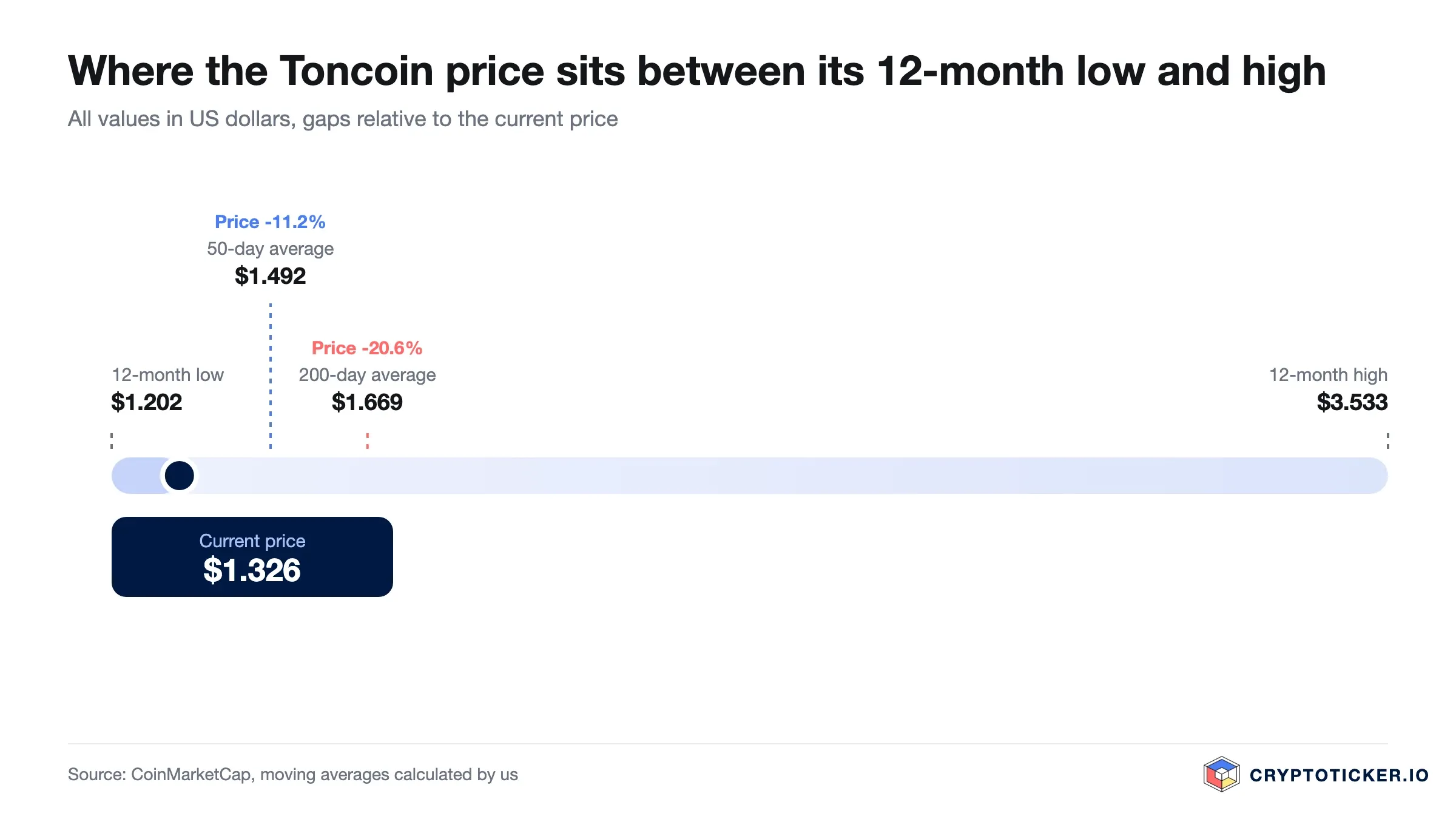
The Toncoin price relative to its 12-month low, high and both moving averages
What has changed is the pace. The gap between the current price at 1.3260 USD and the March low at 1.2022 USD has held for months, which means sellers have not forced a new low despite a weak tape. A base of that kind is a precondition for a trend change without being one in itself.
For the downtrend to count as broken, the price would need to reclaim the 200-day line at 1.6695 USD and hold above it rather than tag it and fall back. Until then, the defensible description is a downtrend in a pause, and anyone buying at current prices is assuming that pause resolves upward.
What RSI and moving averages mean for a Toncoin entry
The relative strength index over 14 days reads 38.3, below the neutral midpoint of 50 and above the 30 mark conventionally treated as oversold. The practical meaning is unspectacular: selling pressure has eased, but no washout has occurred of the kind that often precedes sharp rebounds.
The two moving averages add the structural picture. With the price at 1.3260 USD below the 50-day line at 1.4925 USD, and that line below the 200-day line at 1.6695 USD, the alignment is the one technicians call bearish: the recent average price sits under the longer one, which is what a sustained decline looks like from the inside.
For an entry decision, the combination offers no timing signal at all. It rules out the argument that Toncoin is technically oversold and due a bounce, and equally the argument that the asset is overheated. Investors who need a technical trigger will not find one at 1.3260 USD, which is a reason to think about position sizing rather than entry precision.
What Toncoin trading volume reveals about demand
Volume deserves the most attention here. Toncoin turned over 35.6 million USD in the last 24 hours. The 30-day average sits at 49.5 million USD, the 90-day average at 145.6 million USD, and the full-year average at 161.6 million USD. Activity is running at roughly a fifth of the annual norm.
Thin volume has two consequences for a buyer. Price moves in either direction require less capital, so rallies and declines can both be sharper than the market capitalisation of 3.66 billion USD would suggest. And the drop in turnover indicates departed attention rather than accumulating demand.
Market capitalisation places Toncoin at rank 22 among crypto assets, a large-cap position by any measure. The gap between that rank and current activity is the tension in this asset: a top-25 valuation supported by turnover at a quarter of its own yearly average. The broader market offers little support either, with the Fear and Greed Index at 36, in fear territory.
Structural factors that speak for Toncoin: supply, usage and regulation
Supply mechanics come first. Roughly 2.758 billion coins circulate out of a total supply of about 5.231 billion, with no hard maximum in the sense that Bitcoin has one. Inflation is bounded by protocol rules rather than a fixed cap, so the circulating share can keep rising. A buyer at 1.3260 USD is buying a claim on a supply base that is not fixed, and that belongs in any valuation.
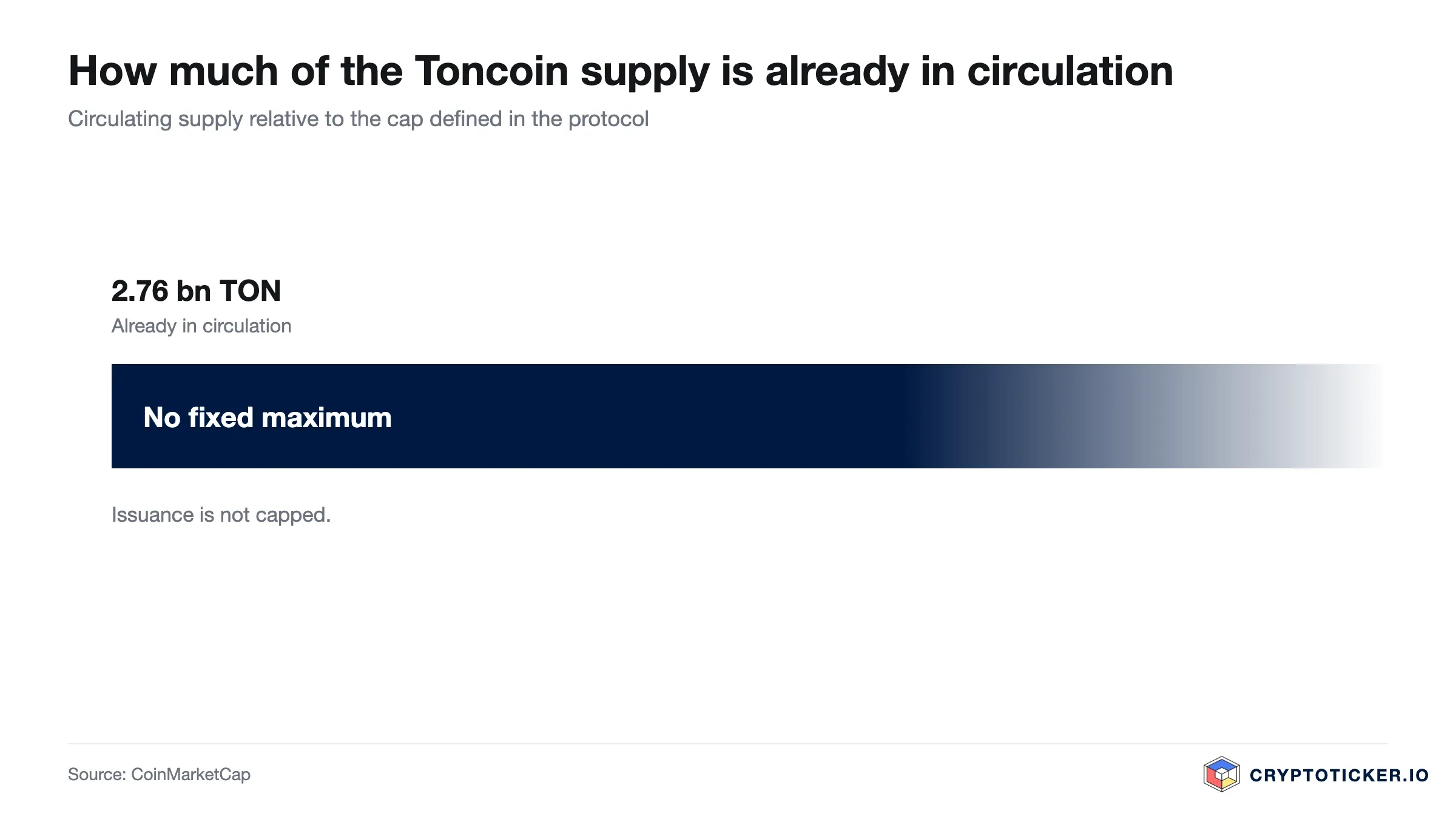
Toncoin supply structure according to CoinMarketCap data
Usage is the more distinctive argument. The network's design and its documentation at docs.ton.org centre on cheap, high-throughput transfers aimed at consumer payments inside a messenger environment rather than on complex financial contracts. That distribution channel is the asset's genuine differentiator among large-cap chains, and it is why the listing survived a 62.5 percent drawdown without losing its top-25 rank.
Regulation is the third factor, and the picture is neutral to mildly favourable. Under the European framework supervised by ESMA, crypto assets face harmonised disclosure and custody requirements across the bloc, which has made large-cap tokens easier for regulated venues to list and keep listed. That lifts no single price, but it lowers the risk that a top-25 coin becomes inaccessible on European platforms.
Against those points, the rename to Gram carries a practical cost that is easy to underestimate: ticker changes fragment search traffic, complicate portfolio tracking and occasionally delay listings on smaller venues. We regard this as transitional friction rather than a structural flaw, and flag it as interpretation rather than measurement.
What speaks for buying Toncoin at current prices
Three arguments carry weight at 1.3260 USD.
The entry sits near a tested floor. At 10.3 percent above the twelve-month low of 1.2022 USD, a buyer here has a reference level close enough to define risk precisely. That is a materially different proposition from buying in the middle of a range, where the nearest meaningful support may be 30 percent away.
The valuation has already absorbed a severe repricing. A decline of 62.5 percent over twelve months has removed most of the optimism priced in at 3.5328 USD. Whatever expectations remain at 1.3260 USD are modest, and assets that have completed their repricing need less good news to move.
The distribution advantage is intact. The messenger-linked reach that made the network interesting remains in place, and a rank-22 market capitalisation of 3.66 billion USD indicates that large holders have not abandoned the listing. Where analysts expect the price to go from here is set out in our Toncoin price prediction.
What speaks against buying Toncoin at current prices
Three counterarguments deserve equal weight.
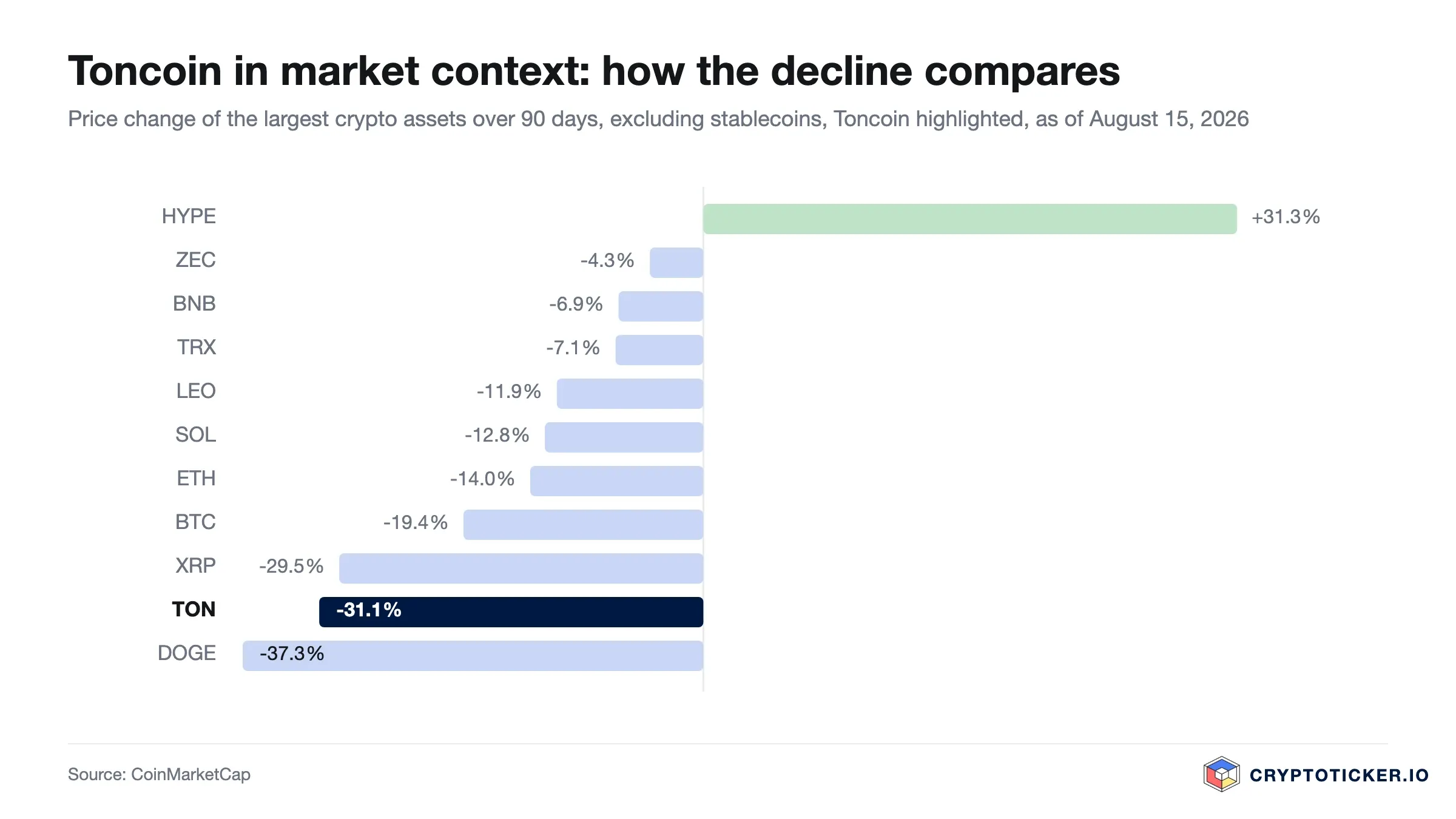
Toncoin compared with the other large crypto assets over 90 days
The trend is still against the buyer. With the price at 1.3260 USD below the 50-day line at 1.4925 USD and the 200-day line at 1.6695 USD, every moving-average signal points down. Buying here means positioning against the prevailing trend and accepting that the asset may spend further months below both lines.
Liquidity has thinned to a worrying degree. Turnover of 35.6 million USD against an annual average of 161.6 million USD means larger orders move the price more, spreads widen when volatility arrives, and exits in a falling market cost more than the screen suggests. This is the most concrete risk in the current setup.
The supply side keeps expanding. With about 2.758 billion of a roughly 5.231 billion total supply in circulation and no fixed cap, new coins keep reaching the market. Where demand has fallen to a fifth of its yearly norm, that puts a structural weight on the price which technical support levels cannot offset.
How to buy Toncoin at current prices: costs, custody and providers
The cost of buying matters more than usual when an asset is this illiquid. Spreads on thinly traded pairs can exceed the visible trading fee by a wide margin, so the headline commission is only part of the bill. Our crypto exchange comparison sets out the fee models side by side.
For European investors, regulatory status is the second filter. Supervised platforms offer clearer complaint routes and stricter custody rules, the relevant distinction once positions grow beyond pocket money. The candidates are collected in our overview of the best regulated crypto exchanges, and among individual venues we have examined Bitpanda in detail and Kraken's fee structure and features separately.
Custody is the third decision and independent of the first two. Coins left on an exchange remain in someone else's control, which is convenient for trading and unhelpful for holding. Investors planning to hold across a full cycle generally move to self-custody, and the trade-offs between the leading devices are laid out in our hardware wallet comparison. Toncoin support varies by device, so check before buying rather than after.
So is Toncoin a good buy at current prices?
The data supports different answers over different horizons, and separating them is the only honest way to close.
Short term, the setup offers no edge. An RSI of 38.3 is neutral, both moving averages sit above the price, and volume at 35.6 million USD gives any move a fragile foundation. The risk of another test of the 1.2022 USD low is real, and if that level gives way on rising volume, the assumption that a base has formed is refuted.
Long term, the case rests on one question: does the messenger-linked distribution advantage translate into sustained usage, or does it remain a promise? If usage grows and turnover recovers toward the 161.6 million USD annual average, the current price will look like the discount phase of a cycle. If turnover keeps falling while supply expands, a rank-22 market capitalisation of 3.66 billion USD becomes hard to defend, and the drawdown from 3.5328 USD reads as a repricing rather than an overreaction.
The condition that would refute the constructive scenario is specific enough to monitor: a sustained close below 1.2022 USD, or a further decline in volume from an already depressed 35.6 million USD. The condition that would confirm it is equally specific: a reclaim of the 200-day line at 1.6695 USD with turnover moving back toward its annual norm. Neither has happened, which is why the answer at 1.3260 USD is a matter of position sizing rather than conviction.
Buying Toncoin: what to take away
- The price sits low in its own range, and the range is what defines the risk. At 1.3260 USD, Toncoin trades 10.3 percent above the twelve-month low of 1.2022 USD and 62.5 percent below the 3.5328 USD high, with both moving averages overhead. Where analysts see the price heading from this zone is covered in our Toncoin price prediction.
- Thin volume is the risk that costs money in practice. Turnover of 35.6 million USD against a 161.6 million USD annual average widens spreads and makes exits expensive, which makes the choice of venue a financial decision rather than an administrative one. The fee models are compared in our crypto exchange comparison.
- Custody is a separate decision from the purchase. Anyone planning to hold beyond a trade should settle the storage question before buying rather than afterwards, and the options are set out in our hardware wallet comparison.
Disclosure: Some of the providers mentioned in this article work with us through partner programmes. This has no influence on the price analysis or on our assessment of the chart situation; the price data comes from a public market data source and can be verified there.
(As of 14 August 2026. This article is not investment advice. Prices, fees and terms change; check them with the provider before every purchase. Crypto assets are subject to high price volatility, and a total loss is possible.)