The chief executive of JPYC, the issuer of the Japanese yen stablecoin, Noritaka Okabe, forecasted an explosion in demand for the company’s flagship product as more people seek alternatives t
The chief executive of JPYC, the issuer of the Japanese yen stablecoin, Noritaka Okabe, forecasted an explosion in demand for the company’s flagship product as more people seek alternatives to the growing issue of banks going dark in the country.
Okabe took to X today to promote his company’s yen stablecoin after service outages caused by GMO Aozora Net Bank having to take its bank API offline on two separate occasions within 12 hours.
Notably, the bank API disruption’s ripple effect reached JPYC’s own yen stablecoin, causing a temporary freeze on redemption rails and crypto exchanges including Binance Japan.
Okabe: More bank disruptions, more JPYC demand
JPYC CEO Norikata Okabe directly responded to the service outages that affected GMO Aozora Net Bank to make the case for the yen stablecoin his company issues on Wednesday.
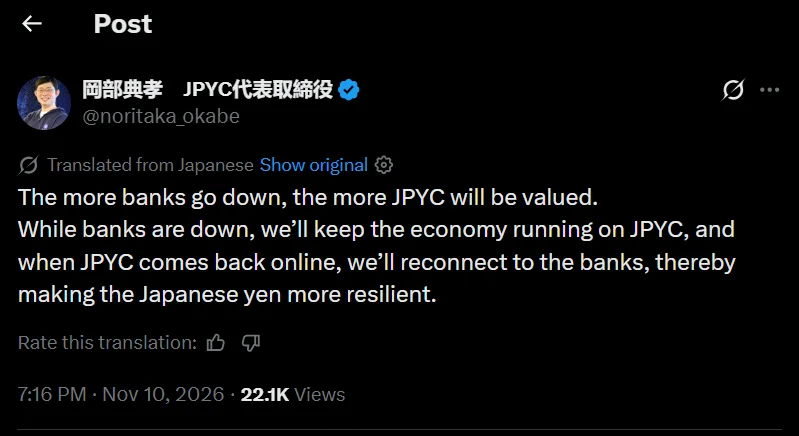
JPYC CEO Okabe’s translated X post. Source: Okabe via X/Twitter
According to the executive, JPYC is best positioned to keep the economy running, becoming the biggest winner as it helps to shore up the overall resilience of the Japanese yen.
Okabe conceded that while bank freeze periods can affect stablecoin issuance and redemption, they do not reach public blockchains, which continue to run without interruption while traditional payment rails are suspended.
Wednesday’s posts were not the first time the JPYC CEO has aimed at traditional institutions. Okabe wrote in late October that “Existing finance doesn’t have long” after reports emerged about unauthorized access at financial institutions. “The lifespan of fiat currency is also uncertain,” Okabe added.
Japanese bank goes offline
Japan’s GMO Aozora Net Bank announced late on Tuesday around 8:42 PM local time (11:42 UTC) that it suspended its bank API after it detected unauthorized external communication against its API infrastructure.
The bank pulled the API again at 1:02 AM (16:02 UTC Tuesday) on Wednesday after briefly restoring service at 10:30 PM (13:30 UTC). It blamed the second outage on more suspicious traffic. The API was back up at 6:25 AM (21:25 UTC Tuesday) and the bank marked the issue as resolved by 6:30 AM (21:30 UTC Tuesday).
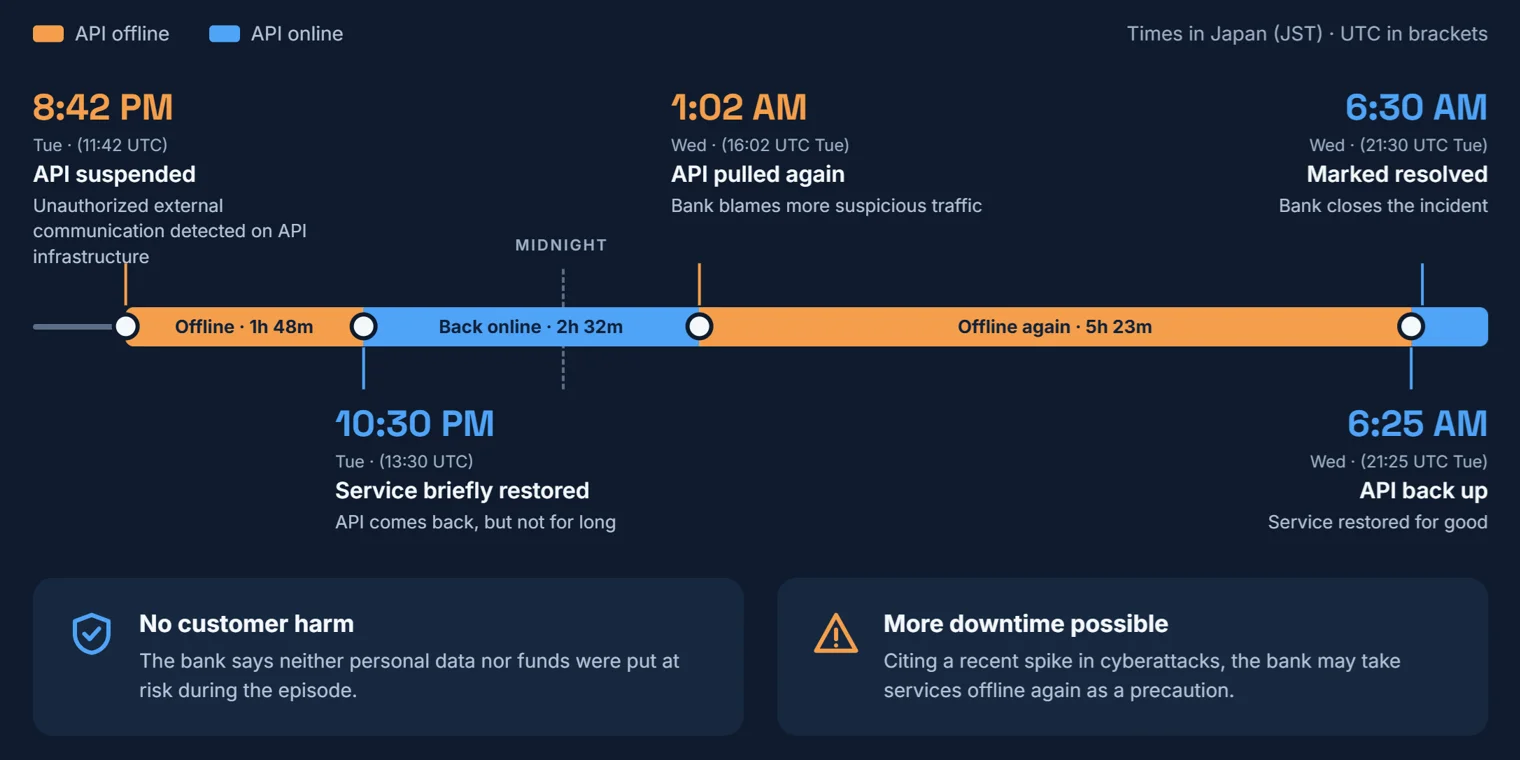
GMO Aozora Net Bank shuts its API twice after suspicious traffic. Source: GMO Aozora Net Bank
GMO Aozora Net Bank warned that due to the recent spike in cyberattacks, it may take services offline again as a precaution, although it clarified that neither personal data nor funds were threatened during the episode.
Bank APIs let outside services check balances, pull transaction records and push transfers through code. When they go down, services connected to them also stop working. However, the bank’s own deposit accounts and internet banking are typically not affected.
JPYC redemption, Binance Japan and other bank partners were affected
GMO Aozora’s partners were affected during the API halts. One of them was JPYC EX, the platform where JPYC is issued and redeemed for yen. Binance Japan also suspended yen deposits and withdrawals routed through the bank. BitTrade and accounting software firm freee also reported stoppages linked to the bank.
JPYC is Japan’s first regulated yen stablecoin, redeemable 1:1 for yen and backed by yen deposits and government bonds, running on Ethereum, Avalanche, Polygon and Kaia. By its first anniversary on October 27, cumulative issuance had passed ¥10 billion, but Okabe told NADA NEWS circulation sat well below internal targets. “Frankly, I don’t think it’s growing,” he was quoted as saying.
Okabe has pinned year-two growth on partnerships, including a logistics deal with AZ-COM Maruwa to pay 2,300 carriers and an October 20 memorandum with SBJ Bank and LINE NEXT to link bank accounts to JPYC wallets.
The GMO Aozora halts are separate from the October breach at GMO Internet’s Onamae.com Desktop Cloud. The bank says it is a different company with independent systems, and no link between the incidents has been published.
If you're reading this, you’re already ahead. Stay there with our newsletter.