



Liquid Raises $18M to Build a Unified Global Trading Super-App
 AI
AI
 NEO
NEO
 X
X
 CVG
CVG
 LBTC
LBTC
GLOBAL Retail trading is undergoing a structural shift. What began as a fragmented ecosystem, with separate apps for stocks, crypto, commodities, and derivatives, is rapidly converging into unified platforms. Liquid is betting on a subset of high-frequency traders who gamble across both crypto and equities.
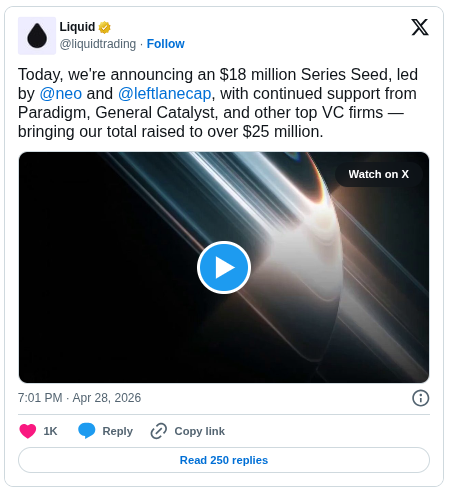
The company has raised $18 million in a new funding round led by Neo and Left Lane Capital, with continued participation from Paradigm and General Catalyst. The round brings Liquid’s total funding to over $25 million and the funding allows Liquid to compete in a crowded market of multi-asset aggregators.
The Deal and Early Traction
Founded in 2025 by Franklyn Wang, a former quantitative researcher at Two Sigma, Liquid started as an aggregator for crypto perpetual futures, a highly active segment of derivatives trading.
The company says it has reached more than 35,000 users across 120 countries and processed over $3 billion in trading volume, but has not disclosed active usage or retention metrics. The platform has expanded beyond crypto to include additional asset classes, many of which are offered as synthetic exposure rather than direct ownershi, adding support for equities, foreign exchange, commodities, prediction markets, and pre-IPO secondary assets.
The move toward multiple asset classes reflects an emerging trend among some platforms, though adoption remains uneven, as platforms try to attract users with broader trading options. However, expanding across markets can also bring added complexity, especially in areas like regulation and liquidity.
Beyond infrastructure, the new funding is also being deployed toward Liquid’s AI layer, internally referred to as Liquid AI or LiMo. Unlike basic trading assistants, the company says the system can assist with risk management and suggest hedging strategies, although its real-world effectiveness has not been independently verified.
The Strategy: A “Universal Exchange” for Retail Traders
Liquid’s core proposition is simple but ambitious. The company aims to offer a single interface for multiple asset classes, though availability varies by jurisdiction and asset structure.
This model reflects changing trader psychology. According to Marc Bhargava, some active retail traders are experimenting with cross-asset strategies, though most participation remains concentrated in a few major markets..
Instead of identifying as crypto traders or equity investors, users are moving fluidly between markets, chasing volatility, arbitrage, and short-term edge.
Platforms like Polymarket and Hyperliquid have already demonstrated this shift by blending non-traditional markets with crypto-native infrastructure. Liquid extends that idea further by integrating everything into one product experience.
Product Design as a Competitive Advantage
Unlike Coinbase and Robinhood, which expanded from single-asset offerings, Liquid is being built as a multi-asset platform from the outset
A key technical nuance is that Liquid operates primarily as a non-custodial aggregator rather than a fully centralized exchange. Instead of acting as the direct counterparty or market maker for all trades, the platform routes orders to external venues such as Hyperliquid, Lighter, and Ostium. This routing-based model may improve capital efficiency, but it also introduces reliance on third-party venues for execution and liquidity.
Additionally, many non-crypto assets offered on the platform, including pre-IPO equities, are structured as synthetic derivatives priced via oracles. Users are not purchasing underlying shares in companies but are instead trading price exposure, a distinction that carries implications for risk, regulation, and investor expectations.
This distinction has technical and strategic implications:
- Unified Margin Systems: Capital can potentially be deployed across asset classes
- 24/7 Market Access: Eliminates dependency on traditional trading hours
- Mobile-First Interface: Designed for high-frequency, on-the-go decision-making
- Leverage Integration: Up to 200x leverage in select jurisdictions
These design choices appear targeted at high-frequency retail traders, though broader adoption remains uncertain. That segment includes high-engagement retail traders who prioritize speed, flexibility, and cross-market access.
Industry Context: Convergence Is Accelerating
Liquid’s raise comes amid a broader industry trend and reflects the latest crypto VC funding trends. Crypto infrastructure is expanding into traditional finance, while traditional platforms are moving toward digital assets.
- Crypto exchanges are adding equities and commodities
- Brokerage apps are experimenting with tokenized assets
- Prediction markets are gaining traction as alternative trading venues
This convergence is driven by two forces. One is technological capability, including blockchain rails, APIs, and synthetic assets. The other is user demand for seamless experiences.
This could point toward a new category of platforms, although it is still too early to determine whether it will sustain long-term adoption.
Risks: Regulation, Leverage, and Liquidity
Despite its early momentum, Liquid faces substantial execution risks.
Regulatory Complexity: Operating across 120+ countries introduces compliance challenges, especially when offering leveraged products, prediction markets, and private securities. Notably, participation from firms like Haun Ventures and K5 Global suggests that Liquid is actively preparing for regulatory engagement, given their track record in navigating complex legal environments in crypto markets.
Leverage Risk: High leverage, up to 200x, can amplify gains but also losses. This raises concerns among regulators and may limit expansion in stricter jurisdictions.
Liquidity Constraints: A multi-asset exchange must maintain deep liquidity across all markets. Without sufficient depth, spreads widen and execution quality suffers, particularly for leveraged trades.
Another emerging consideration is user behavior. A portion of current trading activity may be driven by incentive programs, such as points-based reward systems that often precede token launches in crypto platforms. While effective for early growth, these mechanisms can distort perceived product-market fit until organic usage stabilizes.
What to Watch
Market participants and investors should monitor several key indicators:
- User Growth: Expansion beyond early adopters into mainstream retail
- Product Depth: Integration of additional asset classes and tools
- AI Effectiveness: Adoption and real-world impact of Liquid AI on trading outcomes
- Regulatory Positioning: Ability to maintain compliance across regions
- Liquidity Scaling: Partnerships or mechanisms to deepen market depth
- Next Funding Round: Timeline and valuation for a potential Series B
FAQs
- What does Liquid do?
Liquid is a multi-asset trading platform that allows users to trade stocks, cryptocurrencies, commodities, foreign exchange, prediction markets, and pre-IPO shares within a single mobile-first interface, with 24/7 access and leveraged trading features. - Who invested in Liquid?
The company’s $18 million round was led by Neo and Left Lane Capital, with participation from Paradigm, General Catalyst, Haun Ventures, K5 Global, SV Angel, Anti Fund, and Sunflower Capital. - Is the multi-asset trading platform sector growing?
Yes. The sector is expanding rapidly as traders demand unified access to diverse markets. However, it remains high risk due to regulatory uncertainty, leverage-related concerns, and intense competition among platforms.
