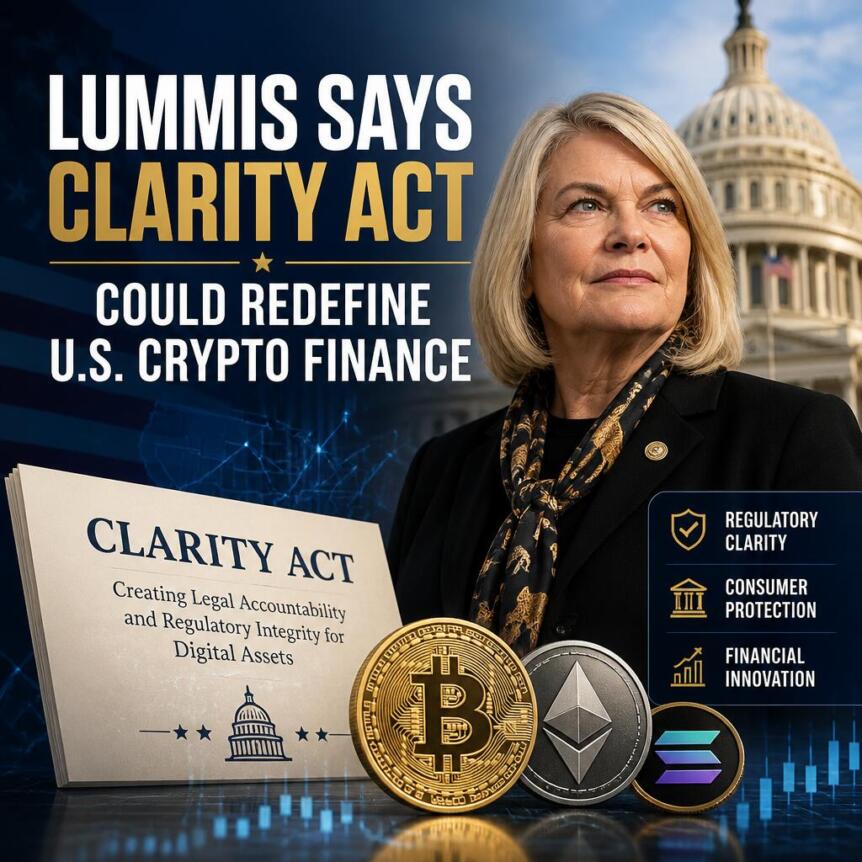
Senator Cynthia Lummis has renewed her push for Congress to advance the CLARITY Act, arguing that the bill could form the foundation for the next era of U.S. financial services. Lummis said t
Senator Cynthia Lummis has renewed her push for Congress to advance the CLARITY Act, arguing that the bill could form the foundation for the next era of U.S. financial services.
Lummis said the legislation would “lay the foundation for the financial services of the 21st century,” according to a post shared by CryptoGoos. She added, “The CLARITY Act is this generation’s contribution to that legacy. Let’s finish the job.”
Source: https://x.com/cryptogoos/status/2073787988807409697?s=20
Her comments come as lawmakers face a limited window to move the bill forward before the August recess. The legislation has become one of the most closely watched crypto policy efforts in Washington because it seeks to define how digital assets should be regulated and which agencies should oversee them.
Senate Timing Remains The Main Hurdle
The CLARITY Act has already passed the House and cleared the Senate Banking Committee. However, it still needs a full Senate floor vote before it can move closer to becoming law.
That timing is now critical. If the Senate fails to act before the August recess, the bill’s path could be pushed into 2027. This makes July an important month for U.S. digital asset policy, especially as crypto firms, banks, and investors wait for clearer federal rules.
Lummis has also opened a final review window for updated bill text. Reports indicate that a revised version was expected around July 4, giving lawmakers and industry groups another opportunity to review possible changes before a Senate floor push.
However, several issues remain under debate. These include stablecoin yield products, ethics rules, and decentralized finance oversight. Those questions matter because Senate leaders need enough support to move the bill through a divided chamber.
SEC And CFTC Roles Would Be Redefined
The CLARITY Act aims to reduce the long-running regulatory conflict between the Securities and Exchange Commission and the Commodity Futures Trading Commission.
Under the proposal, the SEC would continue overseeing investment contract assets, while the CFTC would take a larger role in digital commodity spot markets. This would include greater authority over certain crypto exchange activities.
The bill would also define when a token should be treated as a security and when it should be treated as a commodity. Supporters argue that this could replace enforcement-led regulation with a clearer written framework.
Trading platforms, brokers, and crypto exchanges would also face new requirements, including rules requiring firms to separate customer assets from company funds. That measure is designed to reduce risks similar to those seen in past exchange failures.
Still, critics argue that the bill may not go far enough in protecting users or addressing the complexity of decentralized finance.
Fraud Funding Adds Enforcement Focus
The CLARITY Act also includes funding for enforcement. A separate report said the bill would allocate $150 million for crypto fraud investigations.
Lummis said the funding would help agencies “track down scammers and bad actors in the digital asset space.” That provision could help win support from lawmakers who want stronger consumer protection alongside market structure reform.
The bill would also bring some digital asset firms under Bank Secrecy Act obligations. This could increase reporting and compliance standards for platforms handling customer assets and transactions.
For now, the CLARITY Act remains close to a major Senate test but has not yet become law. Lummis is pressing lawmakers to move forward as the crypto industry waits for final text, a floor vote, and a clearer view of how U.S. digital asset markets may be regulated.
This article was originally published as Lummis Says Clarity Act Could Redefine U.S. Crypto Finance on Crypto Breaking News – your trusted source for crypto news, Bitcoin news, and blockchain updates.