On Nov. 15 at 17:25 UTC, Luxor Technology published a statement on X describing an unauthorized redirect of bitcoin hashrate through Commander, the fleet-management software it sells to minin

On Nov. 15 at 17:25 UTC, Luxor Technology published a statement on X describing an unauthorized redirect of bitcoin hashrate through Commander, the fleet-management software it sells to mining operators. The company said the problem was patched within two hours, that it touched “just over a dozen client accounts,” and that every affected client would be paid in full. The address the diverted machines were pointed at has since been paid twice, and the amounts are small enough to raise a question Luxor has not answered: how much of the 13 EH/s was ever credited to it.
CoreX Hosting, a hosting operator that flagged the redirect while it was happening, put the diverted total at about 13 EH/s on a single Bitcoin address. At the 934 EH/s network hashrate that mempool.space recorded on Nov. 16, that is 1.39% of all bitcoin mining capacity, or roughly a third of the 40.35 EH/s that the OCEAN pool dashboard reported the same morning. Luxor’s own statement is the primary account of the incident and does not repeat the hashrate figure or the machine count.
The incident matters less for what the attacker earned than for what the episode exposes about an industry that has spent three years converting itself into financed, audited infrastructure. Mining fleets are now managed through software dashboards, sold under service contracts, and underpinned by hashrate that carries a dollar value per hour. Whoever controls the dashboard controls the revenue stream, and the revenue stream moves in the coinbase transaction, not in a bank account that can be frozen.
What Luxor Confirmed, and What It Left Out
The statement is unusually direct about mechanics and unusually quiet about quantities. Luxor confirmed the vector, the detection path, the duration of the patch, and the compensation principle. It gave one number, “just over a dozen client accounts,” and no figure for machines, hashrate, lost hours, or money.
Two phrases deserve attention. “No data was leaked or exfiltrated from our systems” is a statement about data, not about access; a configuration change pushed through a management platform does not require exfiltration to have an effect. And “within 2 hours Commander was patched and we started restoring affected machines” describes two separate clocks. The patch is a vendor-side action. The restoration is an operator-side one.
CoreX’s own timeline shows the second clock running slower. At 03:57 UTC on Nov. 15, roughly two hours after the redirect began, the host wrote that “the attack is on-going, the hacker pool address is still sitting at 13EH,” and added: “I am changing miners back as I can.” A patched control plane and a restored fleet are not the same event, and Luxor’s “no action is needed from users” reads differently against an operator manually reversing settings one machine group at a time.
Two Coinbase Payouts, 0.162 BTC, Never Spent
CoreX published the address in its first alert: bc1qphukp9rjfc4rcej7erpm9ae20xmtspw8pcddrr. The chain record for that address contains exactly two transactions, and both are coinbase outputs, the direct block-reward payments that define a non-custodial pool.
The first arrived in block 975,995 at 17:22:50 UTC on Nov. 15 and paid 0.08088977 BTC. The second arrived in block 976,029 at 22:54:00 UTC and paid 0.08113106 BTC. Neither output has been spent. The address balance is 0.16202083 BTC, worth about $10,512 at the $64,883 bitcoin price CoinGecko recorded on Nov. 16.
Block 976,029 is the most recent block listed on OCEAN’s own dashboard, and both coinbases carry 19 and 20 outputs respectively, the shape of a pooled payout split across many miners. That ties the payments to OCEAN’s blocks rather than to some unrelated transfer. The timing is the part that deserves scrutiny: the second payment landed five and a half hours after Luxor said the patch was in and restoration had started.
The 2.6% Slice Is the Number That Matters
Both payments are almost identical in size, which is itself informative. The first equals 2.583% of its block’s 3.1319 BTC of outputs; the second equals 2.589% of 3.1336 BTC. OCEAN distributes each block’s reward to the miners whose shares sit in its log, in proportion to the work they contributed, so a 2.59% slice is a direct statement about credited hashrate.
Applied to the 40.35 EH/s the pool reports, 2.59% implies roughly 1.04 EH/s of credited work. Applied to a pre-incident base near 27 EH/s, it implies about 0.70 EH/s. Either figure is an order of magnitude below the 13 EH/s that CoreX said it observed sitting on the address, and about one-thirteenth of it on the higher base.
Two explanations fit, and they are not exclusive. The first is that the redirection was never fully credited: machines can be pointed at an endpoint without submitting valid shares, and a fleet half-restored at 22:54 UTC would leave only a residue earning. The second is that the 13 EH/s reading captured a transient peak that had already decayed. OCEAN has published no notice about the event on its announcements page, and its sharelog for blocks 975,995 and 976,029 would settle the question in a single query. Until someone publishes it, the gap is a measured discrepancy, not a proven overstatement.
Why OCEAN’s Eight-Block Window Explains Only Part of the Gap
OCEAN does not run a custodial reward pool. Its TIDES payout system pays miners directly from the coinbase transaction, and the Bitcoin address a miner supplies doubles as the worker identity. That design is exactly why pool settings are a valuable target: an attacker who changes the stratum endpoint and the worker name redirects both the work and the payment, with no account, no deposit address on an exchange, and no intermediary to reverse the transfer.
TIDES also pools rewards across a window of eight blocks of network difficulty. At a 40 EH/s pool against a 934 EH/s network, filling that window takes roughly 31 hours of pool history. That lag can dilute the credit of a miner who joins late, which is a plausible partial explanation for the first payment at 17:22 UTC.
It is a weaker explanation for the second. By 22:54 UTC, the diverted address had been in the window for most of a day. If it had been submitting 13 EH/s throughout, the pro-rata split would have put its share in the tens of percent, not at 2.6%. The chain record reads more like a mostly contained incident with a small residual than like 13 EH/s running unopposed for a full day.
What “Paid in Full” Costs at $16,932 an Hour
Luxor’s compensation promise is denominated in hashrate, not dollars, which makes it easy to price and hard to audit. At the difficulty and price recorded on Nov. 16, 13 EH/s of a 934 EH/s network would find 2.004 blocks a day on average, equal to 1.3918% of the 450 BTC issued daily. At $64,883 that is $406,373 a day, or $16,932 an hour of gross block reward, before fees and before power costs.
The bill therefore depends entirely on a number Luxor has not disclosed. Two hours of redirection is $33,864. The 15.4 hours between the reported start and the statement is $261,038. The 20.9 hours to the last observed payout is $353,883. Luxor raised a $16 million strategic round led by CMT Digital, so none of these figures threatens the company. The exposure is reputational, and the precedent is the real cost: a software vendor has now accepted revenue liability for hashrate it does not own or operate.
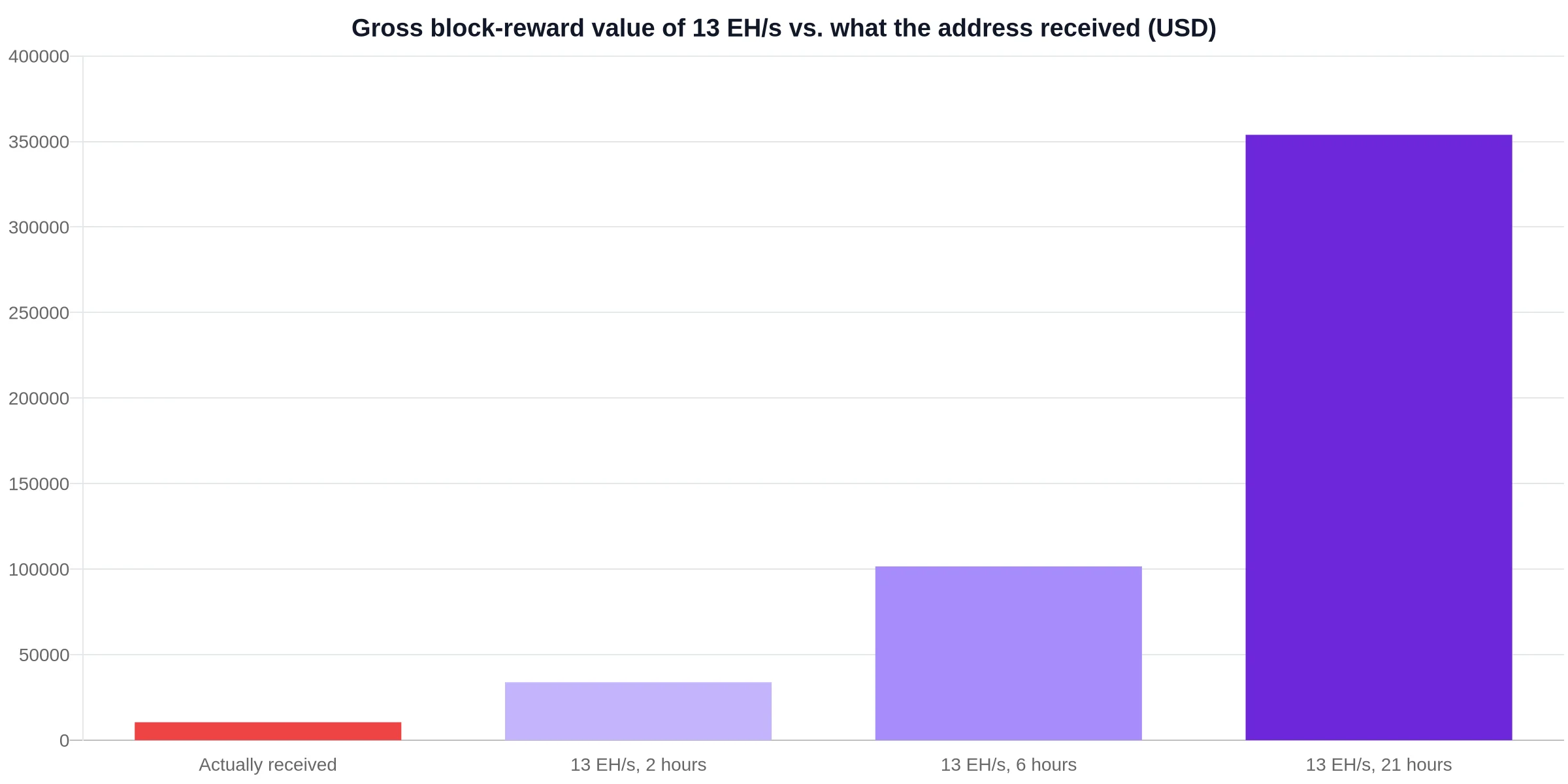
The chart above sets the 0.16202083 BTC the address actually received against the gross value of the hashrate it was credited with. Method: 13 EH/s divided by the 934.03 EH/s network hashrate from mempool.space gives 1.3918% of the 144 daily blocks at 3.125 BTC each; that BTC quantity is valued at the CoinGecko price of $64,883 recorded at 00:41 UTC on Nov. 16. Fees, pool fees and power costs are excluded, so the gross figure overstates net revenue.
The Control Plane Is Now the Attack Surface
Nothing in the Bitcoin protocol failed. No consensus rule was bent, no double spend occurred, and the network kept producing blocks at its usual pace. What changed was a configuration value on machines owned by someone else, reached through software that exists to make bulk changes convenient.
That convenience is the product. Luxor markets Commander as a single control plane for fleet management, energy and pool operations, sits inside an operation that also runs a mining pool and firmware business, and has completed a SOC 1 examination while maintaining SOC 2 compliance. Those attestations cover controls inside Luxor’s own systems. They do not tell a client whether a credential path into its machines is narrow enough, and they say nothing about what happens when an operator’s own workstation is the compromised end.
CoreX’s read leans that way. “Pretty sure I have isolated what I think is the program used,” the host wrote, which points at something running on the operator side rather than at a breach of Luxor’s platform. That distinction decides whether this was a vendor failure or a client-side compromise, and it is not resolved in public. The same pattern is spreading across the sector as fleet software becomes the layer through which hashrate, energy contracts and even AI compute allocations get dispatched. Fifteen mining companies have already backed a rival data layer from Tether, described in BlockchainReporter’s report on the Tether MDK consortium, which pushes agent-driven control into the same machines this exploit reached.
The Post-Mortem Is the Only Document That Can Close This
Luxor has committed to “a full post-mortem,” and that document, not the initial statement, is where the incident becomes auditable. Three disclosures would answer what is currently open: the number of machines and the hashrate actually redirected, the UTC start and end of the redirection window, and the calculation behind the compensation.
Two further signals are worth watching. OCEAN’s silence is conspicuous for a pool that received the hashrate and whose blocks paid the attacker’s address; a statement from the pool would either corroborate or complicate the pro-rata reading above. And the industry parallel sits in plain sight: Binance is winding down its own mining pool while fleet software consolidates control over industrial hashrate, so the concentration of operational permissions is rising just as the sector’s revenue per unit of hashrate is under pressure.
The practical takeaway for operators is narrow. Verify the pool endpoint and the payout address on the machines themselves, not in the dashboard, and treat any bulk-change feature as a privileged system with its own credential hygiene. The attacker in this case captured roughly 3% of what the diverted hashrate was worth, and the reason appears to be timing rather than restraint. The next attempt may land better.