Miami-Dade County Tax Collector Dariel Fernandez announced on November 9, 2026 that Bitcoin is now accepted for property tax payments, making Miami-Dade among the first government agencies in
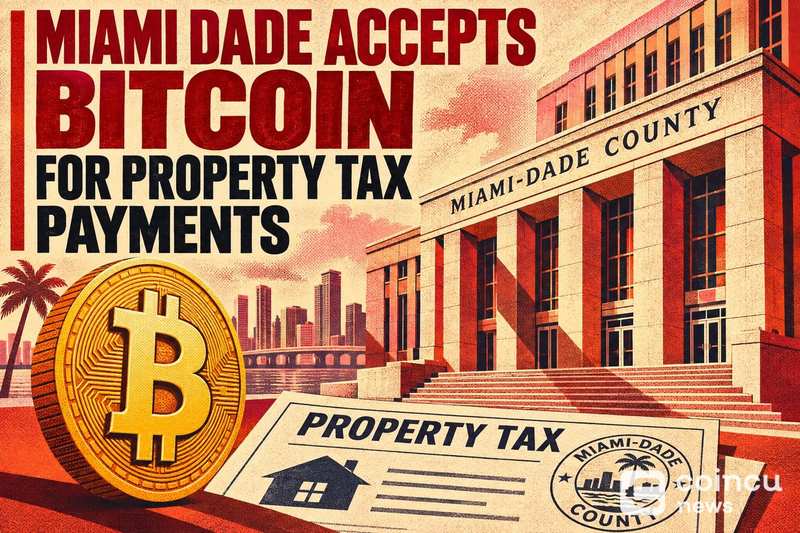
Miami-Dade County Tax Collector Dariel Fernandez announced on November 9, 2026 that Bitcoin is now accepted for property tax payments, making Miami-Dade among the first government agencies in the United States to offer the option, while insulating public funds from crypto market risk through a third-party processor that converts BTC to USD at the moment of payment.
The rollout covers both online transactions and in-person payments at all 13 Tax Collector office locations plus T-Connect mobile units across the county. All existing payment methods, including cash, check, and card, remain unchanged; Bitcoin is entirely optional. The county itself holds zero cryptocurrency at any point in the process. For related coverage, see Unchained Summit India Brings Cross-Border Payments and Digital Finance into Focus as A7 International Joins as Sponsor.
"Government must keep up with the times and the needs of the people we serve," Fernandez said, according to CBS Miami. In a second statement from the same announcement, Fernandez added: "We are embracing new technology without compromising our responsibility to protect taxpayer dollars." Context on this theme: IPX Plans to Bring ‘minicoin’ Payments to LINE FRIENDS Online and Offline Stores, Expanding IP Experiences Beyond Content and Merchandise.
How the Payment Structure Protects Public Funds
The core mechanism is an instant BTC-to-USD conversion handled by an undisclosed third-party processor at the time of each transaction. Because the county receives dollars, not Bitcoin, it assumes no exposure to crypto price swings. The specific processor name and the Bitcoin-specific convenience fee have not been publicly disclosed, per CBS Miami's reporting; credit card and mobile wallet payments already carry a 2.5% fee with a $2.50 minimum, but whether the Bitcoin option carries a comparable or different charge is not yet confirmed. More on this in World Data Centre Summit – Vietnam 2026.
Miami-Dade's approach holds no digital assets and converts payments immediately.
A Five-Year Policy Arc Behind a Single Announcement
The November 9 launch did not emerge overnight. Bitcoin Magazine's reporting traces the policy lineage to a 2021 resolution by Miami-Dade Commissioner Cohen Higgins that laid the groundwork for cryptocurrency integration within county operations. Fernandez himself served on Miami-Dade's Cryptocurrency Task Force before winning election as Tax Collector in November 2024, giving the new payment option an unusually direct line from task force recommendation to administrative implementation.
Miami-Dade joins a short list of U.S. jurisdictions that accept crypto for taxes. Colorado enabled Bitcoin tax payments in 2022; Utah and Detroit followed, with Detroit's program launching in 2025, according to Bitcoin Magazine's historical review. The county's move also carries significance given Miami's positioning as a crypto-friendly city since at least 2021, when Mayor Francis Suarez explored paying municipal workers in Bitcoin.
Miami-Dade's earlier decision to terminate its business relationships with FTX following that exchange's collapse made the county's reentry into crypto-adjacent territory more deliberate; this time, the design explicitly keeps speculative exposure at zero by never holding the asset.
November's 4% Discount Creates a Practical Incentive Window
Miami-Dade issued its 2026 property tax bills on October 30, and property owners who pay in November receive a 4% early-payment discount. The discount schedule steps down monthly: 3% in December, 2% in January, 1% in February, with the full amount due by March.
Pay property taxes in November
4% discount
The seasonal tax discount may give residents an extra reason to try the new Bitcoin payment route.
For Bitcoin holders specifically, the November window provides a time-bounded reason to test the new payment rail while capturing the largest available discount. Whether BTC's current price trajectory makes locking in a payment attractive depends on each holder's cost basis; the county imposes no requirement to use Bitcoin, and the 4% discount applies equally across all accepted payment methods.
Bitcoin Market Context at Announcement
Bitcoin was trading at approximately $73,333 when the Miami-Dade announcement went live on November 9, 2026, per CoinGecko data as of that date, down 1.72% over the prior 24 hours and 5.39% over the prior seven days. Bitcoin's total market capitalization stood near $1.475 trillion at that price level.
Bitcoin price at announcement
$73,333
Market context for the county's Bitcoin property-tax rollout.
That price sits roughly 42% below Bitcoin's all-time high of $126,080 reached on October 6, 2025, CoinGecko data shows. The Crypto Fear & Greed Index registered 32 out of 100, placing sentiment in "Fear" territory on the day of the announcement. The juxtaposition of a bullish institutional-use milestone against a fearful market underscores that government adoption cycles operate on longer timelines than price cycles; the Miami-Dade policy took five years to reach implementation regardless of where BTC traded on any given month.
What Taxpayers Should Confirm Before Paying With Bitcoin
Several operational details remain unconfirmed in publicly available sources as of November 10, 2026. Taxpayers considering the Bitcoin option should verify the following directly through official Miami-Dade Tax Collector channels before initiating a payment.
Practical Checklist
- Official payment portal: Use only the Tax Collector's official site at mdctaxcollector.gov to initiate Bitcoin payments; do not use third-party links or QR codes from social media.
- Fee structure: The Bitcoin-specific convenience fee has not been publicly disclosed. Confirm the fee before authorizing any transaction, as it may differ from the 2.5% card fee already in place.
- Network and wallet compatibility: The supported Bitcoin network (mainnet only, Lightning support, accepted wallets) has not been detailed in official statements; confirm with the county before sending funds.
- Payment receipt: Request or save a confirmed payment receipt. Because BTC converts instantly to USD, the tax record should reflect USD receipt; verify the status updates in your county account before the payment deadline.
- Deadline confirmation: The 4% November discount requires the payment to be received and processed by November 30; confirm whether the BTC transaction timestamp or the USD settlement date governs the discount eligibility.
None of the unresolved items above should be inferred from news coverage. County-issued guidance on the official Tax Collector blog is the authoritative source for each of these operational terms, per the official announcement.
What the Miami-Dade Move Signals for Public-Sector Bitcoin Adoption
Local government payment acceptance differs structurally from legal-tender status or strategic reserve accumulation. Miami-Dade is not treating Bitcoin as a store of value or a reserve asset; it is treating BTC as one of several payment rails alongside ACH, card, and check. The legal and fiscal risk profile is therefore closer to accepting PayPal than to purchasing a Bitcoin treasury position, which is precisely what makes the design politically and legally replicable at other county and municipal levels.
The growth of crypto-native payment infrastructure, as reflected in projects aimed at bringing global banking onchain, lowers the technical barrier for similar government integrations. If Miami-Dade's rollout processes a meaningful volume of Bitcoin tax payments without operational issues through the November-March payment window, the design becomes a referenceable template for other jurisdictions that want to offer crypto payment options without touching the asset directly.
The key variable to watch is transaction volume data from the Tax Collector's office once the November payment window closes. Fernandez has not stated a threshold or timeline for evaluating whether the program continues or expands to additional cryptocurrencies beyond Bitcoin; that decision, along with any public disclosure of the third-party processor's identity and fee schedule, represents the next concrete milestone for observers tracking U.S. public-sector crypto adoption.
FAQ
Can Miami-Dade property taxes be paid with Bitcoin?
Yes. Miami-Dade Tax Collector Dariel Fernandez confirmed on November 9, 2026 that Bitcoin is now accepted for property tax payments, both online and in person at all 13 Tax Collector office locations and T-Connect mobile units, according to the official announcement and CBS Miami reporting.
Does the county hold Bitcoin after the payment?
No. A third-party processor converts BTC to USD instantly at the time of payment. Miami-Dade County holds zero cryptocurrency and assumes no crypto market risk, per the official announcement.
What should I verify before paying property taxes with Bitcoin?
Confirm the convenience fee, accepted wallet types, network requirements, and whether the BTC transaction timestamp or the USD settlement date determines discount eligibility. Use only mdctaxcollector.gov as the payment portal and save a confirmed receipt after completing the transaction.
Does accepting Bitcoin mean Miami-Dade accepts all cryptocurrencies?
No. The announcement specifies Bitcoin only. No other cryptocurrency has been confirmed as an accepted payment method for Miami-Dade property taxes as of November 10, 2026.
Is there an early-payment discount for Bitcoin tax payments?
The 4% November early-payment discount applies to all accepted payment methods; the discount schedule then drops to 3% in December, 2% in January, and 1% in February, with the full amount due in March. Bitcoin payments are subject to the same schedule, though taxpayers should confirm whether settlement timing affects discount eligibility with the Tax Collector's office directly.
Editorial credits
SP
Sophia Panel
Writer · Coincu
SD
Samantha Doyle
Duty editor · Coincu
Monitors published articles around the clock and can correct or withdraw them.
Checked by Coincu QC Team before publishing on November 10, 2026 for headline accuracy, original value, factual consistency, metadata and authorship claims: our AI review system checks every article before it goes live, and our duty editor monitors it after publication. Report an error.
Coincu uses AI for research, drafting and review. Our editorial team is responsible for every article and corrects or withdraws articles when needed. How we review.
Disclaimer: This article is for informational purposes only and does not constitute financial or investment advice. Cryptocurrency and digital asset markets carry significant risk. Always do your own research before making decisions.
The post Miami-Dade Accepts Bitcoin for Property Tax Payments was initially published on Coincu.