Markets5 min read
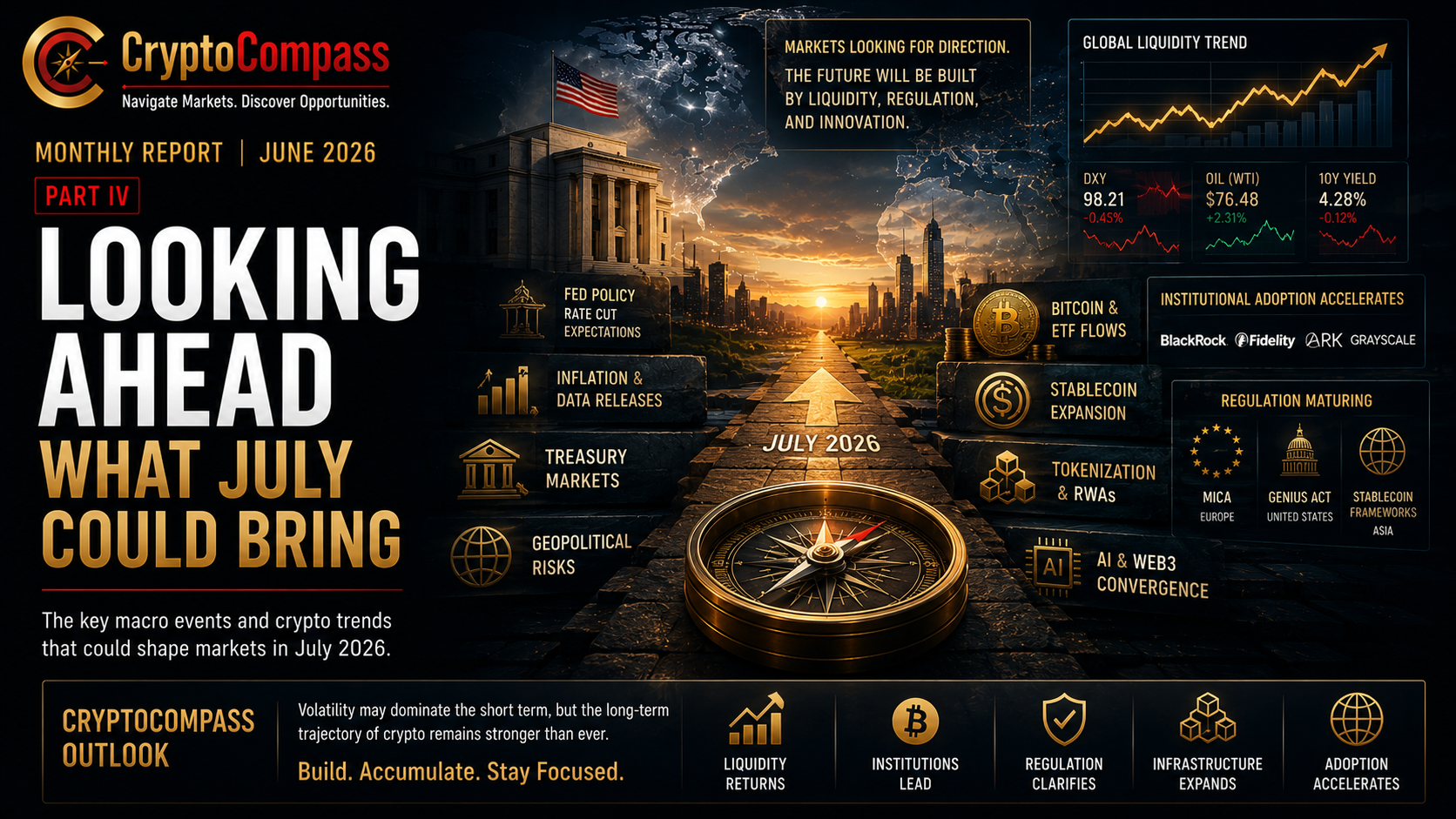
Monthly Report | Part IV — Looking Ahead: What July Could Change
Geopolitical tensions reminded investors that global markets remain vulnerable to external shocks.
Liquidity may not be returning today—but markets are beginning to price its eventual return.
Executive Summary
If geopolitics dominated the headlines during June, liquidity quietly remained the market's most important underlying driver.
Throughout the month, investors constantly shifted between two competing narratives.
Would inflation remain stubborn enough to delay Federal Reserve easing?
Or was the U.S. economy finally slowing enough to bring lower interest rates back into view?
Every employment report.
Every Treasury auction.
Every inflation indicator.
Every Federal Reserve speech.
Immediately became a market-moving event.
Although risk assets experienced periods of volatility, one idea gradually returned to the center of investor discussions:
Liquidity may not be returning today—but markets are beginning to price its eventual return.
For Bitcoin, equities and virtually every risk asset, that distinction mattered enormously.
Markets Never Stopped Watching The Federal Reserve
At the beginning of June, investors believed monetary policy remained the single most important variable for global markets.
That assumption never disappeared.
Instead, it became more complicated.
Military tensions pushed oil prices higher.
Higher oil prices threatened inflation.
Persistent inflation could force the Federal Reserve to delay interest-rate cuts.
Meanwhile, softer economic data suggested that growth itself was beginning to slow.
Markets found themselves balancing two opposing forces.
Inflation argued for higher rates.
Economic weakness argued for lower rates.
This tension defined trading throughout the month.
Payroll Data Reopened The Liquidity Debate
One of the month's most closely watched releases came from the U.S. labor market.
Employment growth showed further signs of moderation while hiring momentum gradually cooled.
Although the labor market remained historically resilient, investors increasingly questioned whether the economy was finally losing momentum.
The immediate market reaction was predictable.
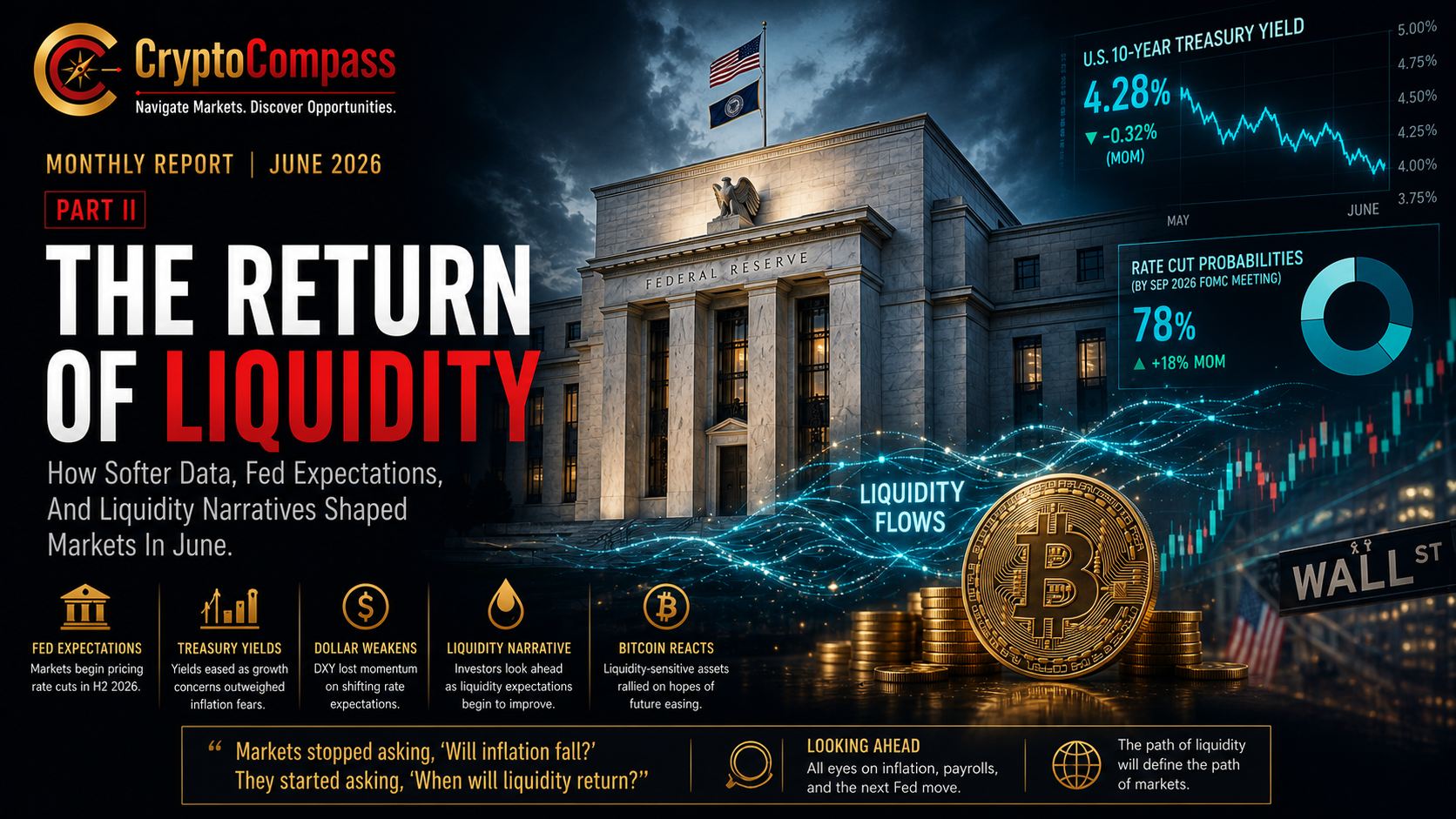
Treasury yields eased.
Rate-cut expectations improved.
Technology stocks outperformed.
Bitcoin strengthened alongside other liquidity-sensitive assets.
The report did not guarantee easier monetary policy.
It simply made that outcome appear more plausible.
Financial markets rarely wait for central banks to act.
They begin repricing long before policy changes occur.
Treasury Markets Told Their Own Story
While equity investors focused on headlines, bond markets delivered a more nuanced message.
Throughout June, Treasury yields fluctuated as investors attempted to reconcile resilient inflation with gradually weakening economic activity.
The result was increased volatility across fixed-income markets.
Every movement in government bond yields immediately affected valuations across technology companies, growth stocks and digital assets.
This relationship has become increasingly important.
Bitcoin no longer trades independently of the broader financial system.
Institutional investors now evaluate Bitcoin alongside other duration-sensitive assets.
When real yields decline, liquidity expectations improve.
When liquidity expectations improve, demand for risk assets generally strengthens.
That transmission mechanism has become one of the defining characteristics of the current cycle.
The Dollar Quietly Lost Momentum
Another important development during June was the behavior of the U.S. Dollar.
Although the dollar remained historically strong, expectations for future monetary easing limited further upside.
Currency markets began pricing a future in which the Federal Reserve could eventually become less restrictive than previously expected.
For global financial markets, a softer dollar carries significant implications.
Emerging markets benefit from easier financial conditions.
Commodity prices often receive support.
Dollar-denominated debt becomes easier to finance.
Risk appetite gradually improves.
Historically, Bitcoin has also tended to perform better during periods of declining dollar strength, particularly when accompanied by improving global liquidity.
While no relationship remains perfectly consistent, investors increasingly monitor the Dollar Index alongside Bitcoin itself.
Liquidity Is More Than Interest Rates
One of the biggest misconceptions among retail investors is that liquidity depends solely on the Federal Reserve.
In reality, global liquidity reflects a much broader financial ecosystem.
Central-bank balance sheets.
Commercial bank lending.
Government borrowing.
Money market funds.
Treasury issuance.
Stablecoin creation.
Institutional capital flows.
Together, these variables determine how much capital is available to move across financial markets.
June demonstrated that even without an immediate rate cut, investors were already searching for signs that liquidity conditions could improve during the second half of the year.
Markets trade expectations.
Not calendars.
Bitcoin Continues Trading Like A Global Macro Asset
Perhaps the clearest evidence of Bitcoin's institutional evolution appeared in its response to macroeconomic data.
Employment reports produced immediate price reactions.
Treasury yields influenced Bitcoin alongside Nasdaq futures.
Federal Reserve speeches affected crypto just as they affected equities.
This represents a dramatic departure from previous cycles.
Only a few years ago, Bitcoin's largest price movements were driven primarily by exchange failures, regulatory announcements or crypto-native speculation.
Today, macroeconomic variables increasingly dominate.
Bitcoin is gradually becoming another asset through which investors express views on liquidity, monetary policy and global risk appetite.
That shift reflects the growing influence of institutional capital throughout the digital asset ecosystem.
Why Liquidity Still Matters More Than Narratives
Narratives can drive attention.
Liquidity drives prices.
This distinction became increasingly clear throughout June.
Artificial intelligence remained one of the year's strongest investment themes.
Tokenization continued expanding.
Stablecoin adoption accelerated.
Corporate Bitcoin treasuries kept growing.
Yet none of these developments fully escaped the influence of monetary conditions.
When liquidity tightens, even strong narratives struggle.
When liquidity improves, capital becomes more willing to fund long-term opportunities.
History repeatedly demonstrates that bull markets are rarely sustained by optimism alone.
They require expanding liquidity.
That remains true across equities, private markets and digital assets alike.
Looking Toward July
As June concluded, investors entered the second half of the year with several critical questions still unanswered.
Will inflation continue moderating?
Will labor markets weaken further?
Can the Federal Reserve begin easing without reigniting inflation?
Will geopolitical risks keep oil prices elevated?
The answers to these questions will determine whether liquidity conditions continue improving or tighten once again.
For Bitcoin and the broader crypto market, the implications are profound.
The next major trend may depend less on blockchain innovation than on the direction of global monetary policy.
CryptoCompass View
June reminded investors that liquidity remains the foundation upon which every market narrative is built.
Artificial intelligence.
Bitcoin.
Real-world assets.
Equities.
Even geopolitical events ultimately influence markets through their impact on liquidity, interest rates and capital allocation.
The encouraging signal is that investors have once again begun discussing easing rather than additional tightening.
That does not guarantee an immediate bull market.
But it suggests that the financial environment is becoming less restrictive than it appeared only a few months ago.
If Part I explained why markets repriced risk, Part II explains why investors are already looking beyond today's uncertainty.
They are trying to anticipate tomorrow's liquidity.
Author
By Suttermill
CryptoCompass Editorial Desk