Markets5 min read
Monthly Report | Part III — Crypto Quietly Grew Stronger
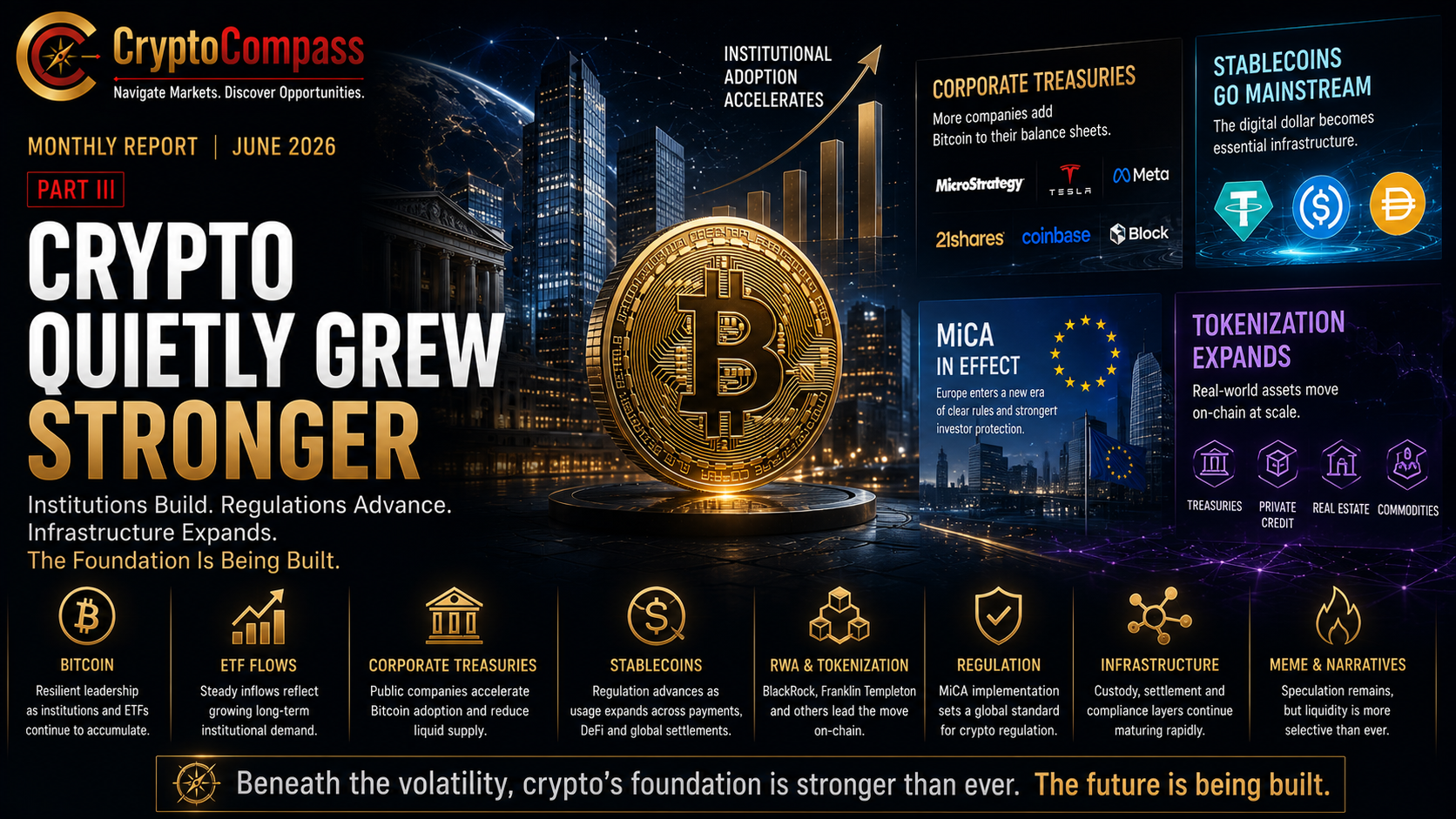
If June's headlines suggested uncertainty, the crypto industry's underlying fundamentals told a very different story.
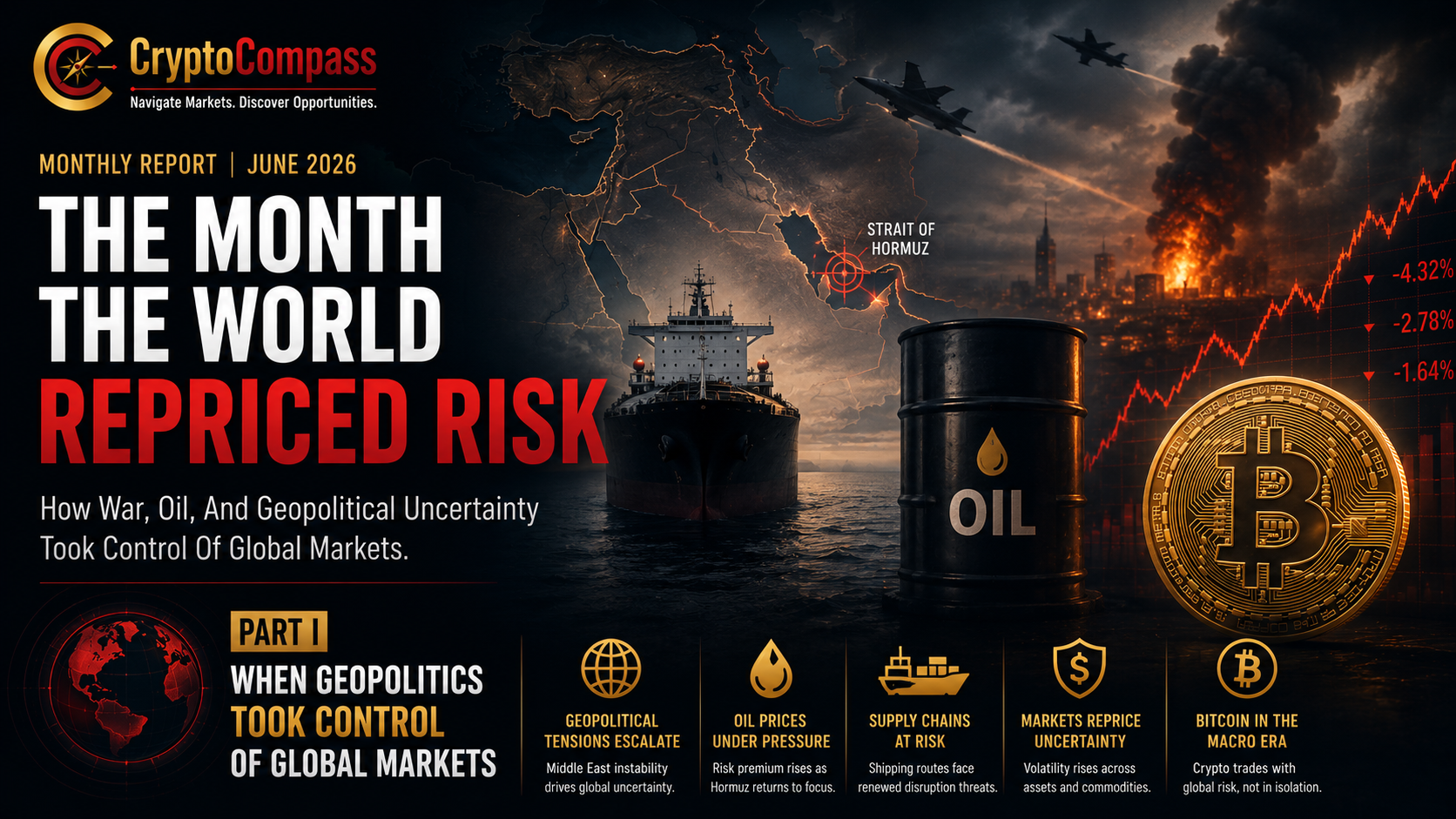
Geopolitical tensions reminded investors that global markets remain vulnerable to external shocks.
Executive Summary
June answered many important questions.
It also created even bigger ones.
Geopolitical tensions reminded investors that global markets remain vulnerable to external shocks.
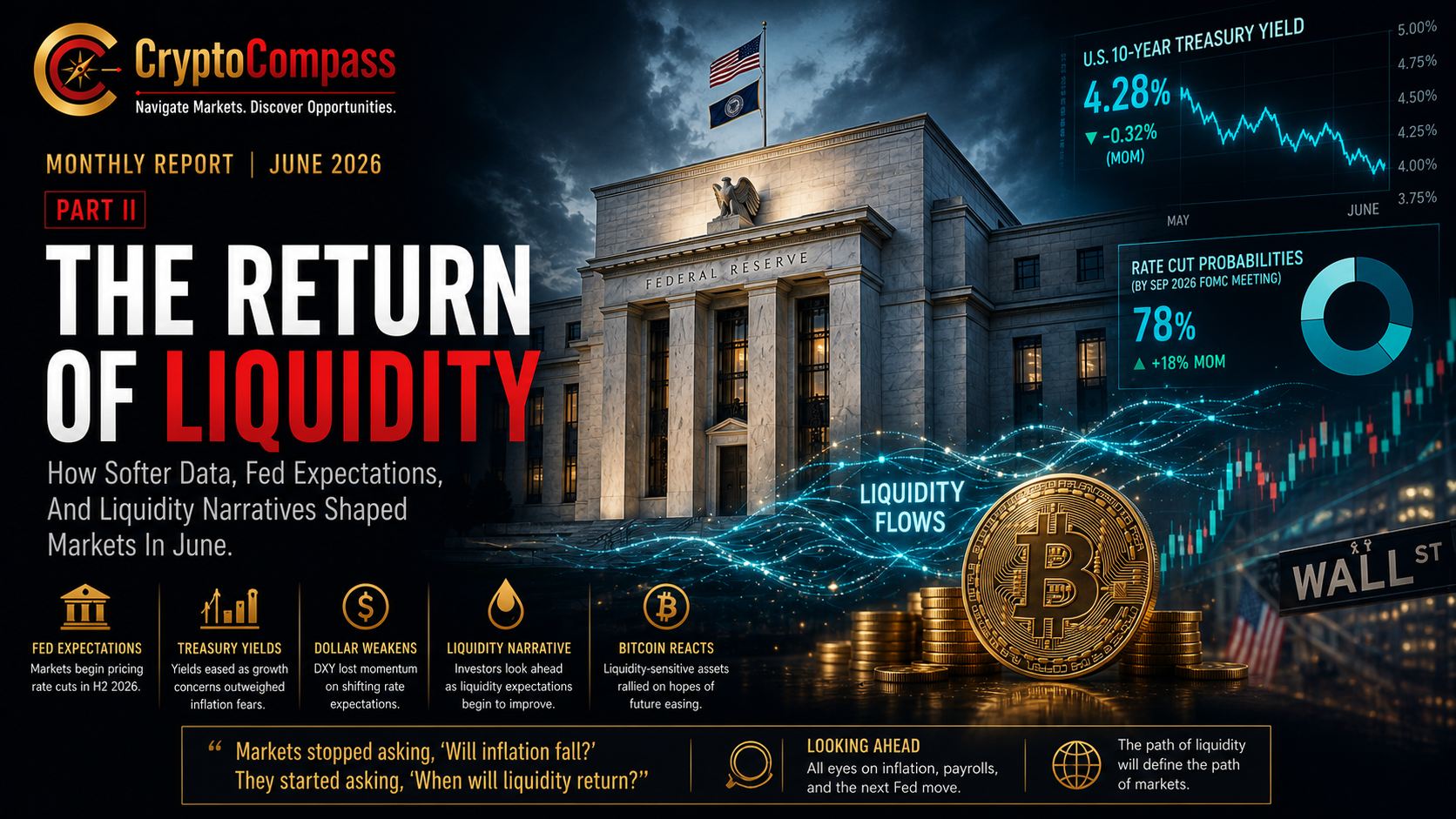
Federal Reserve expectations shifted almost weekly.
Institutional adoption continued accelerating.
Stablecoin regulation entered a new phase.
Corporate Bitcoin accumulation expanded.
Now investors face a very different challenge.
Not understanding what happened.
Understanding what happens next.
History shows that major market turning points rarely occur because of a single event.
They emerge when multiple trends begin reinforcing each other.
As July begins, those trends are becoming increasingly visible.
Liquidity.
Institutional capital.
Regulation.
Tokenization.
Artificial intelligence.
Geopolitics.
Each will influence the next phase of both traditional finance and digital assets.
The Federal Reserve Remains The Market's Anchor
Despite geopolitical uncertainty, one institution still holds enormous influence over every major asset class.
The Federal Reserve.
Markets will continue watching every employment report, inflation release and FOMC communication for clues about future monetary policy.
If economic growth slows while inflation continues easing, expectations for lower interest rates could strengthen.
That would likely support equities, technology stocks and digital assets.
However, if inflation remains persistent—particularly because of higher energy prices—the path toward easier monetary policy could become more complicated.
For investors, July may prove less about actual rate cuts and more about how expectations evolve.
Bitcoin's Institutional Era Is Just Beginning
Bitcoin enters July from a position fundamentally different than previous market cycles.
Institutional ownership continues expanding.
Spot ETFs remain one of the strongest structural demand sources in the market.
Corporate treasury adoption continues growing.
Supply available on exchanges has gradually declined.
Unlike earlier cycles dominated by retail enthusiasm, today's Bitcoin market increasingly reflects long-term capital allocation decisions.
That shift reduces speculative excess while strengthening structural demand.
Short-term volatility will always remain.
Long-term ownership is becoming increasingly institutional.
Stablecoins Could Become The Next Major Infrastructure Layer
If one sector deserves close attention during the second half of 2026, it is stablecoins.
Governments are moving toward comprehensive regulatory frameworks.
Banks are exploring tokenized deposits.
Payment companies continue integrating blockchain settlement.
Cross-border transfers increasingly rely on digital dollars.
Rather than replacing existing financial infrastructure, stablecoins are beginning to integrate with it.
This transition could become one of the decade's largest financial stories.
Tokenization Moves Beyond The Pilot Phase
Another trend worth monitoring is tokenization.
Only a few years ago, tokenized assets were viewed as experimental.
Today, governments, banks and asset managers are treating them as practical financial infrastructure.
Treasury bills.
Private credit.
Money market funds.
Real estate.
Corporate debt.
Increasingly, these assets are moving on-chain.
The long-term implications extend far beyond crypto.
Blockchain is gradually becoming settlement infrastructure for traditional finance.
Europe May Become Crypto's Regulatory Blueprint
The implementation of MiCA has positioned Europe as one of the world's most mature regulatory environments for digital assets.
Other jurisdictions will closely observe its outcomes.
If investor protection improves while innovation continues, similar regulatory frameworks could emerge elsewhere.
The long-term winner may not be any individual exchange or token.
It may be regulatory certainty itself.
Markets allocate capital more efficiently when rules become predictable.
Artificial Intelligence And Crypto Are Beginning To Converge
Throughout June, artificial intelligence remained one of global markets' strongest investment themes.
At the same time, blockchain infrastructure continued expanding.
Increasingly, these trends are intersecting.
Decentralized compute.
AI marketplaces.
Identity verification.
Data ownership.
Autonomous financial agents.
The next generation of blockchain applications may be driven less by finance alone and more by AI-powered digital economies.
This convergence remains early.
But it deserves close attention.
Geopolitics Will Continue Influencing Markets
Although June's geopolitical tensions gradually stabilized, investors should not assume geopolitical risk has disappeared.
Energy markets remain sensitive.
Global shipping routes remain strategically important.
Election cycles continue reshaping policy expectations.
Defense spending continues rising.
Markets increasingly recognize that geopolitical developments influence inflation, monetary policy and global capital allocation.
The era in which crypto traded independently of world events is ending.
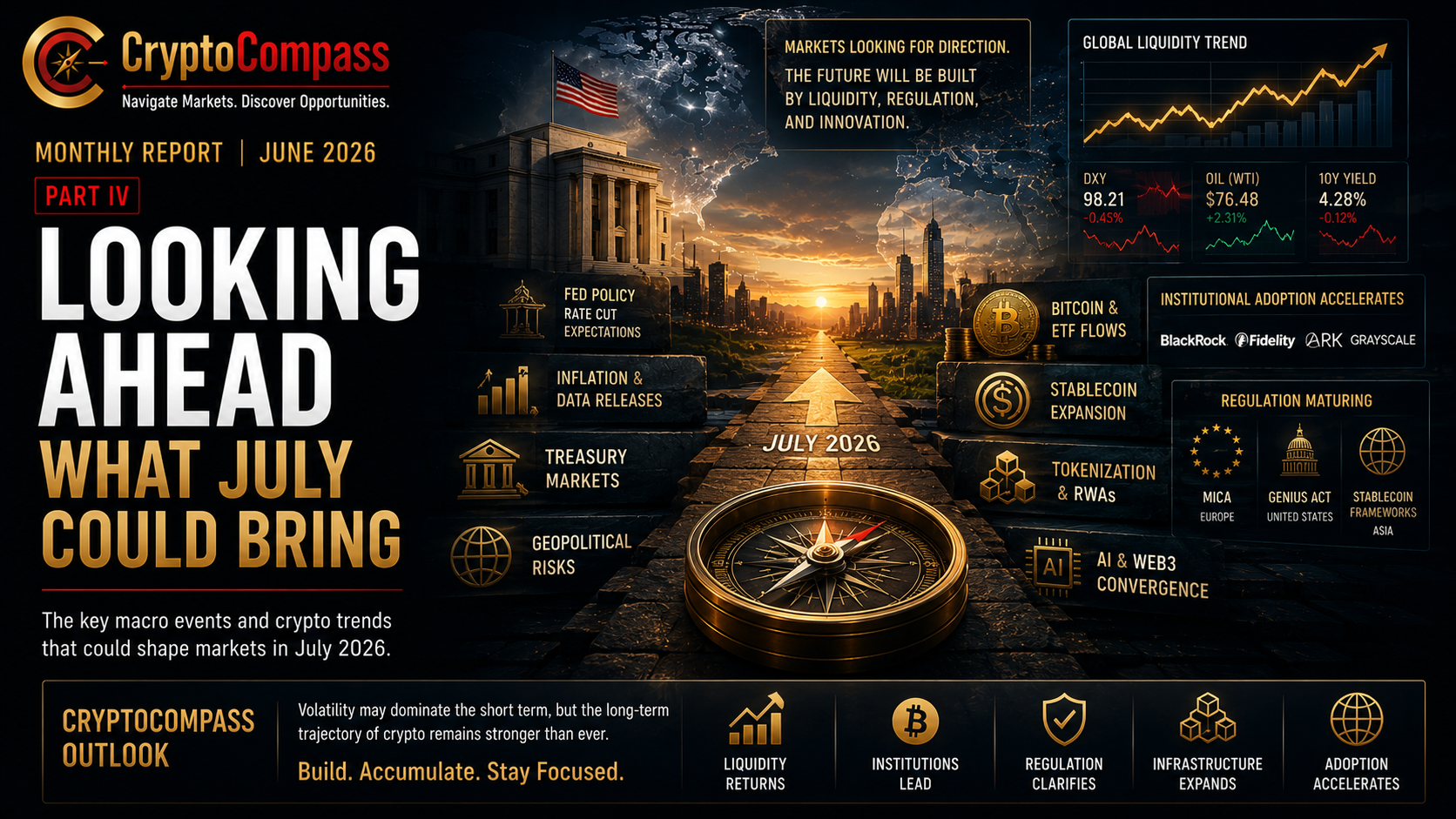
What CryptoCompass Will Watch In July
Our editorial team will closely monitor eight key themes throughout July:
1. Federal Reserve Expectations
Every major macro release will influence liquidity expectations.
2. U.S. Inflation Data
Will inflation continue moderating despite higher energy prices?
3. Bitcoin ETF Flows
Institutional demand remains one of Bitcoin's strongest structural drivers.
4. Corporate Treasury Activity
Will more companies follow the growing Bitcoin treasury trend?
5. Stablecoin Regulation
Regulatory clarity continues improving across multiple jurisdictions.
6. Tokenized Real-World Assets
Watch whether institutional adoption continues accelerating.
7. AI Infrastructure Investment
The intersection of AI and blockchain may become increasingly important.
8. Geopolitical Developments
Oil, shipping routes and global security remain essential macro variables.
Final Thoughts
June was not simply another month of market volatility.
It marked the beginning of a broader transition.
Markets became more macro-driven.
Bitcoin became more institutional.
Stablecoins became more legitimate.
Blockchain became more integrated with traditional finance.
Regulation became more constructive.
Infrastructure continued expanding.
Meanwhile, speculation became increasingly selective.
These are not isolated developments.
They are interconnected pieces of a larger transformation.
The crypto industry is gradually evolving from an emerging technology sector into part of the global financial system.
That transition will not happen overnight.
But June demonstrated that it is already underway.
CryptoCompass View
Successful investors rarely focus only on today's headlines.
They focus on structural trends that unfold over years.
Looking ahead, CryptoCompass believes five themes will define the remainder of 2026:
• Global Liquidity
• Institutional Bitcoin Adoption
• Stablecoin Expansion
• Tokenized Financial Infrastructure
• Regulatory Integration
Short-term volatility will continue.
Macro headlines will dominate daily trading.
But beneath the noise, the industry's foundation continues strengthening.
Markets may fluctuate.
Infrastructure compounds.
History suggests the latter ultimately matters far more.
June may eventually be remembered not for its volatility—but for the quiet acceleration of crypto's institutional era.
End of Report
By Suttermill
CryptoCompass Editorial Desk