Markets5 min read
Monthly Report | Part IV — Looking Ahead: What July Could Change
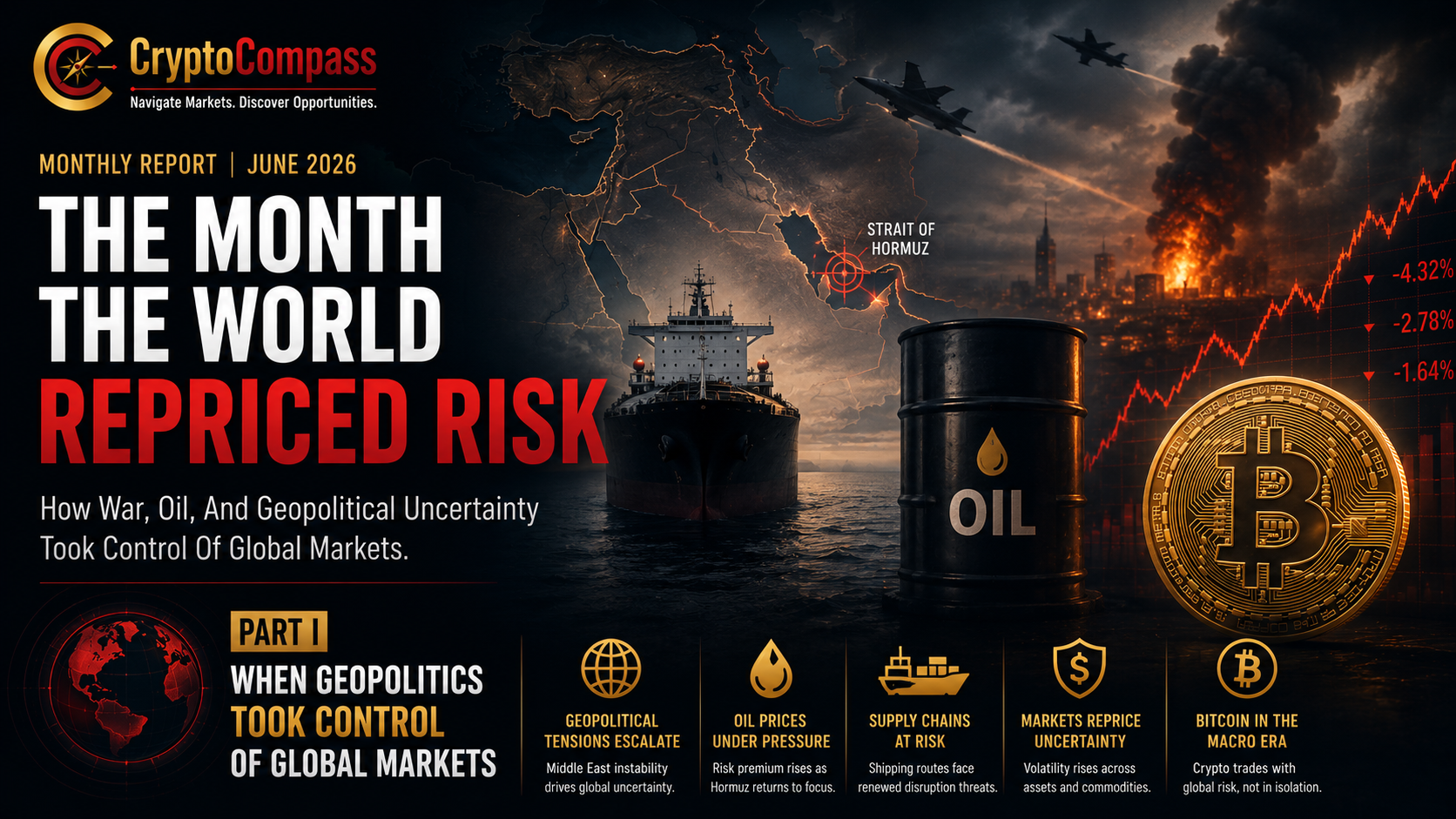
Geopolitical tensions reminded investors that global markets remain vulnerable to external shocks.
If June's headlines suggested uncertainty, the crypto industry's underlying fundamentals told a very different story.
Executive Summary
If June's headlines suggested uncertainty, the crypto industry's underlying fundamentals told a very different story.
Prices fluctuated.
Sentiment weakened.
Speculation cooled.
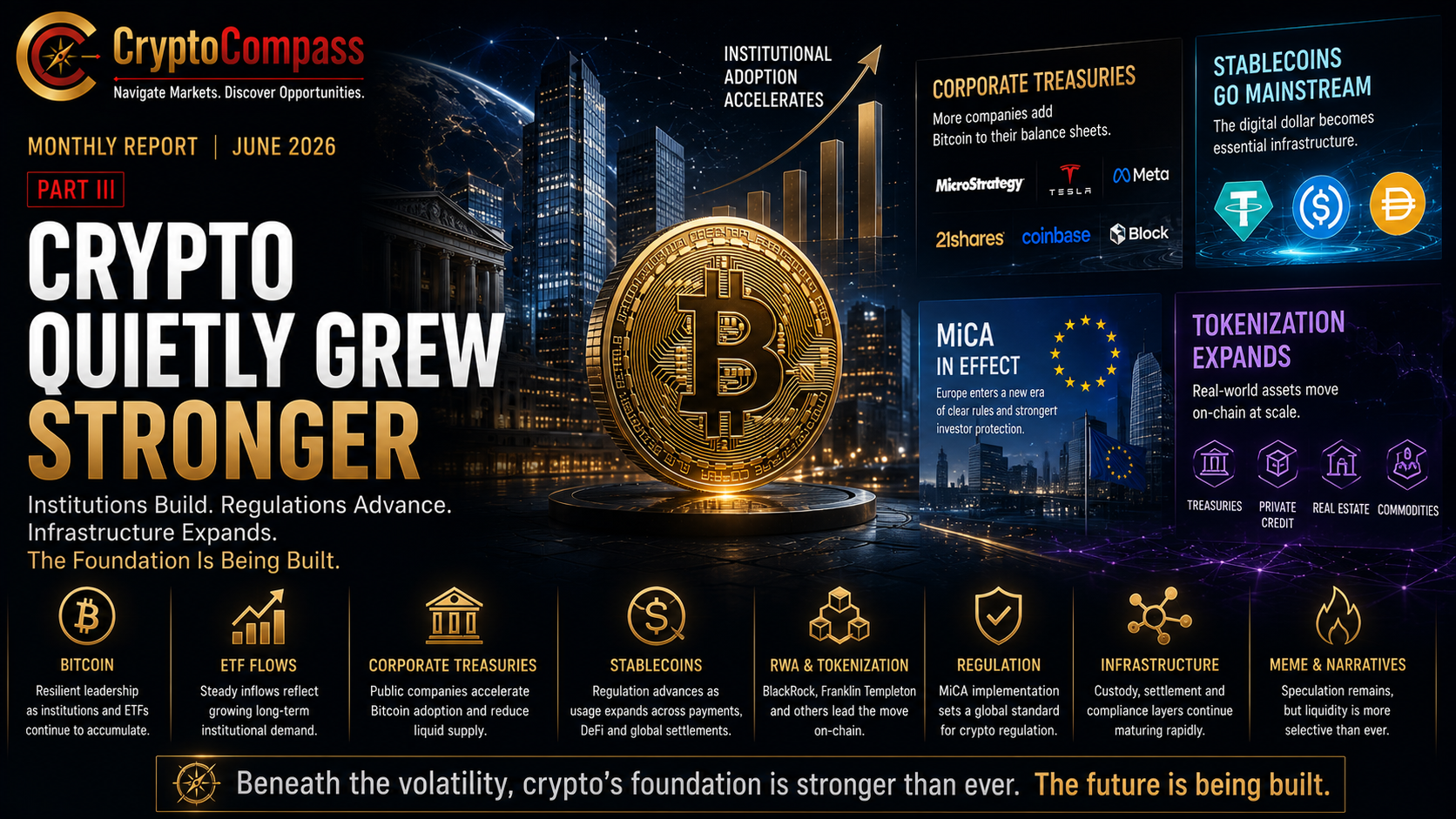
Yet beneath the surface, institutional adoption continued accelerating.
Bitcoin treasury holdings reached new milestones.
Stablecoin regulation advanced.
Europe officially entered the MiCA era.
Tokenized real-world assets expanded.
Wall Street increased its blockchain exposure.
For long-term investors, June reinforced an increasingly important reality:
Crypto is becoming an infrastructure industry rather than a speculative experiment.
The difference between price and progress has rarely been more apparent.
Bitcoin Continued Separating Itself From The Rest Of Crypto
One of the clearest themes throughout June was Bitcoin's continued outperformance relative to the broader digital asset market.
While many altcoin sectors struggled under macro pressure, Bitcoin remained comparatively resilient.
This divergence reflects a structural change that has been developing for more than a year.
Institutional investors increasingly treat Bitcoin as a distinct asset class rather than simply another cryptocurrency.
Spot ETF adoption has expanded access.
Corporate treasury allocations continue reducing liquid supply.
Professional asset managers now evaluate Bitcoin alongside gold, equities and Treasury securities.
As a result, capital exiting speculative crypto assets is increasingly rotating into Bitcoin instead of leaving the ecosystem altogether.
That behavior simply did not exist in previous market cycles.
Corporate Treasury Adoption Accelerated
Another defining story of June was the continued expansion of corporate Bitcoin ownership.
More publicly listed companies added Bitcoin to their balance sheets, reinforcing a trend that began after the approval of U.S. spot Bitcoin ETFs.
Collectively, corporate treasuries now control a meaningful percentage of Bitcoin's fixed supply.
This matters for one simple reason.
Unlike retail investors, corporations rarely purchase Bitcoin with short-term speculation in mind.
Treasury allocations are strategic decisions.
They are measured in years rather than weeks.
Every additional corporate buyer reduces future circulating supply while increasing Bitcoin's institutional legitimacy.
The market often focuses on ETF inflows.
Corporate treasury demand may ultimately prove just as significant.
Stablecoins Quietly Became Global Financial Infrastructure
Although Bitcoin remained the industry's flagship asset, stablecoins arguably experienced the most meaningful structural progress during June.
Across multiple jurisdictions, governments continued moving away from debating whether stablecoins should exist.
Instead, policymakers focused on how they should be regulated.
This represents a profound shift.
Only a few years ago, stablecoins were widely viewed as regulatory risks.
Today, they are increasingly recognized as essential payment infrastructure.
Cross-border settlements.
Corporate treasury management.
On-chain finance.
Tokenized assets.
Institutional lending.
Each of these rapidly growing sectors depends on reliable digital dollars.
The stablecoin conversation has moved beyond crypto.
It is becoming a discussion about the future of money itself.
Europe Entered The MiCA Era
Perhaps the most important regulatory milestone of the month came from Europe.
The Markets in Crypto-Assets (MiCA) framework officially entered its next phase of implementation.
For consumers, MiCA promises greater transparency and stronger investor protections.
For institutions, it provides regulatory certainty that has long been missing.
The immediate consequence was significant industry consolidation.
Only firms meeting Europe's new licensing standards retained broad access across the European market.
For many smaller companies, compliance proved too expensive or too complex.
In the short term, competition declined.
In the long term, confidence may increase.
This is often how financial markets mature.
Regulation initially reduces participation.
Eventually, it expands institutional adoption.
Tokenization Continued Expanding
One of the month's least discussed—but arguably most important—developments was the continued growth of tokenized real-world assets.
Private credit.
Government securities.
Money market funds.
Corporate bonds.
Institutional lending products.
All continued migrating onto blockchain infrastructure.
Unlike previous crypto narratives driven primarily by speculation, tokenization addresses a genuine financial inefficiency.
Traditional assets settle slowly.
Blockchain assets settle continuously.
Traditional collateral remains fragmented.
Tokenized collateral can move globally within minutes.
This efficiency explains why some of the world's largest financial institutions continue investing heavily in blockchain infrastructure despite broader market volatility.
Wall Street Continued Building
Throughout June, major financial institutions quietly expanded their digital asset strategies.
Rather than chasing speculative tokens, they focused on infrastructure.
Custody.
Settlement.
Tokenization.
Digital payments.
Stablecoins.
Institutional lending.
This reflects an increasingly consistent investment thesis.
Wall Street is no longer asking whether blockchain will matter.
It is deciding which parts of the financial system should eventually move on-chain.
That question may define the industry's next decade.
Speculation Didn't Disappear—It Became More Selective
Despite the broader shift toward institutional adoption, crypto remained capable of generating extraordinary speculative activity.
Several meme-related narratives briefly produced outsized returns despite relatively cautious market conditions.
This highlights an important distinction.
Speculation has not disappeared.
It has become concentrated.
Capital is no longer flowing indiscriminately across thousands of tokens.
Instead, liquidity rapidly rotates toward narratives capable of attracting widespread attention.
The result is fewer speculative opportunities—but significantly greater volatility when they emerge.
The Industry Is Growing Up
Perhaps June's most important lesson had little to do with price.
Instead, it reflected the industry's continued maturation.
Bitcoin increasingly behaves like a macro asset.
Stablecoins resemble payment infrastructure.
Tokenization connects blockchain with traditional finance.
Regulation is shifting from prohibition to integration.
Institutions continue building regardless of short-term volatility.
Taken together, these developments suggest crypto is entering a fundamentally different stage of its evolution.
Previous cycles were driven primarily by retail speculation.
The current cycle is increasingly defined by infrastructure.
CryptoCompass View
Markets often confuse price action with progress.
June demonstrated why they are not the same thing.
While volatility dominated headlines, the industry's foundation continued strengthening.
Bitcoin adoption expanded.
Corporate treasuries accumulated.
Stablecoin legislation advanced.
Europe established clearer regulatory standards.
Tokenized assets continued growing.
Institutional infrastructure quietly improved.
These developments rarely generate the excitement of meme rallies.
But history suggests they are far more consequential.
Bull markets are sustained by infrastructure.
Not headlines.
If Part I explained why markets repriced risk, and Part II explained why investors focused on liquidity, then Part III explains why crypto's long-term investment case continued strengthening even as short-term sentiment weakened.
The industry's future is being built quietly.
That may be the strongest signal of all.
Author
By Suttermill
CryptoCompass Editorial Desk