Ostium Hack Explained: $24M DeFi Exploit, Trade Suspended on Arbitrum Fourteen minutes and twenty-three seconds. That's the exact window in which millions vanished from a live DeFi vault on A
Ostium Hack Explained: $24M DeFi Exploit, Trade Suspended on Arbitrum
Fourteen minutes and twenty-three seconds. That's the exact window in which millions vanished from a live DeFi vault on Arbitrum. If you hold exposure to RWA perpetuals or liquidity vaults, this incident should change how you think about "safe" yield.
Here's what most reports aren't telling you — including where the stolen funds actually went, and why the attacker's opening move gave away a bigger clue than anyone initially realized.
What Happened to the Ostium Vault
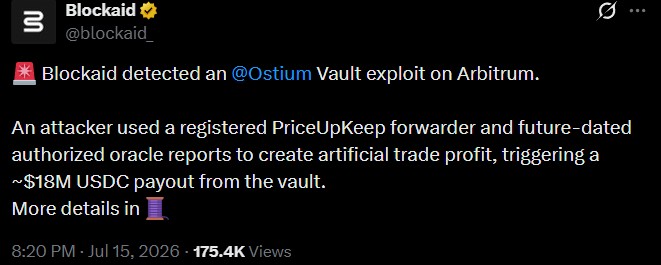
On July 15, 2026, security firm Blockaid flagged an Ostium hack, a real-world-asset (RWA) perpetuals protocol built on Arbitrum. An attacker used a registered PriceUpKeep Forwarder combined with a future-dated, authorized Oracle report to fabricate artificial trading profits.
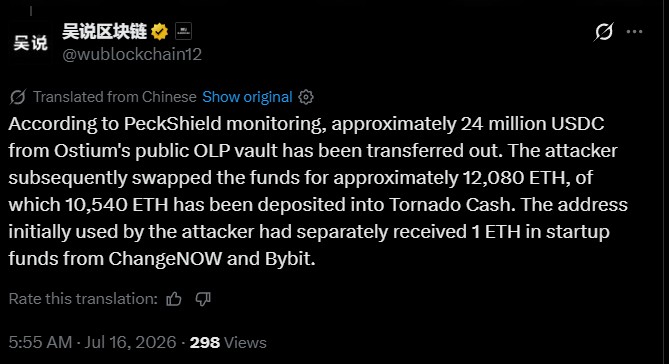
That manipulation triggered a payout of roughly $18 million in USDC from Ostium's public OLP vault. PeckShield's monitoring later put the drained amount closer to $24 million once the full flow of funds was tracked.
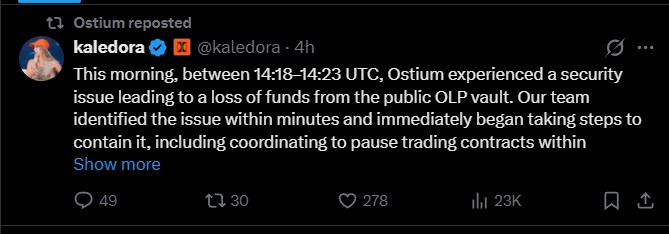
Ostium founder Kaledora confirmed the breach occurred between 14:18 and 14:23 UTC — a five-minute window. The team said it detected the anomaly within minutes and had trading contracts paused within the hour.
What Is Ostium? Ostium is a decentralized finance (DeFi) protocol built on Arbitrum that offers perpetual trading of real-world assets (RWAs), including stocks, commodities, forex, and indices. It enables leveraged trading using USDC and is backed by investors such as Coinbase Ventures, Jump Crypto, and General Catalyst.
Source: Official Post
Why This Happened?
Blockaid's analysis points to a compromised oracle signer key rather than a flaw in Ostium's core contract logic.
With signer access in hand, the attacker could authorize a price report dated for a future moment, then use a legitimate, already-registered PriceUpKeep Forwarder to push that fabricated price on-chain.
The vault's payout logic trusted the oracle input as genuine, so it settled a trade that only looked profitable because the price feed itself had been forged.
Who Did This, and How?
The exploiter's address is publicly known and was seeded with 1 ETH each from ChangeNOW and Bybit exchange before the attack, a common pattern for funding "clean" wallets.
Using the forged report, the attacker opened and closed positions that appeared profitable on paper, draining the OLP vault, then swapped USDC for ETH and moved most of it to Tornado Cash.
Source: Blockaid X
Why This Matters for Traders and Investors
Ostium isn't a small experimental protocol. It offers perpetual contracts on stocks, commodities, forex, and indices with leverage up to 200x, and had raised approximately $27.8 million from backers including General Catalyst, Jump Crypto, Coinbase Ventures, Wintermute, and GSR.
For anyone parking liquidity in RWA vaults chasing yield, this exploit is a reminder that oracle infrastructure — not just smart contract code — is a live attack surface. A single compromised or manipulated price feed was enough to unlock a nine-figure-adjacent payout.
Key Details Traders Are Tracking
Exploit window: 14:18–14:23 UTC, July 15, 2026
Amount drained: ~$18M–$24M USDC (figures vary by source/monitoring firm)
Attack method: Registered PriceUpKeep Forwarder + future-dated oracle authorization
Fund movement: Stolen USDC converted to roughly 12,080 ETH; about 10,540 ETH routed into Tornado Cash
Attacker's seed funding: The exploiter's initial address reportedly received 1 ETH from both ChangeNOW and Bybit before the attack
Source: Wu Blockchain
Has This Happened Before?
Oracle manipulation is one of DeFi's most recurring attack patterns, distinct from simple smart contract bugs because the code itself often works exactly as written.
Protocols relying on a single trusted price source or signer key remain especially exposed, since compromising that one key can be enough to fabricate an entire trade's worth of "profit."
Ostium hack adds to a long list of vault and lending exploits traced back to oracle trust assumptions rather than reentrancy or logic errors, reinforcing why auditors increasingly flag oracle design as a top-tier risk category.
How Are Users Affected?
The exploit mainly affects users who deposited funds into Ostium's public OLP vault, as millions in USDC were drained. Trading has been suspended while the investigation continues, preventing normal platform activity. Although Ostium has not reported losses for all users, affected depositors now face uncertainty over reimbursements, recovery timelines, and when withdrawals or trading services will fully resume.
What to Watch Next
It is working with law enforcement, SEAL 911, and third-party cybersecurity teams and has promised continued disclosures. Traders should watch for:
Whether Ostium hack confirms a full root-cause report on the Oracle signer compromise
Any statement on reimbursement plans for affected OLP vault depositors
Whether trading resumes with revised oracle safeguards, and on what timeline
Follow-up tracing of the Tornado Cash-routed funds by on-chain investigators
Conclusion
The Ostium Hack is one of the more technically distinct DeFi hacks of the year, relying on oracle timing manipulation rather than a straightforward contract bug. With trading paused and investigators involved, the next update from Ostium's team will likely determine whether user funds outside the OLP vault remain fully safe — and whether this becomes a cautionary tale or a quickly contained incident.
Disclaimer: This article is for informational purposes only and does not constitute financial, investment, or legal advice. Cryptocurrency markets are highly volatile and carry significant risk. CoinGabbar does not guarantee the accuracy of third-party claims referenced in this article. Readers should conduct their own research (DYOR) before making any investment decisions.