






Paradigm offers anti-quantum protection for Satoshi’s $84bn Bitcoin
 SATS
SATS
 DAN
DAN
 SATOSHI
BTC
SATOSHI
BTC
 SCR
SCR
The $84 billion worth of Bitcoin attributed to Satoshi Nakamoto could well be under threat from quantum computers. Paradigm has come up with a revolutionary solution: PACTs, a method of securing these funds without revealing their owner. A major breakthrough for the crypto ecosystem.
In brief
- Paradigm offers PACTs: quantum protection for Satoshi Nakamoto’s $84 billion Bitcoin.
- PACTs work in 3 stages: silent commitment, waiting, and secure redemption via STARK proofs.
- Bitcoin anticipated quantum, but pre-2012 addresses remain vulnerable; PACTs close this loophole.
Paradigm’s method for protecting Satoshi’s $84 billion in Bitcoin
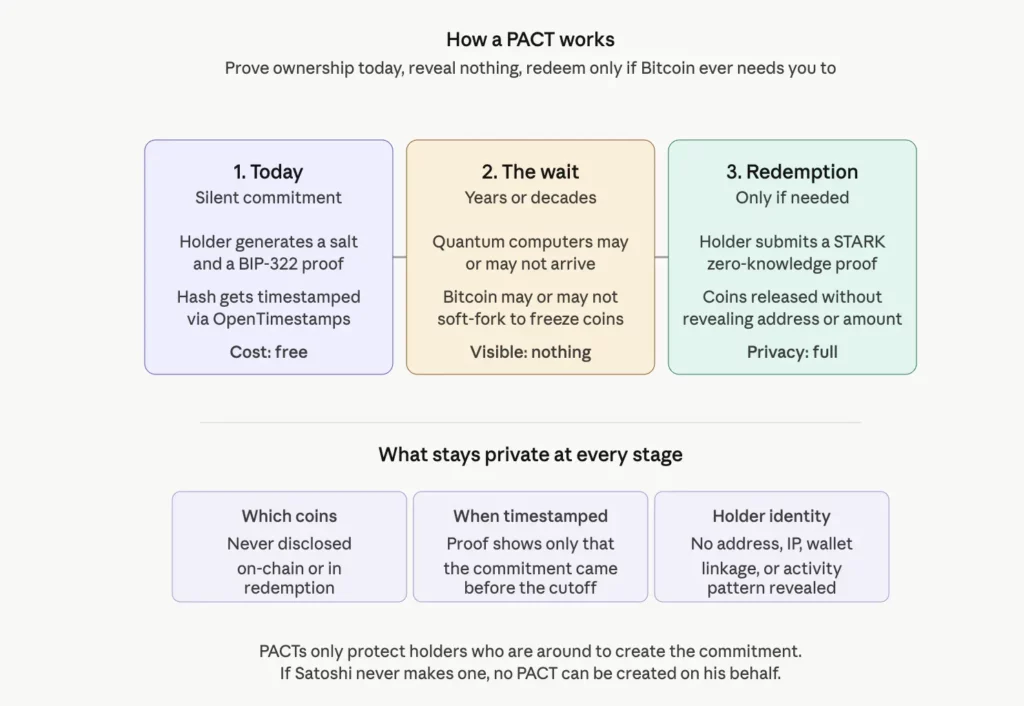
A few days after a researcher broke a crypto key using a consumer quantum computer, Paradigm, via its partner Dan Robinson, unveiled an innovative proposal: Provable Address-Control Timestamps (PACTs). This mechanism enables Bitcoin holders, like Satoshi Nakamoto, to prove their ownership without moving their funds or revealing their identity. In concrete terms, PACTs work in three stages:
- Silent commitment: the holder generates a time-stamped crypto proof via OpenTimestamps, at no cost ;
- Waiting: Data remains private, even if a soft fork freezes vulnerable addresses;
- Secure redemption: In the event of a quantum threat, a STARK (zero-knowledge) proof enables funds to be released without divulging sensitive information.
This solution avoids the dilemma of BIP-361, which required holders to reveal their identity to protect their assets. With PACTs, Satoshi could secure his 1.1 million BTC without revealing himself, while preserving Bitcoin’s decentralization and confidentiality.
Bitcoin has already anticipated the quantum threat
Contrary to popular belief, Bitcoin has already incorporated safeguards against quantum attacks right from the start. According to an analysis by Bernstein, the network uses resilient signature algorithms such as ECDSA, which, although vulnerable in the long term, are reinforced by mechanisms such as single-use addresses and hierarchical keys (BIP-32).
However, pre-2012 addresses, such as Satoshi’s, remain exposed, as they do not benefit from these modern protections. This is where Paradigm’s PACTs come in: they close this loophole by enabling a secure transition to quantum-resistant proofs, without the need for forced migration.
Bitcoin has always been proactive in the face of technological threats. Regular soft forks, such as Taproot, demonstrate its ability to evolve. With PACTs, the network could become totally resistant to quantum attacks, while preserving its ethos of decentralization and confidentiality.
Paradigm’s PACTs offer an elegant solution for protecting the funds of Satoshi and bitcoin’s early adopters. But this innovation raises a question: should we sacrifice a little bit of BTC’s decentralization for absolute security in the face of quantum?
