PrimeRevenue, a supply chain finance platform that processes payment obligations for large corporate buyers and their supplier networks, has moved to tokenize corporate payment drafts on the
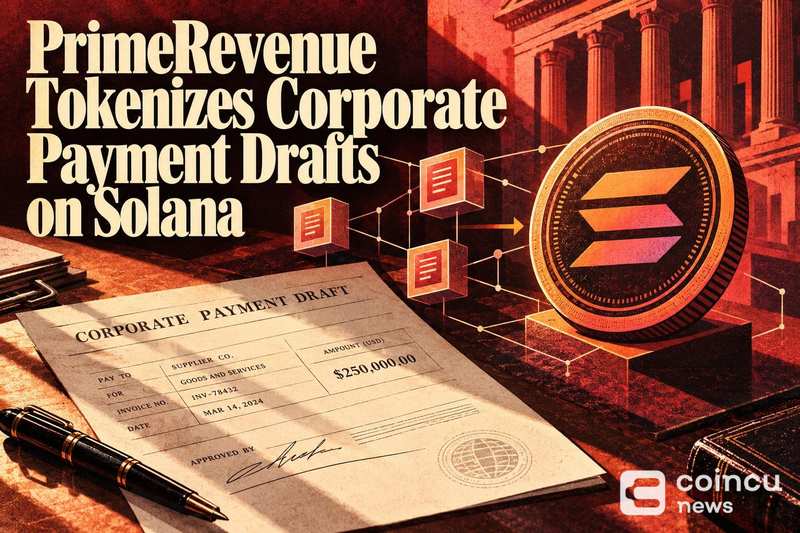
PrimeRevenue, a supply chain finance platform that processes payment obligations for large corporate buyers and their supplier networks, has moved to tokenize corporate payment drafts on the Solana blockchain, a step that positions institutional payment instruments directly on a high-throughput public ledger for the first time under the company's product umbrella.
The announcement marks a deliberate choice to bring a traditionally paper-heavy, bank-intermediated financial instrument into on-chain infrastructure, amid growing institutional interest in using programmable blockchains to digitize trade finance instruments that have remained largely unchanged for decades. The move is consistent with a broader pattern of fintech and financial services firms testing Solana as a settlement layer for non-speculative, real-economy use cases, even as the network's decentralized finance ecosystem continues to attract billions in total value locked. For related coverage, see Why Is MemeCore (M) Price Down Today? Key Drivers Explained.
PrimeRevenue operates as a working capital platform connecting large corporate buyers with their supplier bases, facilitating early payment programs that allow suppliers to receive funds before invoice due dates. Corporate payment drafts, the instrument at the center of this tokenization effort, represent a buyer's formal commitment to pay a specified amount on a future date, functioning as a negotiable claim that can be transferred, discounted, or used as collateral within trade finance workflows. For related coverage, see Ritual Launches AI-Native Layer 1 for Autonomous Agents.
What Confirmed and What Remains Conditional
As of publication, the confirmed fact is that PrimeRevenue is tokenizing corporate payment drafts on Solana. Specific implementation details, including launch timeline, transaction volumes, counterparty arrangements, the legal structure governing tokenized drafts, and the precise smart contract architecture, have not been independently verified by this publication. Readers and counterparties should treat any secondary reporting on those specifics as unconfirmed until official documentation is released. For related coverage, see Bitmine Immersion Technologies (BMNR) Announces ETH Holdings Reach 6.05 Million Tokens, and Total Crypto and Total Cash & Marketable Securities Holdings of $15 Billion.
What the announcement does establish is a directional commitment: PrimeRevenue is treating Solana as production-grade infrastructure rather than a proof-of-concept sandbox. That distinction matters for enterprise buyers evaluating whether on-chain trade finance instruments can carry the legal weight and operational reliability required for balance-sheet transactions. For related coverage, see Curve Collapses: The $930M Hole That Brought It Down.
Corporate Payment Drafts as an On-Chain Instrument
A corporate payment draft is a formal, time-bound payment obligation issued by a buyer to a payee, typically a supplier, specifying an amount and a settlement date. In traditional trade finance, these instruments circulate through bank custody, require manual reconciliation across counterparty ledgers, and settle through correspondent banking rails that can take multiple business days to finalize. Discounting a draft, converting its future value to present cash for the supplier, typically involves a financial institution verifying the draft's authenticity and the buyer's creditworthiness before advancing funds.
Tokenization, as applied to a payment draft, means representing the economic claim embedded in that instrument as a digital token recorded on a blockchain. The token carries metadata encoding the payment terms, the obligor identity, and the maturity date, allowing it to be transferred, fractionalized, or collateralized within smart contract logic without requiring manual bank intermediation at each step. A tokenized draft does not, by itself, create new legal enforceability; the underlying contractual obligation between buyer and supplier still governs, and jurisdiction-specific laws on negotiable instruments apply regardless of the on-chain representation.
This distinction between the on-chain token and the off-chain legal instrument is a structural constraint that every tokenized trade finance project must navigate. PrimeRevenue's existing position as a platform with established relationships across large corporate buyer networks gives it a stronger starting position than a greenfield crypto project attempting to enter the same space, because the legal relationships and credit underwriting infrastructure already exist off-chain. Similar logic has drawn other institutional players to experiment with tokenized real-world assets on public blockchains; OCBC Bank, for instance, launched a tokenized gold fund spanning both Ethereum and Solana, demonstrating that regulated financial institutions are actively selecting Solana alongside Ethereum for asset tokenization programs.
Why Solana Fits a Corporate Payments Architecture
Solana is named in the announcement as the network of choice, and the selection reflects identifiable operational priorities for a payment-oriented use case. Solana's architecture processes transactions at throughput levels measured in thousands of transactions per second, with fees that have historically remained in fractions of a cent per transaction, characteristics that matter when the underlying workflow involves high-frequency, low-margin supply chain payment events rather than occasional large settlements.
Programmability is the second structural advantage. Solana's smart contract environment allows payment terms, early payment discount rates, maturity triggers, and counterparty whitelisting to be encoded directly in the protocol layer rather than managed through a combination of spreadsheets, ERP integrations, and bilateral bank agreements. In theory, a tokenized payment draft on Solana could auto-settle at maturity against a stablecoin or central bank digital currency counterpart without a manual bank instruction, compressing the settlement lifecycle. Whether PrimeRevenue's implementation pursues auto-settlement or uses the blockchain primarily as an immutable audit layer is not yet confirmed.
Solana's SOL token and the network's broader ecosystem have attracted institutional attention precisely because enterprise developers can build on its infrastructure without the congestion and fee spikes that have historically affected Ethereum's base layer at peak demand. That said, Solana carries its own operational history, including past network outages that temporarily halted transaction processing. For a corporate payments workflow where settlement timing has legal and financial consequences, network reliability is a non-negotiable consideration, and institutional adopters will be watching Solana's uptime record under production load as a key evaluation metric.
Reconciliation and audit trail generation are practical benefits that often go underdiscussed in tokenization narratives. Every on-chain transaction generates an immutable, timestamped record that both buyer and supplier can independently verify through a block explorer such as Solscan, without relying on a bank or platform intermediary to produce a report. For corporate finance teams managing hundreds or thousands of outstanding payment obligations, that transparency can reduce month-end reconciliation cycles from days to minutes, provided the on-chain data maps cleanly to existing ERP and accounting systems.
Compliance, Privacy, and Integration Constraints
Corporate payment workflows operate inside tightly regulated environments. Know-your-customer and anti-money-laundering obligations require that every counterparty in a payment chain be verified, a requirement that public blockchain permissionlessness does not automatically satisfy. PrimeRevenue's existing compliance infrastructure, built to meet the requirements of large corporate buyers in regulated industries, will need to extend to cover on-chain activity, likely through permissioned token standards that restrict transfer to whitelisted wallet addresses.
Data privacy introduces a parallel constraint. Payment draft terms, including amounts, parties, and due dates, constitute commercially sensitive information that buyers and suppliers may be legally or contractually required to keep confidential. Posting that data in plaintext to a public blockchain would be incompatible with most enterprise confidentiality frameworks. Production implementations typically resolve this through either zero-knowledge proofs, which allow verification of payment validity without revealing underlying terms, or through private metadata stored off-chain with only a cryptographic hash committed to the ledger. Which approach PrimeRevenue has selected is among the unconfirmed implementation details.
Integration with existing financial systems is the third major constraint. Corporate buyers operate SAP, Oracle, and similar ERP systems that generate and track payment obligations. Suppliers receive payments through banking networks that operate on SWIFT or domestic ACH rails. A tokenized payment draft that lives only on Solana creates value only if it connects bidirectionally to those existing systems, allowing on-chain state changes to trigger off-chain banking actions and vice versa. Building and maintaining those integrations at enterprise scale is a significant engineering and operational undertaking, separate from the blockchain deployment itself.
What This Means for Supply Chain Finance and On-Chain Business Payments
If PrimeRevenue's tokenization of corporate payment drafts on Solana reaches production scale, the implications extend across several dimensions that institutional observers in both TradFi and on-chain finance are tracking. For supply chain finance as a product category, an on-chain payment draft that can be transferred instantly and settled programmatically creates the conditions for a secondary market in discounted corporate obligations that operates outside traditional bank balance sheet constraints.
For the Solana ecosystem specifically, a live enterprise payment application backed by an established fintech operator would represent a meaningful step beyond retail and speculative DeFi use cases. Enterprise adoption signals to institutional allocators and developers that the network's infrastructure can support real-economy workflows with compliance requirements, and that signal tends to accelerate the pipeline of subsequent institutional deployments.
For corporate treasury and procurement teams, the most concrete near-term benefit from a working implementation would be visibility: a real-time, auditable record of outstanding payment obligations that does not require a phone call to a bank or a report from a platform dashboard. That transparency reduces the information asymmetry that currently exists between large buyers, who know exactly when they intend to pay, and smaller suppliers, who must manage cash flow against uncertain receipt timelines.
The key constraints on adoption are not technical but organizational and regulatory. Counterparty acceptance, meaning the willingness of supplier-side finance teams and their banks to interact with tokenized instruments, will determine whether the on-chain layer becomes the system of record or merely a parallel data store that nobody actually relies on for settlement decisions. Legal enforceability of tokenized payment drafts under applicable commercial law in each buyer's and supplier's jurisdiction will need to be established before institutional treasury teams can treat these instruments as equivalent to their traditional counterparts on the balance sheet.
What to Watch Next
The next concrete milestones for this announcement are the publication of technical specifications confirming the smart contract architecture and token standard, regulatory guidance or legal opinions governing the enforceability of tokenized payment drafts in the jurisdictions where PrimeRevenue operates, and the disclosure of initial transaction volumes and counterparty counts that would establish whether this is a pilot program or a scaled commercial deployment. Institutional players evaluating the supply chain finance tokenization space will be watching whether PrimeRevenue produces an auditable on-chain transaction record on Solscan that can serve as independent verification of the workflow's production status.
The broader question for on-chain business payments over the next six months is whether compliance-ready tokenization infrastructure, the kind that satisfies AML, privacy, and ERP integration requirements simultaneously, matures quickly enough to meet the adoption timelines that enterprise buyers are now setting. PrimeRevenue's move onto Solana is a data point in that timeline, and the pace of its follow-on disclosures will indicate whether the industry is approaching a threshold where tokenized trade finance instruments become a standard procurement finance option rather than a fintech experiment.
FAQ
What did PrimeRevenue announce?
PrimeRevenue announced that it is tokenizing corporate payment drafts on the Solana blockchain. Specific implementation details, counterparties, launch dates, and transaction volumes have not been independently confirmed as of publication.
What are tokenized corporate payment drafts?
A corporate payment draft is a buyer's formal, time-bound obligation to pay a specified amount to a supplier on a future date. Tokenizing a payment draft means recording that payment claim as a digital token on a blockchain, allowing it to be transferred, discounted, or collateralized using smart contract logic rather than manual bank intermediation. The on-chain token does not replace the underlying legal contract; it represents it.
Why is Solana involved?
Solana is the blockchain named in PrimeRevenue's announcement. The network offers high transaction throughput, low per-transaction fees, and a programmable smart contract environment, characteristics that suit high-frequency corporate payment workflows. The selection of Solana over other networks is a product decision by PrimeRevenue; the specific technical and commercial reasons behind that choice have not been publicly detailed.
Does tokenization replace traditional payment and compliance processes?
No. Tokenizing a payment draft creates an on-chain representation of an existing financial obligation; it does not replace the off-chain banking rails, KYC and AML compliance processes, legal frameworks governing negotiable instruments, or ERP system integrations that corporate payment workflows depend on. On-chain and off-chain systems must be connected and synchronized for the tokenized instrument to carry operational value in a real enterprise environment.
What should counterparties and investors watch for next?
Key signals to monitor include: the publication of technical specifications and the smart contract address on Solana that would allow independent verification via Solscan; legal documentation establishing enforceability of the tokenized drafts; and disclosure of initial transaction volumes confirming whether this is a production deployment or a limited pilot. Regulatory guidance on tokenized trade finance instruments in PrimeRevenue's primary operating jurisdictions will also shape the pace of adoption.
Disclaimer: This article is for informational purposes only and does not constitute financial or investment advice. Cryptocurrency and digital asset markets carry significant risk. Always do your own research before making decisions.
The post PrimeRevenue Tokenizes Corporate Payment Drafts on Solana was initially published on Coincu.