Proof of reserves is a verification tool that can show a crypto platform controls certain on-chain assets at a moment in time, but on its own it cannot prove that the platform is solvent, liq
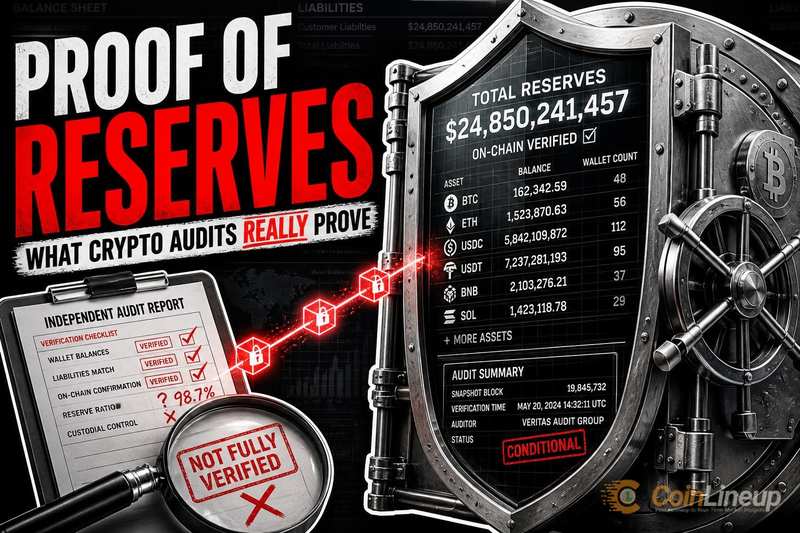
Proof of reserves is a verification tool that can show a crypto platform controls certain on-chain assets at a moment in time, but on its own it cannot prove that the platform is solvent, liquid, or safe.
KEY TAKEAWAYS
- Proof of reserves can support asset-control claims: evidence that a platform held specific wallets at a snapshot date.
- Customer inclusion proofs can support balance-accounting claims: evidence that a user's balance was counted in the liability dataset.
- Reserves alone do not establish solvency, liquidity, or safety, because they say nothing about total liabilities or operational controls.
How Proof of Reserves Verification Works
Proof of reserves is a process by which a crypto platform tries to demonstrate that it holds assets backing customer balances. A platform can show control of on-chain assets through wallet verification, either by cryptographically signing a message from a disclosed address or by moving funds from that address. For related coverage, see What Is a Stablecoin? Peg, Reserves, Redemption, and How They Work.
The customer side typically uses a Merkle tree, a data structure that aggregates every account balance into a single fingerprint called the Merkle root. Individual users receive a Merkle proof, letting them confirm their balance was included in the total without exposing every other account. Both Binance's proof-of-reserves system and Kraken's approach publish results tied to a specific snapshot date, the point in time at which balances were measured.
These exercises are usually a point-in-time attestation or an agreed-upon-procedures engagement, not a full financial statement audit. Implementations vary widely, and simply publishing a list of wallet balances is not a complete proof-of-reserves process, because it omits the liability side entirely. The cryptographic scheme behind solvency proofs is described in detail in Vitalik Buterin's write-up on proof of solvency. For related coverage, see Top RWA Crypto Projects in 2026: 10 Real-World Asset Tokens and Protocols to Know.
What Proof of Reserves Can Prove
A cryptographic wallet challenge can provide evidence that a platform controlled particular addresses at the time of verification. Because public blockchains are open, anyone can independently confirm the balances and transaction history of disclosed addresses at a specified block or time. For related coverage, see Cleveland Fed: Bitcoin's 12-Month Gains Attract New Crypto Investors.
A valid Merkle inclusion proof can show that a customer balance was included in the liability dataset used to calculate the published root, without revealing every account. These conclusions apply only to the disclosed addresses, the defined set of assets, the reported customer-balance dataset, and the snapshot date. For related coverage, see Fed Study Finds Bitcoin Returns Can Drive More Crypto Buying.
Repeatable disclosures and independently checkable methods can improve transparency and make unexplained asset movements easier to spot over time. This is useful context for assets whose entire model depends on backing, such as the reserves discussed in this explainer on how stablecoin pegs and reserves work. Still, proof that assets exist and are controlled is not the same as proof that those assets are actually available to satisfy customer claims. For related coverage, see Can a $0.0001 Crypto Make You Rich? Explore Apeing’s Upcoming Crypto Presale as TRUMP and Pepe Soar.
What Proof of Reserves Cannot Prove, and What to Check Instead
A reserve snapshot does not reveal all customer liabilities, corporate debt, pledged collateral, off-chain obligations, or claims that rank senior to customer withdrawals. Proof of reserves therefore does not by itself prove solvency, because solvency requires a reliable comparison of total assets against total liabilities.
Assets can also be borrowed or temporarily moved around a snapshot, and disclosed balances may not establish whether funds are encumbered or liquid under stress. The U.S. audit regulator has cautioned investors to exercise caution with third-party proof-of-reserve reports, noting they are not the same as audits. Common failure modes include incomplete liabilities, omitted wallets, double-counted or shared assets, borrowed funds, stale snapshots, illiquid tokens, and verifier scope limitations.
Cryptographic verification also does not assess governance, internal controls, cybersecurity, legal segregation of customer assets, withdrawal policies, or business continuity. These same segregation and backing questions surface across the sector, including in tokenized assets covered in this overview of real-world asset crypto projects.
Before relying on a proof-of-reserves claim, readers can work through a compact checklist: the publication date and frequency; the named verifier and its exact scope; the wallet ownership method; the coverage of liabilities; whether users can run their own inclusion check; asset quality and liquidity; disclosed encumbrances; withdrawal performance; and any complementary audited financial or regulatory disclosures.
Treated this way, proof of reserves is one useful transparency signal to combine with broader due diligence, not a guarantee that funds are safe. The practical question to ask is always what claim was actually tested, at what time, and what material information remains outside the test.
Disclaimer: This article is for informational purposes only and does not constitute financial or investment advice. Cryptocurrency and digital asset markets carry significant risk. Always do your own research before making decisions.
Read original article on coinlineup.com