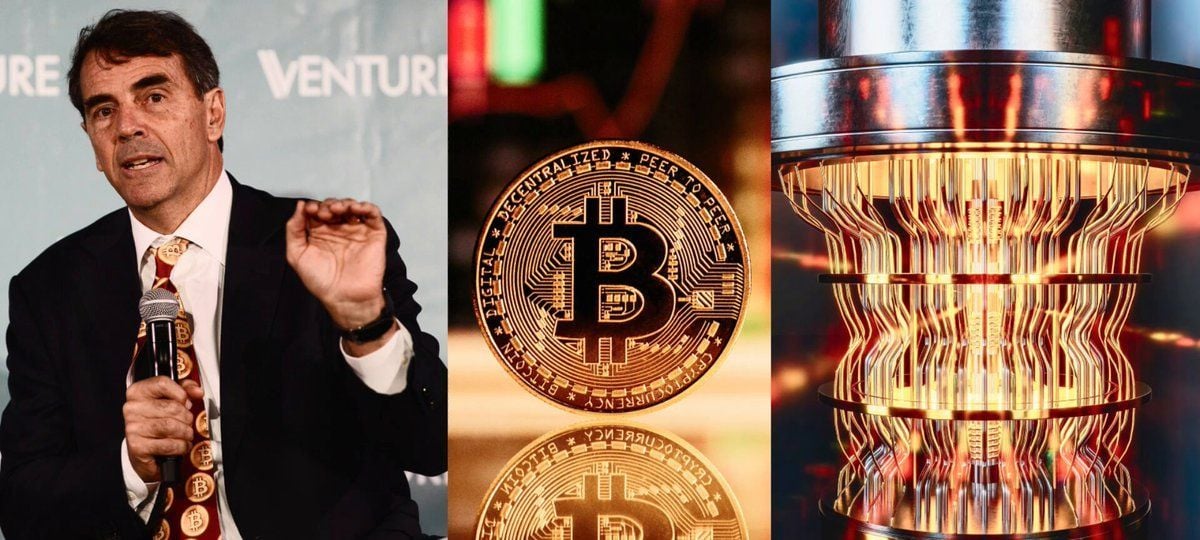
Billionaire venture capitalist Tim Draper is pushing back against fears that quantum computing will bring down Bitcoin $BTC before the network can adapt. Speaking in a recent interview, Drape
Billionaire venture capitalist Tim Draper is pushing back against fears that quantum computing will bring down Bitcoin $BTC before the network can adapt. Speaking in a recent interview, Draper argued that traditional banks are the softer target, and that legacy finance faces a far more immediate risk than the blockchain.
Banks in the Crosshairs, Not Bitcoin
Draper's reasoning centres on the relative complexity of attacking a decentralised, open-source network versus the more uniform and centralised architecture of traditional banking infrastructure. The billionaire venture capitalist argued that traditional banks and fiat systems face the more immediate threat, saying Bitcoin holdings are more secure than dollars kept in banking institutions. He also pointed to Bitcoin's adaptability: he argued that even in the event of a hack, the network could be rolled back to the last secure block, a process often described as a fork.
Not everyone agrees. Prominent Bitcoin developer Jameson Lopp argued that banks could upgrade "orders of magnitude faster" than Bitcoin to quantum threats.A blockchain rollback, while technically possible, is rarely carried out except in extreme cases and requires widespread agreement among node operators and miners. It could also run counter to Bitcoin's core argument of immutability.
A Real and Accelerating Threat
The debate is not merely theoretical. A March 2026 whitepaper by Google Quantum AI dramatically lowered the estimated barrier to entry, concluding that it would require fewer than 500,000 physical qubits to crack ECDSA-256, a 20-fold reduction from 2019 estimates.On a quantum computer with a sufficiently fast clock speed, the attack could be executed in as little as nine minutes, short enough to threaten digital signatures exposed during the Bitcoin transaction broadcast process.
Developers are already moving. Proposals such as BIP 360, Pay-to-Merkle-Root, have been introduced to create quantum-resistant address formats.Researchers note that while quantum attacks are not yet feasible, the findings increase urgency for transitioning to post-quantum cryptography and adopting interim measures to reduce blockchain vulnerabilities.
For his part, Draper remains unfazed. "It's not a threat, it's an opportunity," Draper said. The billionaire has a long track record of contrarian conviction on Bitcoin and shows no sign of changing course.
Sources:Benzinga: Tim Draper Says Bitcoin Safer Than DollarsSecurityWeek: Google Slashes Quantum Resource Requirements for Breaking Crypto EncryptionQuantum Computing Report: Re-estimating the Quantum Threat to Blockchain Infrastructure