All figures as of September 8, 2026 On September 2, Robinhood Chain ran up $19.1 million in fees, more than any other chain in crypto and about 70% more than Solana. It kept $4.3 million of t
All figures as of September 8, 2026
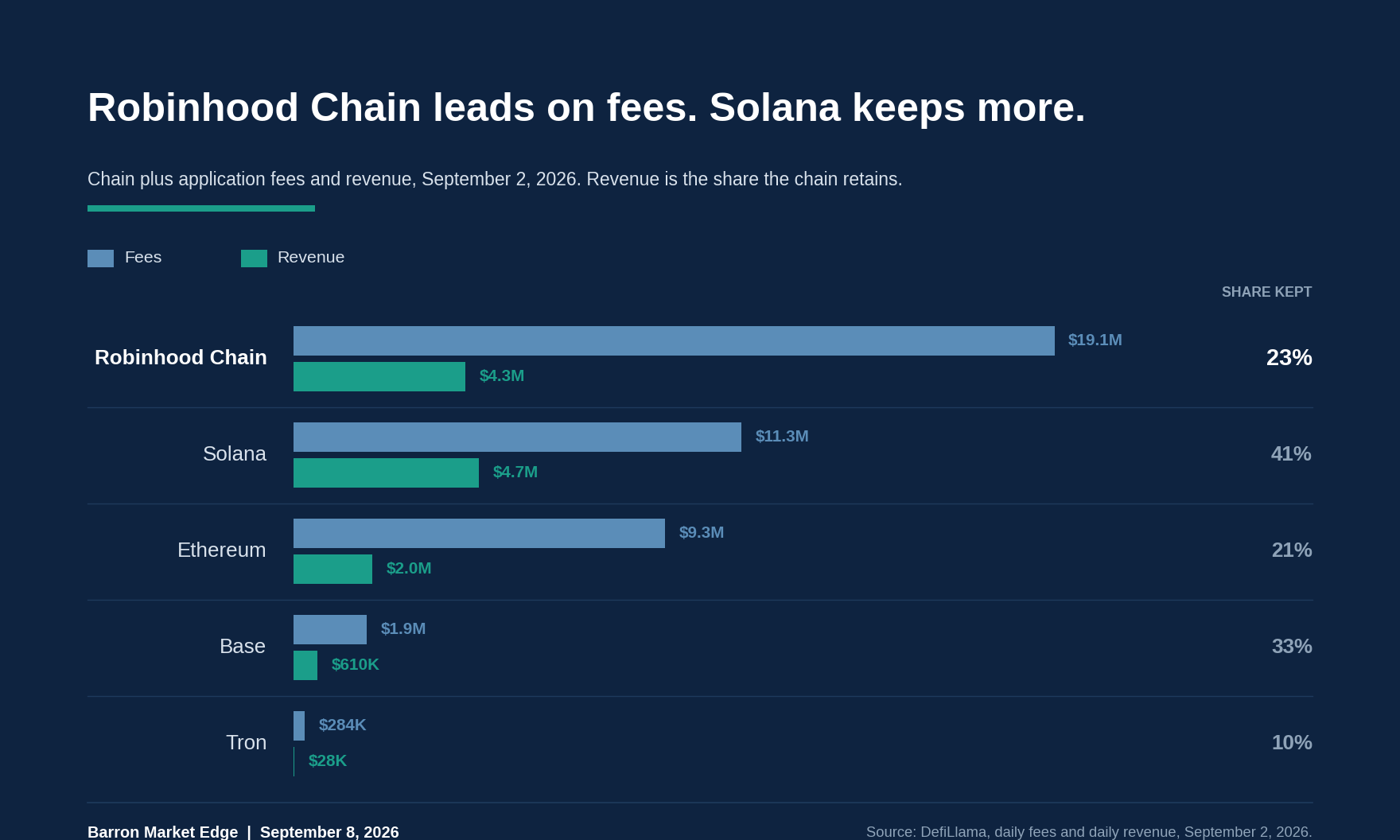
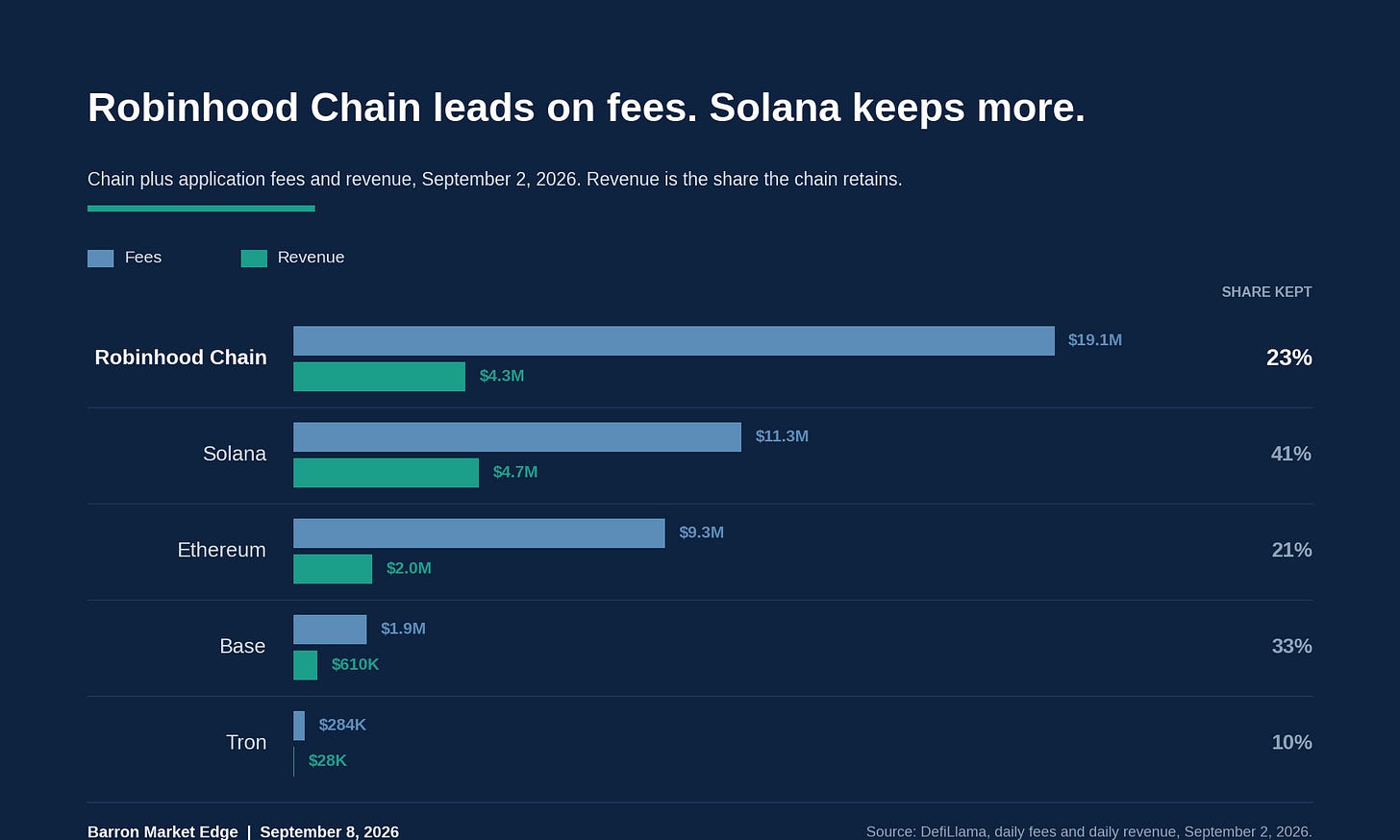
On September 2, Robinhood Chain ran up $19.1 million in fees, more than any other chain in crypto and about 70% more than Solana. It kept $4.3 million of that. Solana kept $4.7 million. Robinhood’s chain is sixty-nine days old, most of its volume is memecoins, and the company hasn’t called it material to earnings.
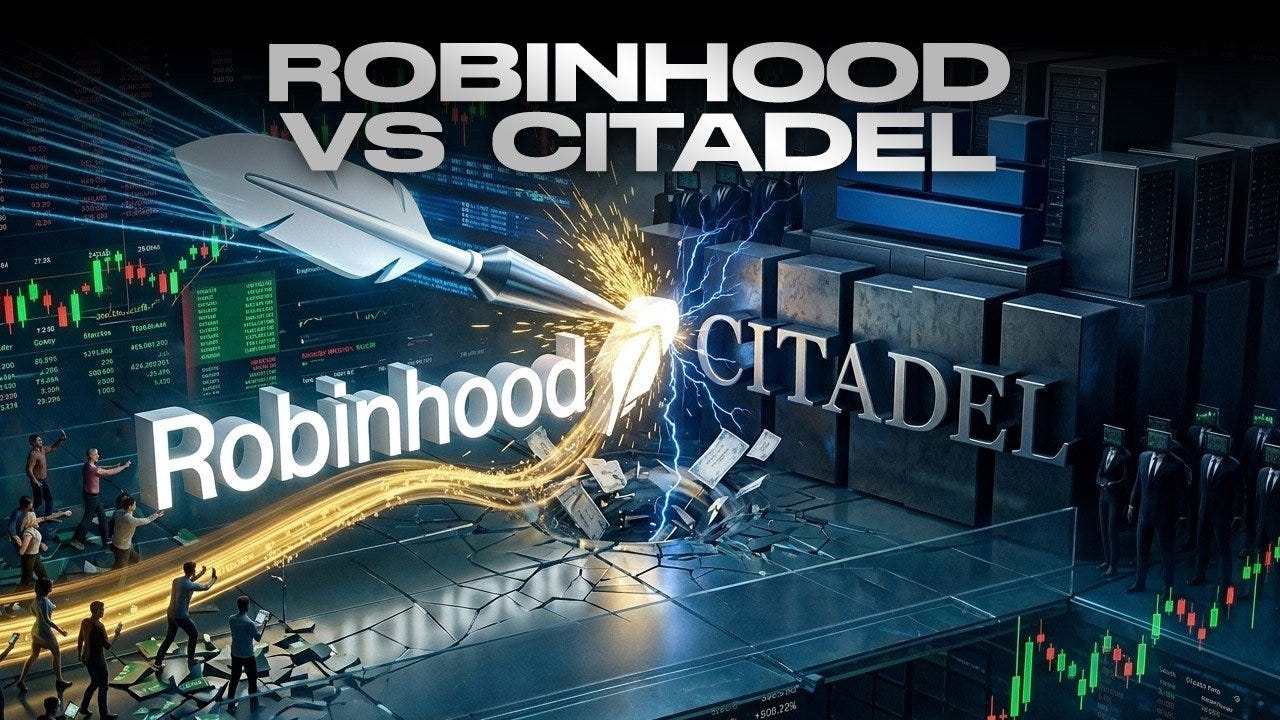
What matters is where the flow comes from. Robinhood already had 28.4 million funded customers, and since 2015 it has sold its order flow to wholesalers like Citadel Securities. On its own chain, there’s no wholesaler to sell to.
None of it is available here. Robinhood can’t sell Stock Tokens to Americans, so the chain takes no order flow from Citadel today, and it won’t until the SEC changes the rule. The objections are arriving anyway. Citadel started writing comment letters a year before this chain existed, and AMC’s CEO has hired securities counsel over a token his own shareholders are barred from buying. That’s the fight worth watching: who owns the retail customer, and who gets paid when that customer trades, argued out before the product is legal.
Earn cashback on trades of tokenized stocks: S&P 500, gold, BTC, and more. https://www.ether.fi/@paulbarron
The Numbers: Fastest L2 Ramp of the Cycle
Robinhood Chain went live July 1 as an Arbitrum-stack Ethereum Layer 2 with ETH for gas. The company’s own two-month report claims $34.6 billion in cumulative DEX volume, 576 million transactions, 12.3 million addresses, and more than 190 Stock Tokens live. Those are unaudited company figures, and we haven’t found Robinhood’s underlying post, so treat them as its claim rather than a tracker’s.
The daily prints are independently visible, and they’re the ones that turned heads. September 1 set a record DEX day at $1.595 billion, up 61% from $989 million on August 28. Gas paid on the chain rose 82-fold in eleven days, from $54,254 on August 22 to $4.45 million on September 2.
Two things to keep straight. Fees and revenue are separate columns, and running them together is how “Robinhood out-earns Solana” got into circulation. On fees, Robinhood Chain led every chain in crypto on September 2. On revenue, the money a chain actually keeps, Solana beat it that day and on both days on either side. That gap is Solana’s doing. It keeps 41% of its fees; Robinhood’s 23% sits next to Ethereum’s 21%.
For context, HOOD trades at ~$120.47 on a $108.31 billion market cap. Q2 revenue was $1.31 billion, up 32%, while crypto segment revenue fell 38% to $100 million. This chain is a bet on the next five years, not on this quarter’s print.
What’s Driving It & The September 29 Problem
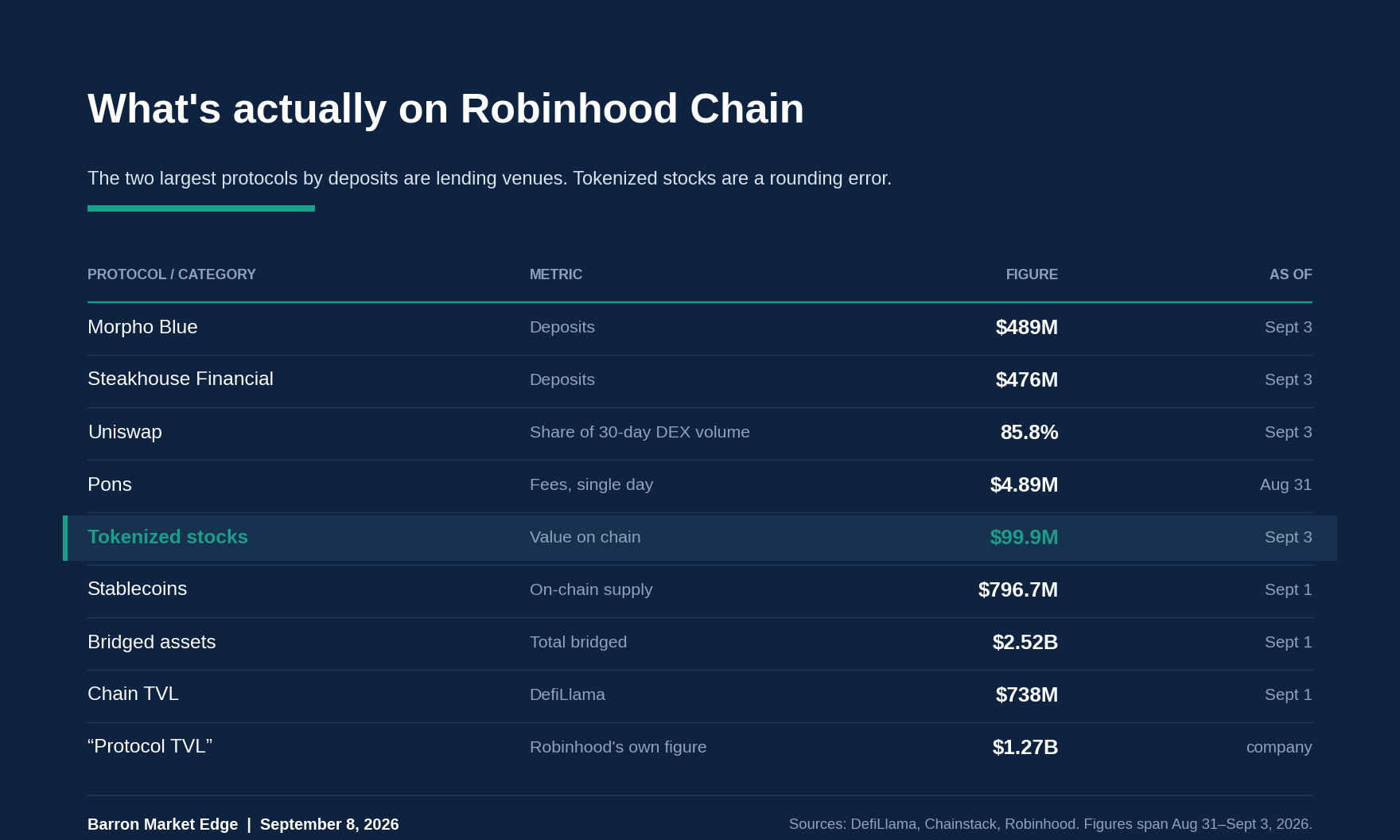
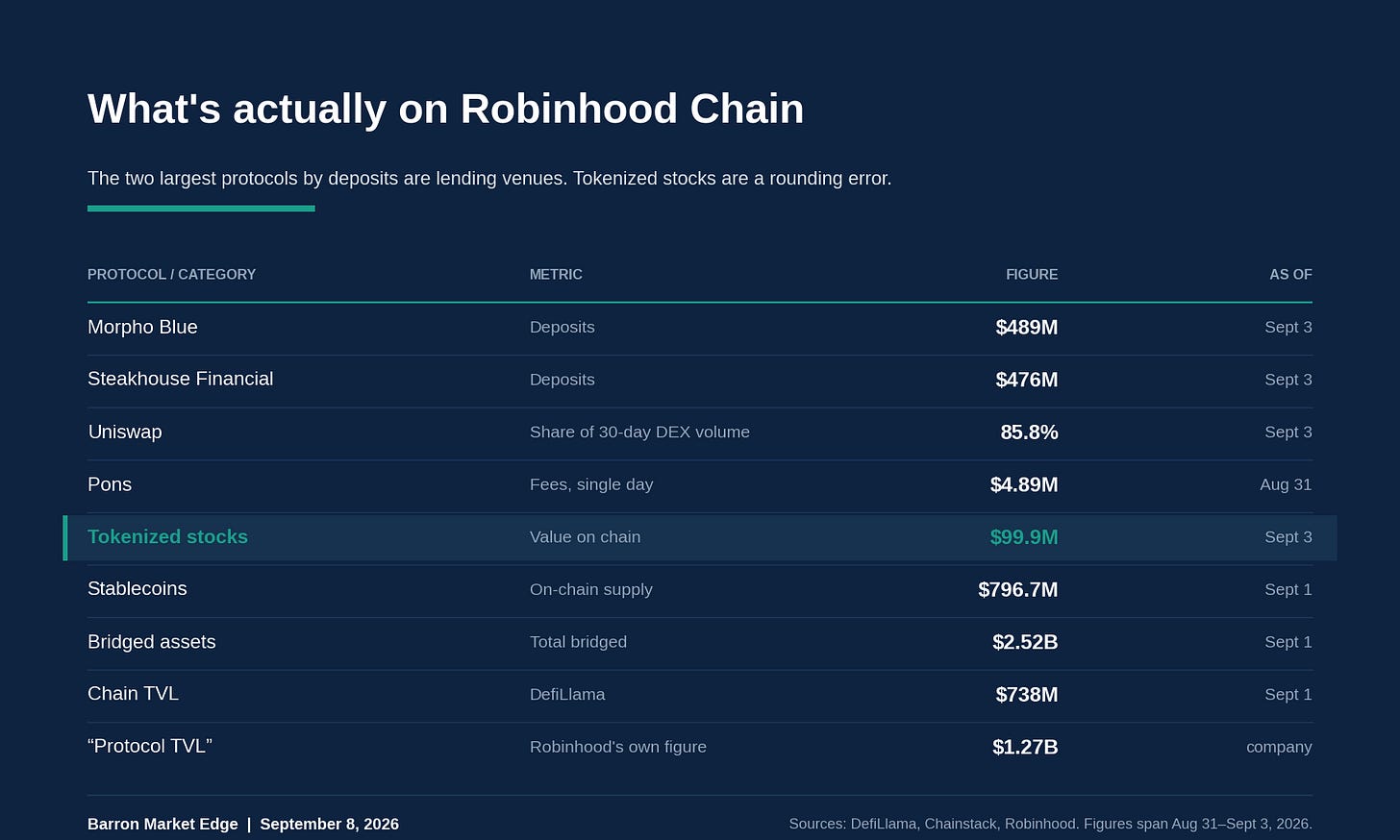
Be honest about the composition. The memecoin launchpad Pons took $4.89 million in fees in a single day on August 31, roughly 64% of all launchpad fees on the chain. Uniswap handles about 86% of tracked 30-day DEX volume. The two largest protocols by deposits are lending venues Morpho Blue and Steakhouse Financial, and neither is the Stock-Token market Robinhood pitched at launch. Tokenized stocks sit under $100 million, while the chain holds billions.
Then there’s the subsidy. The chain produced every number above while Robinhood covered swap costs above $5 for Robinhood Wallet users. That 90-day program ends September 29. Third-party wallets have been paying full freight all along. After the 29th, everyone does. Johann Kerbrat calls the design “two wolves”: speculative flow brings the crowd; stock tokens keep them. The bear case is that the crowd leaves with the free gas. Three weeks from now we find out, and the first two weeks of October are the only data that will matter.
The Citadel Connection
Citadel Securities is Robinhood’s most important counterparty, the largest wholesaler buying its equity and options order flow, and payment for order flow is still the core of Robinhood’s transaction revenue. The two firms are welded together at the plumbing level.
Which makes Citadel’s filings worth reading closely. Its July 21, 2025 letter asked whether tokenized equities would “siphon liquidity away” from US equity markets into pools that pensions, endowments and banks can’t legally touch. It argued that “seeking to exploit regulatory arbitrage for ‘look-a-like’ securities is not innovation.” A December 2 follow-up went after DeFi protocols directly, arguing they meet the statutory definitions of exchange and broker-dealer, and footnoting a16z about nine times. a16z, the DeFi Education Fund and the Uniswap Foundation answered jointly, saying Citadel had misrepresented how the technology actually works.
Neither letter mentions Robinhood Chain. Both predate it. The fragmentation argument also isn’t wrong, since splitting a stock across two pools does widen spreads for everyone. But Citadel’s business model is buying Robinhood’s orders, and it is arguing against venues where there are no orders to buy. Citadel has been a thorn in Robinhood’s side for years, and it’s one reason the chain exists at all. Robinhood hasn’t cut Citadel off and can’t. PFOF still pays the bills. It built the alternative somewhere Citadel’s comment letters don’t reach.
On September 17, the SEC will host a roundtable on 24-hour trading. Robinhood’s Matt Billings sits on Panel 1, Citadel Securities’ Michael Harrington on Panel 3, with BlackRock, Nasdaq and NYSE across the day. It was scheduled as a market-hours discussion. After last week, it became a tokenization hearing, whatever the agenda says.

iTrustCapital | Get $100 Funding Reward + No Monthly Fees when you sign up using our custom link! ➜ https://www.itrustcapital.com/go/paulbarron
The AMC Blowup & What It Actually Revealed
On Thursday, September 3, AMC CEO Adam Aron posted that Robinhood was behind a Stock Token tracking AMC shares, that AMC had nothing to do with it and hadn’t approved it, and that he found the practice “contemptible, outrageous, disgusting, detestable, inexcusable, vile.” Tenev answered, “What’s the concern?”
Aron escalated Friday, demanding Robinhood stop trading the token and saying his securities counsel would look at forcing the issue. Robinhood CLO Dan Gallagher, a former SEC commissioner, told him to send his lawyers.
AMC fell about 4% on Thursday while Aron was posting, then gained it back on Friday. After two days of public warfare with the brokerage, the shares finished about where they started.
Aron’s stated concern is shareholder rights and unregistered securities, and those are real questions. The tokens are Jersey-issued debt instruments that confer no rights in the underlying shares. The SEC walked through the difference in January. A token like this is a claim on Robinhood’s Jersey entity. It isn’t a claim on AMC, and if that entity ever fails, the holder gets in line with Robinhood’s creditors. OpenAI made that argument last year, saying it never approved any transfer of its equity. Robinhood didn’t pull the tokens. The Bank of Lithuania asked for clarifications and never said what it found. But the unstated concern is capital raising. AMC survived the last five years selling stock into retail enthusiasm, and Aron said so himself, arguing that a synthetic market “decouples stock token ownership from a company’s ability to control its own capital raising.”
The 2021 echo is what’s really changed. Last time Robinhood, Citadel and AMC shared a headline, retail’s theory was that Citadel pressured Robinhood to protect Wall Street. Now Robinhood is building the venue that routes around Citadel, Citadel is writing to the SEC asking for restraint, and the CEO whose stock retail saved wants Robinhood reined in.
Could HOOD Be the Most Valuable Financial Asset in 10 Years?
Citadel Securities has written to the SEC twice about tokenized equities. Adam Aron has hired securities counsel. Neither firm does that over $34 billion of memecoin volume on a sixty-nine-day-old chain. They’re doing it because of what the chain becomes if the Stock Token share ever moves, and both get paid out of the market structure that replaces it.
Whether that’s worth a 10x from here is a separate question. HOOD would have to compound at roughly 26% for a decade, from a multiple already north of 45x, to sit alongside JPMorgan and Visa. Four things would have to hold.
The customer. Ondo, xStocks and Binance have to buy their users. Robinhood already has 28.4 million of them funded. This breaks if the SEC never opens the door to US persons. That door is stuck: Atkins promised an “innovation exemption” in April, then the Commission pulled the August release after the White House worried it would disrupt Clarity Act negotiations. Two delays, nothing published.
The venue. Robinhood controls the sequencer and keeps most of what the chain earns. Arbitrum’s Expansion Program takes 10%, which on the September 1 peak meant $175,612 to the Arbitrum DAO. The $377,000 figure is arithmetic on a fee figure, not an observed payment. This breaks if sequencer economics never replace what PFOF pays today, and nobody has shown that they do.
The stack. Robinhood built the chain on other people’s protocols. About 86% of the DEX volume runs through Uniswap, which Robinhood doesn’t own and can’t stop from serving Coinbase tomorrow. Same with the price feed. Coinbase also has the better instrument. Its tokenized shares went live on Base in August, backed by real shares at a regulated custodian, so if Coinbase fails, those shares are still there. A Jersey debt note doesn’t do that. What’s left is the customer list, and Stock Token share of activity is the number that tests whether it’s enough.
The flow. September 29 tests whether any of this is real demand.
The AMC fight and the Citadel letters tell us the people whose margins Robinhood is targeting think the threat is real, and that’s a stronger signal than any DEX volume chart. It isn’t a valuation. A 10x on a 45x multiple is a thesis, not a forecast.
What to Watch
September 17. Nobody at the SEC planned to spend the 24-hour trading roundtable on tokenization. Then Aron started posting. Atkins has slipped the innovation exemption twice. We think he’ll slip it again rather than commit to a date while the Clarity Act is still moving.
September 29. Robinhood stops paying for gas. Traders who haven’t paid a fee on this chain all summer get their first bill, and the daily DEX prints that week will say whether any of this was real demand.
The other CEOs. A demand letter from AMC is noise. One angry issuer is a rant; five is a pattern.
Q3 earnings. Someone finally asks management to put a number on chain economics against PFOF.
Stay tuned. We’ll keep tracking how this distribution fight unfolds.
This is not financial advice. Figures are as of September 8, 2026, from DefiLlama, Chainstack and Robinhood’s dashboard. Fees and revenue are different metrics; both here are chain-plus-application figures. Trackers disagree, several metrics rest on one source, and Robinhood’s two-month numbers are company-reported and unaudited. HOOD is volatile, tokenized stocks are legally unsettled, Stock Tokens are unavailable to US residents, and the subsidy behind every chain metric above ends this month. DYOR.