Introduction Crypto rarely moves in straight lines. Instead, it moves in narratives. Every bull market creates a new story that captures the attention of retail investors, attracts fresh liqu
Introduction
Crypto rarely moves in straight lines.
Instead, it moves in narratives.
Every bull market creates a new story that captures the attention of retail investors, attracts fresh liquidity, and produces extraordinary winners. Sometimes those narratives are built around revolutionary technology. Other times, they are driven almost entirely by memes.
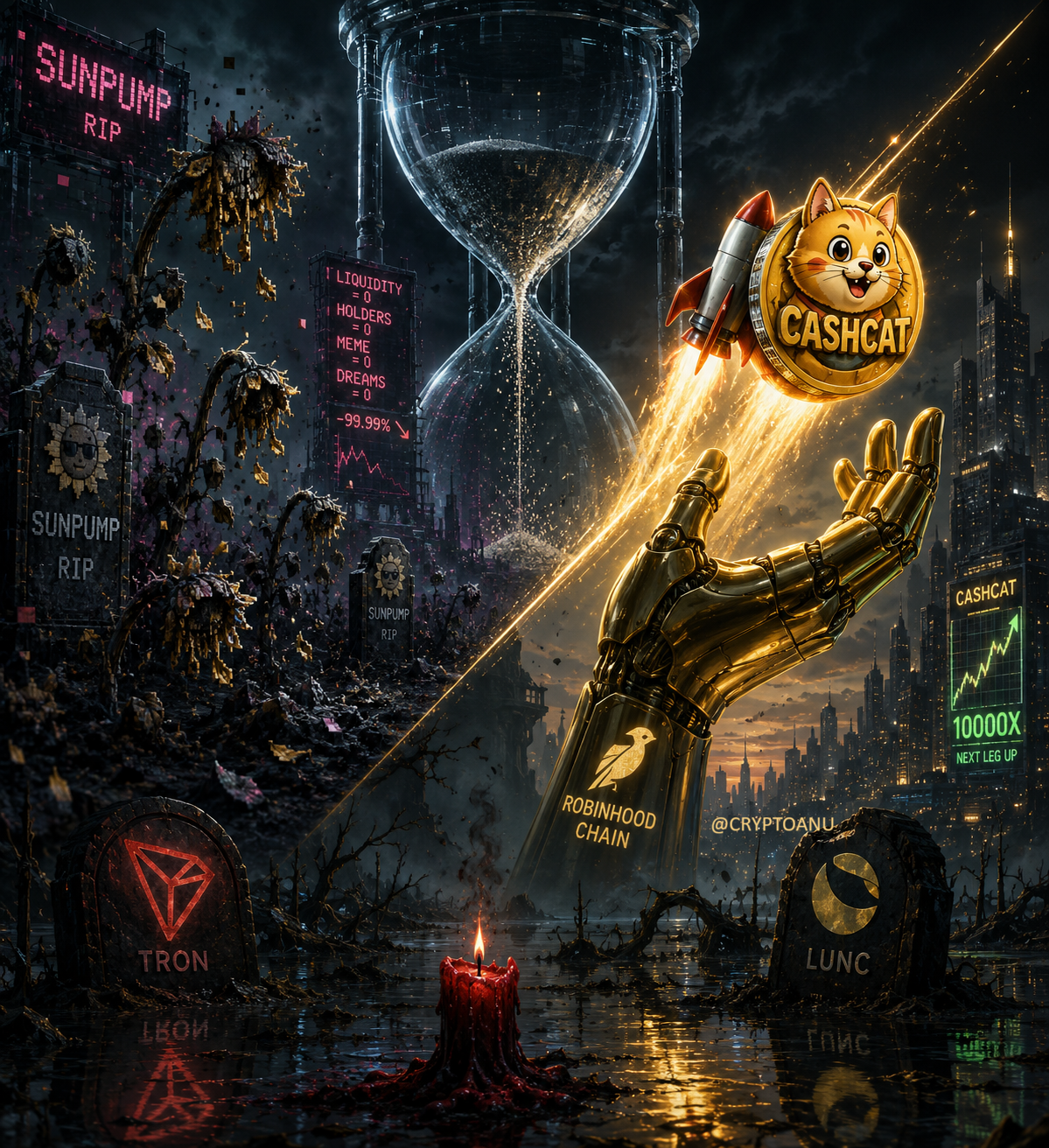
In 2024, one of the strongest examples of this phenomenon was TRON's SunPump ecosystem. Thousands of memecoins launched within weeks, speculative trading exploded, and enormous fortunes were made almost overnight. Yet as excitement faded, the overwhelming majority of those tokens collapsed by more than 90%.
Fast forward to 2026, and another blockchain appears to be following a remarkably similar path.
Robinhood Chain, originally introduced as infrastructure for tokenized real-world assets, has unexpectedly become one of crypto's fastest-growing memecoin ecosystems. At the center of the movement sits $CASHCAT, a token that surged more than 1,400% shortly after launch and helped ignite one of the biggest retail trading frenzies of the year.
The similarities between these two ecosystems raise an important question:
Is Robinhood Chain creating the next major blockchain ecosystem—or simply repeating the SunPump cycle?
The SunPump Blueprint
SunPump demonstrated how quickly memecoins can transform an ecosystem.
The ingredients were simple:
- Extremely low transaction costs
- Instant token launches
- Strong social media narratives
- Viral speculation
- Massive retail participation
Within weeks, thousands of new projects appeared.
Liquidity flooded into TRON.
Volumes reached impressive levels.
For a brief period, it seemed as though every new token could become the next breakout success.
Reality eventually caught up.
Most projects disappeared.
Many investors were left holding illiquid tokens that never recovered.
However, the blockchain itself benefited.
TRON gained users, activity, and visibility far beyond what traditional marketing campaigns could have achieved.
Robinhood Chain Is Following a Familiar Path
Robinhood Chain launched with an entirely different objective.
Its primary focus was tokenized stocks, real-world assets, and AI-native financial infrastructure.
The community, however, had other ideas.
Thanks to low fees, fast settlement, decentralized exchanges, and easy token creation, memecoins rapidly became the dominant narrative.
Rather than discussing tokenized equities, traders began discussing viral meme launches.
Within days, Robinhood Chain had become one of crypto's most active speculative ecosystems.
The Rise of $CASHCAT
Every successful memecoin cycle needs a flagship project.
For Robinhood Chain, that role belongs to $CASHCAT.
Inspired by Robinhood's early internal mascot, the token quickly became the ecosystem's defining symbol.
Its explosive rise attracted attention across Crypto Twitter, decentralized exchanges, and trading communities.
The remarkable appreciation in both price and trading volume demonstrated how powerful narrative-driven markets can become.
Whether or not $CASHCAT ultimately succeeds over the long term, its importance extends beyond its own market capitalization.
It represents the moment Robinhood Chain officially entered crypto's meme economy.
Why Memecoins Matter
Many investors dismiss memecoins as pure speculation.
While individual projects often fail, memecoins consistently perform an important role within blockchain ecosystems.
They attract users.
They create wallets.
They increase trading activity.
They generate liquidity.
Developers frequently follow liquidity.
Applications follow developers.
Infrastructure grows around active users.
History suggests that successful blockchain ecosystems often experience a speculative phase before broader adoption arrives.
Ethereum experienced ICO speculation.
Binance Smart Chain experienced memecoin speculation.
Solana experienced memecoin speculation.
TRON experienced SunPump.
Robinhood Chain may simply be entering the same stage.
Fresh Retail Capital Changes Everything
One factor distinguishes Robinhood Chain from many previous ecosystems.
Robinhood already serves millions of retail investors through its traditional financial platform.
Many of these users have little or no experience interacting with decentralized finance.
Robinhood Chain lowers that barrier significantly.
If even a small percentage of Robinhood's user base begins experimenting with on-chain assets, the resulting influx of new participants could reshape the ecosystem far beyond the current memecoin narrative.
Unlike previous cycles that primarily recycled existing crypto liquidity, Robinhood has the potential to introduce entirely new participants into blockchain markets.
Lessons from SunPump
SunPump teaches several valuable lessons.
First, narratives are incredibly powerful.
Second, early participants often capture the largest rewards.
Third, most speculative assets fail.
The blockchain itself, however, frequently emerges stronger.
This distinction is critical.
Investors often confuse successful ecosystems with successful individual tokens.
The two are not always the same.
What Does This Mean for LUNC?
For Terra Luna Classic investors, Robinhood Chain should not necessarily be viewed as competition.
Instead, it may represent another source of expanding market liquidity.
Historically, during strong bull markets, capital rarely remains isolated within a single ecosystem.
Bitcoin leads.
Large-cap altcoins follow.
Eventually, speculative liquidity rotates into community-driven ecosystems such as LUNC.
If Robinhood successfully attracts millions of new crypto participants, the entire digital asset market could benefit—not only Robinhood Chain itself.
Risks Should Not Be Ignored
Despite the excitement, investors should remain cautious.
Rapid token launches create opportunities, but they also increase risks:
- Rug pulls
- Copycat projects
- Liquidity fragmentation
- Unsustainable valuations
- Extreme volatility
History reminds us that while ecosystems may thrive, individual speculative tokens often do not.
Distinguishing between infrastructure and short-term hype remains one of the most valuable skills in crypto investing.
Conclusion
Robinhood Chain and TRON's SunPump share striking similarities.
Both demonstrate how communities—not corporations—often define the identity of blockchain ecosystems.
Both show the extraordinary power of memes to attract liquidity and users.
Yet they also remind investors that speculation alone rarely creates lasting value.
The coming months will determine whether Robinhood Chain becomes another temporary memecoin frenzy or evolves into a mature blockchain ecosystem capable of sustaining long-term growth.
Either way, one lesson remains clear:
In crypto, technology builds the platform.
Communities build the narrative.