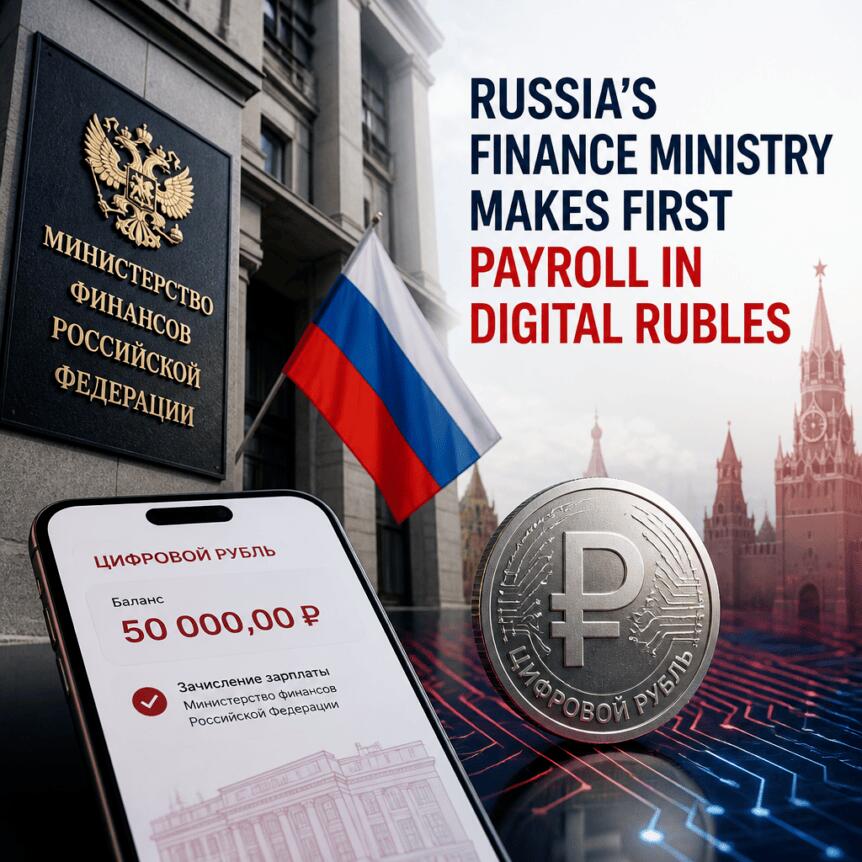
Russia’s Ministry of Finance said Friday that some of its employees have started receiving wages in digital rubles—marking an early real-world use case for the central bank’s tokenized curren
Russia’s Ministry of Finance said Friday that some of its employees have started receiving wages in digital rubles—marking an early real-world use case for the central bank’s tokenized currency. The option for payroll payments in the digital ruble began on Thursday, Oct. 1, and is described as voluntary for participating citizens.
In a press release, the ministry said it has not disclosed how many employees took part or the total amount paid out in digital rubles. It did, however, frame the move as a deployment of “proven rails” already tested during government spending trials next year.
Key takeaways
- Russia’s Ministry of Finance says it has started paying some employees in digital rubles on Oct. 1, under a voluntary program.
- The ministry did not specify participation numbers or the payroll value in digital currency.
- Russia cited prior budget-process trials in 2025, referencing the disbursement of about 16 million digital rubles (roughly $192,245).
- Implementation for budget-related use is described as a joint effort between the Bank of Russia and the Ministry of Finance.
- The digital ruble rollout has been shaped by EU sanctions announced in April, which targeted the currency.
Payroll in digital rubles begins on a voluntary basis
According to the ministry’s announcement, citizens can choose to receive wages in the digital ruble issued by the central bank. The ministry described the wage payments as part of a broader availability of digital rubles to the public, rather than a mandatory conversion of payroll into the tokenized format.
The practical impact for employees is straightforward: if they opt in, compensation flows through the digital ruble system. For observers, it is a signal that Russia is moving from pilots and trials into routine administrative operations—at least within parts of the federal workforce.
Why the ministry points to 2025 budget trials
In its release, the Ministry of Finance linked the payroll start to earlier testing of digital-ruble rails during federal budget spending trials in 2025. The ministry said about 16 million digital rubles (reported as $192,245) were disbursed during those trials.
While the ministry did not provide further operational detail—such as how payroll integration works behind the scenes—its emphasis on previously tested infrastructure is notable. It suggests that the payroll rollout is intended to reuse mechanisms already validated in budget execution scenarios, potentially reducing implementation risk compared with launching from scratch.
For investors and market participants tracking central bank digital currencies, the move underscores a recurring pattern: CBDC programs often progress from controlled payment or procurement pilots toward institutional workflows before broader consumer scaling. What remains unclear is how widely wage payments could expand beyond the initial group of ministry employees and what uptake looks like once voluntary opt-in is offered.
Bank of Russia and the Ministry of Finance coordinate rollout work
The ministry stated that work on incorporating the digital ruble into the budget process is being carried out by the Bank of Russia together with the Ministry of Finance. This aligns with the notion that CBDC deployment in government contexts requires both issuance/technical authority from the central bank and policy execution coordination from the finance ministry.
Earlier reporting by Cointelegraph on July 2 said Russia planned to launch the central bank digital currency on Sept. 1, when major banks and retail companies would begin enabling transactions with the new currency. At that time, coverage also described the digital ruble as intended to complement Russia’s fiat ruble and initially be accepted by financial and credit institutions, citing statements from Russian state media.
Sanctions continue to loom over the digital ruble
Russia’s digital ruble progress has taken place against a backdrop of international restrictions. In April, EU authorities announced restrictions that targeted the digital ruble, according to the European Council. The Council said the sanctions package responded to Russia’s “war of aggression against Ukraine,” which it started in February 2022.
These kinds of measures can affect the CBDC ecosystem indirectly—through banking relationships, cross-border compliance, and the ability of certain counterparties to engage with new financial infrastructure. However, the payroll step announced by Russia’s Ministry of Finance suggests that domestic rollout efforts remain active even amid external pressure.
What to watch next is how the digital ruble’s use expands beyond internal government payroll and trials. The ministry did not disclose whether the pilot will widen quickly, nor did it provide any public metrics beyond the previously cited 2025 budget spending figure. Readers should also monitor whether additional institutional wage or government payment channels are added after the initial voluntary opt-in phase.
This article was originally published as Russia’s Finance Ministry Makes First Payroll in Digital Rubles on Crypto Breaking News – your trusted source for crypto news, Bitcoin news, and blockchain updates.