



RWA Market Hits $38B as Institutions Expand Tokenized Finance on Blockchain
ETH
 XZK
XZK
 UTED
UTED
 IBIT
IBIT
 BLACKROCK
This article was first published on TurkishNY Radio.
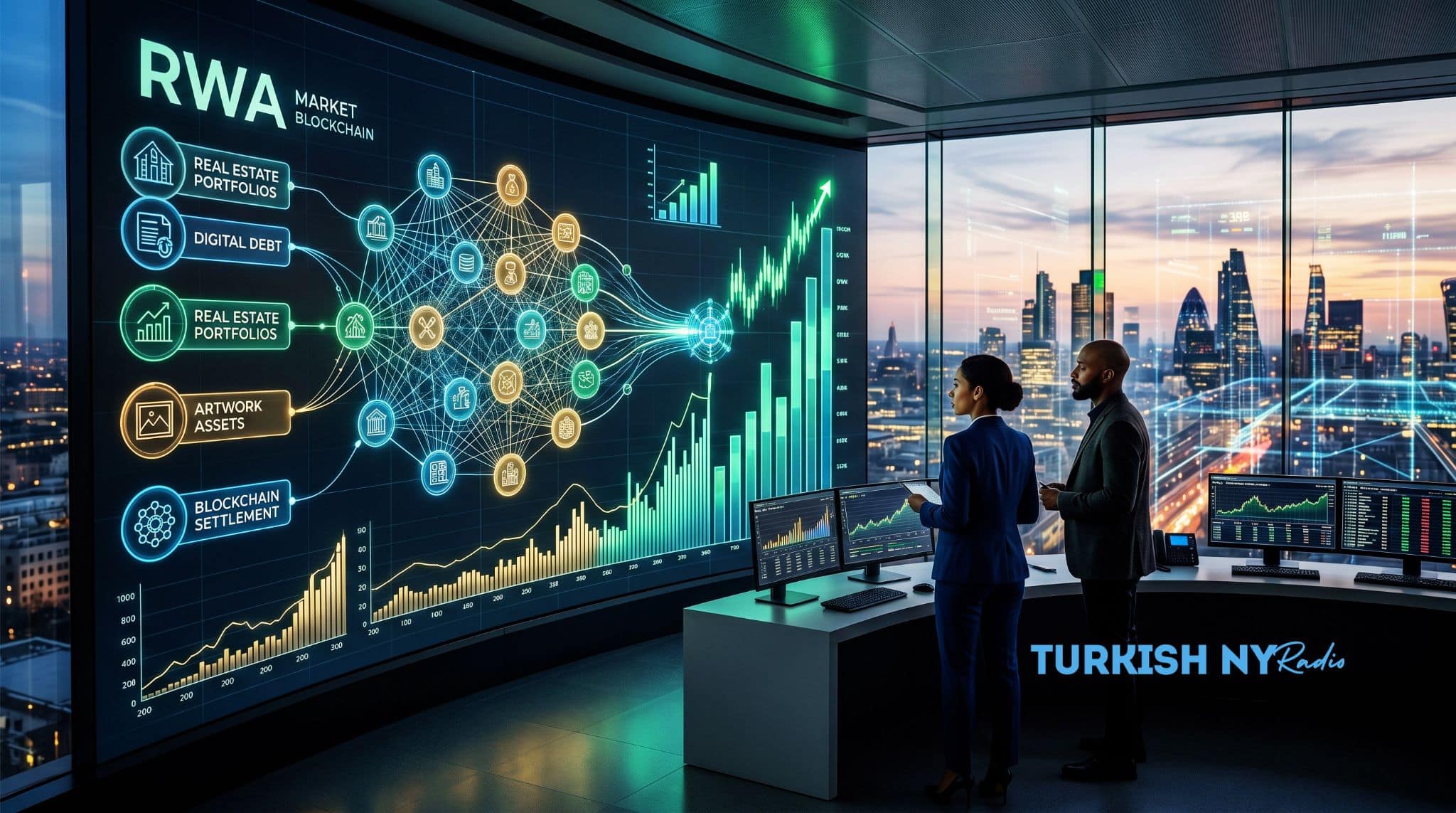
The RWA market has climbed to $38 billion, showing how tokenized real-world assets are becoming one of the strongest areas of growth across the digital asset sector.
Blockchain-based versions of traditional financial products are continuing to attract attention from institutional investors, fintech firms, and crypto infrastructure providers.
The latest rise in the RWA market comes as financial companies increasingly explore tokenized treasuries, private credit, and blockchain settlement systems as part of broader digital finance strategies.
RWA Market Pushes Deeper Into Traditional Finance
The RWA market includes blockchain-based representations of traditional assets such as government bonds, treasury bills, private lending products, commodities, and real estate investments.
Instead of relying entirely on legacy banking systems, tokenized assets allow ownership records and transactions to move through blockchain networks. Supporters believe this can reduce settlement delays, improve transparency, and lower operational costs.
Tokenized U.S. Treasury products have become one of the fastest-growing segments inside the RWA market during the past year. Several blockchain-based treasury funds now manage billions of dollars in assets.
The growing size of the RWA market also reflects a broader shift in how financial institutions are approaching blockchain technology. Rather than focusing only on speculative crypto trading, many firms are now exploring blockchain systems for payments, settlements, and yield-generating financial products.

RWA Market Sees Rising Institutional Demand
Large financial firms have steadily increased blockchain-related activity during the past two years. Companies including BlackRock, Franklin Templeton, and JPMorgan Chase have either launched or tested tokenized asset initiatives tied to blockchain infrastructure.
Tokenized private credit products are also expanding quickly inside the RWA market. Investors are increasingly using blockchain-based lending platforms to access fixed-income opportunities that were traditionally limited to institutional finance.
Market analysts say the appeal is partly tied to efficiency. Blockchain settlement systems can operate continuously, while tokenization also allows fractional ownership structures that may widen investor access.
The RWA market has additionally benefited from demand for blockchain products connected to relatively stable yields, especially during periods of volatility across broader crypto markets.
Ethereum Remains the Main Hub for the RWA Market
Ethereum continues to dominate a large share of tokenized finance activity, particularly in treasury-backed products and institutional blockchain settlement systems.
Ethereum hosts most major tokenized treasury projects currently operating in the market. However, competing blockchain networks are also attempting to gain market share by offering lower fees and faster transaction processing.
Solana, Avalanche, and several permissioned blockchain systems have expanded efforts to support institutional tokenization projects during recent months.
As the RWA market grows, competition between blockchain ecosystems is expected to intensify, especially among networks targeting banks, payment providers, and large financial institutions.
Regulation Could Decide the Pace of Future Growth
Regulatory clarity remains one of the biggest factors influencing the future of the RWA market.
Governments and financial regulators across the United States, Europe, and Asia are continuing to evaluate rules tied to digital securities, tokenized investment products, and blockchain settlement infrastructure.
Many institutional firms are waiting for clearer compliance frameworks before scaling tokenized finance products more aggressively.
Even so, the RWA market reaching $38 billion shows that tokenized finance is moving beyond a small experimental category inside crypto. The sector is now becoming part of a larger conversation about how traditional financial infrastructure could operate through blockchain networks in the years ahead.
Summary
- The RWA market has grown to $38 billion as more financial companies move traditional assets like treasuries and private credit onto blockchain networks.
- Investors are showing stronger interest in tokenized finance because it offers faster settlements and easier access to yield-focused products.
- Ethereum continues leading the sector, while other blockchain networks compete for institutional adoption.
- Major firms such as BlackRock and JPMorgan Chase are steadily expanding their blockchain finance strategies.
Glossary of Key Terms
| RWA Market | The RWA market is where real-world assets like property, bonds, or commodities are turned into digital assets that can move through blockchain networks. |
| Tokenized Assets | Tokenized assets are digital versions of traditional investments, similar to converting physical paperwork into online ownership records that are easier to trade. |
| Blockchain | A blockchain works like a shared digital notebook where transactions are recorded securely and cannot easily be changed or erased afterward. |
| Tokenized Treasuries | These are blockchain-based versions of government treasury products that let investors access yield-focused investments through digital platforms instead of traditional systems. |
| Private Credit | Private credit refers to loans provided by investment firms or private lenders rather than banks, usually offering fixed returns to investors over time. |
| Ethereum | Ethereum is one of the most widely used blockchain networks for building digital assets, payment systems, and tokenized finance products. |
| Settlement | Settlement is the final step of a transaction where ownership and payments are officially completed between buyers and sellers. |
| Fractional Ownership | Fractional ownership allows people to buy small shares of expensive assets, much like owning one piece of a large property or investment. |
FAQs About RWA Market
What is the RWA market?
The RWA market brings real-world assets like government bonds, private credit, real estate, and commodities onto blockchain networks for easier and faster digital trading access.
Why are big financial firms interested in the RWA market?
Many institutions see the RWA market as a way to improve settlements, reduce costs, access stable returns, and modernize parts of traditional financial infrastructure systems.
Is the RWA market safe for investors?
The RWA market is growing under developing regulations, while blockchain security, licensed custodians, and compliance standards continue improving to support safer institutional participation globally.
Which blockchain networks are leading the RWA market?
Ethereum currently handles most RWA market activity, but networks like Solana and Avalanche are also expanding tokenized finance services for institutions and digital asset firms.
References
