



Singapore Gulf Bank Stablecoin Push Adds Zero-Fee Solana Access
 STABLE
 BANK
BANK
 SOL
SOL
 USDC
USDC
 WOULD
WOULD
Singapore Gulf Bank has turned its stablecoin strategy into a live banking product, giving corporate and high-net-worth clients direct fiat-to-stablecoin conversion and temporary zero-fee access on Solana. The rollout turns an earlier infrastructure plan into an active service aimed at large-ticket treasury flows rather than retail trading.
What to Know
- In its April 17, 2026 launch note, SGB said eligible clients can convert between fiat and stablecoins directly from SGB accounts, starting with USDC transactions above USD 100,000.
- SGB said it will waive both gas and bank fees on Solana for a limited period, with USDT, USDe, and USDG listed as the next assets to follow.
Singapore Gulf Bank’s Stablecoin Expansion in Focus
In its April 17, 2026 announcement, Singapore Gulf Bank said corporate and high-net-worth clients can mint and redeem stablecoins directly from their bank accounts. That makes the story notable as a bank-led crypto adoption move, because the conversion rail sits inside a regulated deposit relationship rather than on a standalone exchange wallet.
The live service begins with USDC transfers above USD 100,000, and SGB said USDT, USDe, and USDG are planned next. That initial threshold suggests the bank is targeting treasury desks, OTC-style settlement, and large private clients instead of day-to-day retail payments.
In its February 2, 2026 platform update, SGB said SGB Net was already handling more than USD 2 billion in monthly fiat transaction volume and would extend stablecoin support across Solana, Ethereum, and Arbitrum. SGB also said it is licensed and regulated as a Conventional Wholesale Bank by the Central Bank of Bahrain, with KYC, KYB, and AML controls built into the platform.
Blockhead’s February 3, 2026 report separately said SGB Net would support USDC and USDT across Solana, Ethereum, and Arbitrum. That independent confirmation matters because it shows the April go-live terms are follow-through on a disclosed cross-chain banking plan, not a last-minute marketing pivot.
Why Zero-Fee Solana Access Matters
SGB’s limited-period fee waiver lands on a network that already has scale: DeFiLlama currently lists Solana TVL at about USD 13.32 billion. For a bank deciding where to route its first live mint-and-redeem lane, that data point gives Solana more weight than a low-fee narrative alone.
CoinGecko showed SOL at about USD 88.89, with a market cap near USD 51.1 billion, when this article was prepared. Those figures help explain why a regulated bank would treat the Solana network as a serious settlement venue rather than a niche altcoin rail.
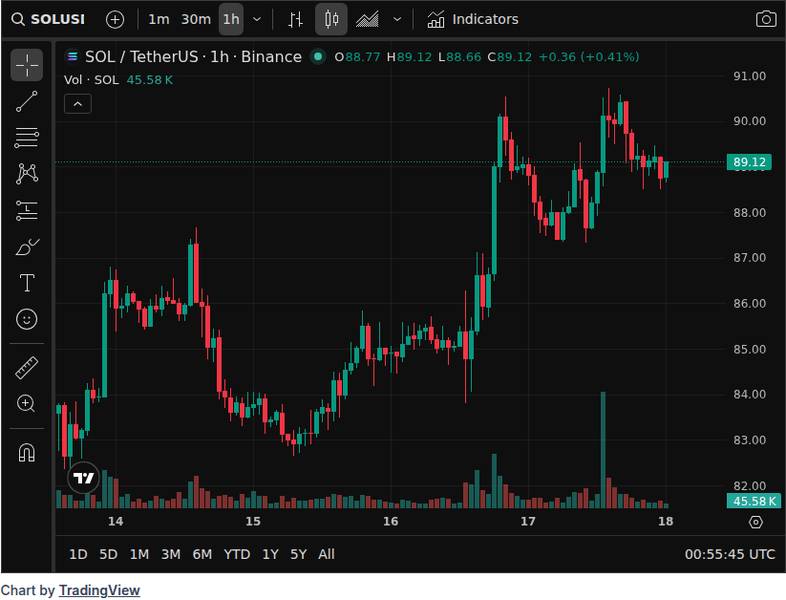
With the USD 100,000 USDC minimum in place, SGB’s temporary waiver of both gas and bank fees on Solana lowers the cost of testing bank-led stablecoin flows. That is the practical differentiator in the launch, because the offer removes two layers of transaction friction at the exact point where institutions decide whether a new rail is worth operational effort.
Shawn Chan wrote in SGB’s February release that the product thesis was to simplify stablecoin working capital for businesses. The April launch gives that thesis a live Solana settlement path instead of leaving it as platform language.
“Stablecoins have become the working capital of the digital asset economy, yet managing them remains unnecessarily complex.”
— Shawn Chan
What the Move Could Mean for Crypto Banking Competition
The competitive positioning is clearest when the launch data points are stacked together: a USD 100,000 entry threshold, a banking network already moving more than USD 2 billion a month, and a zero-fee Solana window. That combination points to wholesale settlement and treasury operations, which is a different battleground from exchange-led retail crypto services.
The broader market context is still cautious, with the Fear & Greed Index at 26. Against that backdrop, SGB’s expansion looks more like infrastructure positioning than a momentum trade tied to short-term sentiment.
Institutional interaction with digital assets is already showing up through large regulated transfers and official actions, as seen in US Government Moves Bitcoin Linked to $9 Billion Bitfinex Hack. SGB is trying to capture the service layer between that kind of institutional balance-sheet activity and the stablecoin rails now available inside its own banking stack.
Outside banking, crypto businesses are still competing to keep users inside dollar-linked payment loops, which is also visible in Best Crypto Casinos of 2026: Spartans, Stake, Bitcasino.io, & Rollbit Redefine Online Gambling and Spartans Casino Claims the #14 Spot Worldwide While Razed Faces Regulatory Struggles & Gamdom Blocks Cash Users. SGB’s difference is that it is combining stablecoins and Solana in one offering inside a bank account framework, which could make it more competitive for high-value clients that care about compliance as much as speed.
If SGB adds the follow-on assets it listed after the initial USDC rollout, the bank will move closer to a fuller stablecoin stack. For now, the key test is whether the live Solana lane can turn the February SGB Net expansion into repeat institutional volume under Bahrain-regulated controls.
Disclaimer: This article is for informational purposes only and does not constitute financial or investment advice. Cryptocurrency and digital asset markets carry significant risk. Always do your own research before making decisions.
Bitcoininfonews first published the article titled Singapore Gulf Bank Stablecoin Push Adds Zero-Fee Solana Access.
