



Solana captures 41% onchain trading market share in Q1
SOL
 AXIOM
AXIOM
 JUP
JUP
 SANDY
SANDY
 JUP
JUP
The first quarter of 2026 has marked a definitive turning point for the Solana network.
While the broader digital asset market faced various headwinds, Solana emerged as the primary destination for onchain activity, capturing a dominant 41% share of the total spot trading volume.
According to the latest Q1 Token Holder Report by Blockworks Advisory, the network is no longer just a high-speed alternative to older blockchains; it is increasingly becoming the "everything exchange" for both retail and institutional participants.
Related: SoFi taps Solana to power 'Big Business Banking'
Great flip in real-world assets
One of the most significant takeaways from the quarter is Solana’s rise in the real-world asset (RWA) sector.
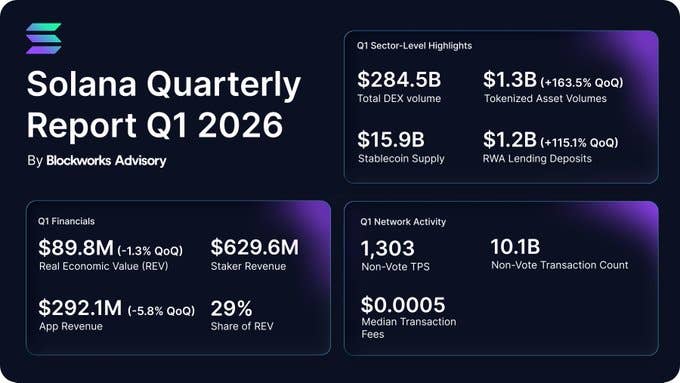
For the first time, Solana has surpassed Ethereum during the quarter to become the leading blockchain for RWA lending deposits. Deposits in this category surged by 115% over the last three months, reaching a staggering $1.23 billion.
This growth was largely driven by innovative markets such as Figure’s PRIME, which is backed by home equity loans, and OnRe, which focuses on reinsurance.
By bringing these traditional financial products onchain, Solana is providing investors with yield opportunities that are not tied to the typical volatility of the crypto market.
Additionally, tokenized asset volumes reached a new all-time high of $1.3 billion, fueled by interest in tokenized public equities and pre-IPO company exposure.
Institutional demand and application revenue
Institutional interest in Solana remains exceptionally strong. Despite a general market downturn, Solana-based exchange-traded products (ETPs) recorded $208 million in net inflows.
While Bitcoin ETPs saw higher absolute numbers, Solana actually attracted four times more institutional money per dollar of market cap.
This suggests that large-scale investors are viewing the network as a high-growth pillar of the digital economy.
Most Popular on TheStreet Roundtable:
- Trump's Fed pick discloses holdings in Musk's SpaceX, Polymarket, and Solana
- New report reveals nearly 40% of Americans have less than $500 in savings
- BlackRock posts 46% income jump as CEO hails 'strongest start to year'
The network’s application ecosystem also proved to be a major revenue engine.
Solana-based apps generated $292 million in total revenue during the quarter. The leading performer was the token launchpad Pump.fun, which captured 42% of that total with $123 million in revenue.
Other notable contributors included the Axiom platform ($58 million), the Phantom wallet ($33 million), and the decentralized exchange Jupiter ($14 million).
Since its inception, pump.fun alone has generated over $1 billion in cumulative revenue, proving that the network has a deep and active retail user base.
Unrivaled network performance and reliability
At the technical level, Solana continues to push the boundaries of what a blockchain can handle.
The network processed a record-breaking 10.1 billion non-vote transactions in the first quarter, with a throughput of roughly 1,300 transactions per second (TPS).
Perhaps most impressive was the network's stability during periods of extreme market stress.
In early February, when the market saw over $2 billion in liquidations, Solana′s median transaction fees remained remarkably steady at roughly a twentieth of a cent ($0.0005).
During the same period of high volatility, fees on Ethereum spiked as high as $8.67.
This consistent reliability makes Solana an ideal environment for professional traders and market makers who need to manage risk in real-time without worrying about unpredictable costs.
Related: Wall Street legend's firm reports $3.8 billion in quarterly loss
Push for mobile and enterprise growth
Solana is also making significant strides in consumer hardware and enterprise partnerships. The Seeker, Solana Mobile’s second device, saw a strong rebound in sales, generating $1.3 million in revenue.
More importantly, developer activity on the mobile platform has doubled, with 476 new applications launching in this quarter alone.
On the enterprise side, the launch of the Solana Developer Platform (SDP) in late March has brought in Fortune 500 giants like Mastercard, Western Union, Worldpay, and Alibaba Cloud.
While these partnerships are still in their early stages, they signal a growing confidence from traditional finance leaders that Solana is a viable layer for global payment settlements.
Trending on TheStreet Roundtable:
- Franklin Templeton's Sandy Kaul says tokenization will do to ETFs what ETFs did to mutual funds
- Billionaire Tim Draper doubles down on bold Bitcoin target
- DTCC's Nadine Chakar predicts treasuries will dominate tokenization in 2026
Building for a high-speed future
Looking toward the rest of 2026, developers are focused on reducing network latency even further.
Plans are underway to potentially halve "slot times" to 200 milliseconds, which would make the network even more responsive.
Additionally, a new protocol proposal called "Constellation" aims to stop transaction censorship and improve the quality of execution for market makers.
As the quarter ends, Solana stands as the clear leader in onchain trading and a rising force in institutional finance.
By combining record-breaking transaction speeds with consistently low fees and massive enterprise backing, the network is well-positioned to continue its growth as the backbone of the new digital economy.
Related: Every stablecoin dollar on Solana turns over 6x faster than on Ethereum
