Solar panels have a fairly simple job: generate electricity. But behind every panel is another type of output that doesn't get nearly as much attention: data. How much energy was produced? Wh
Solar panels have a fairly simple job: generate electricity.
But behind every panel is another type of output that doesn't get nearly as much attention: data.
How much energy was produced? When was it generated? Can that production be verified? And can the environmental value attached to it be turned into something that has real economic use?
These questions are becoming more relevant as solar generation spreads across homes, businesses and larger renewable-energy projects. The problem is that the information and financial systems around that production are still fairly fragmented.
That's the gap Solarious is trying to address.
The project is building a Layer-1 blockchain around verified renewable-energy production, with the idea of bringing real-world solar activity onto a network where it can be tracked, verified and potentially connected to additional sources of value.
The interesting part is what happens before the blockchain
Solarious doesn't simply rely on someone reporting how much electricity their panels produced.
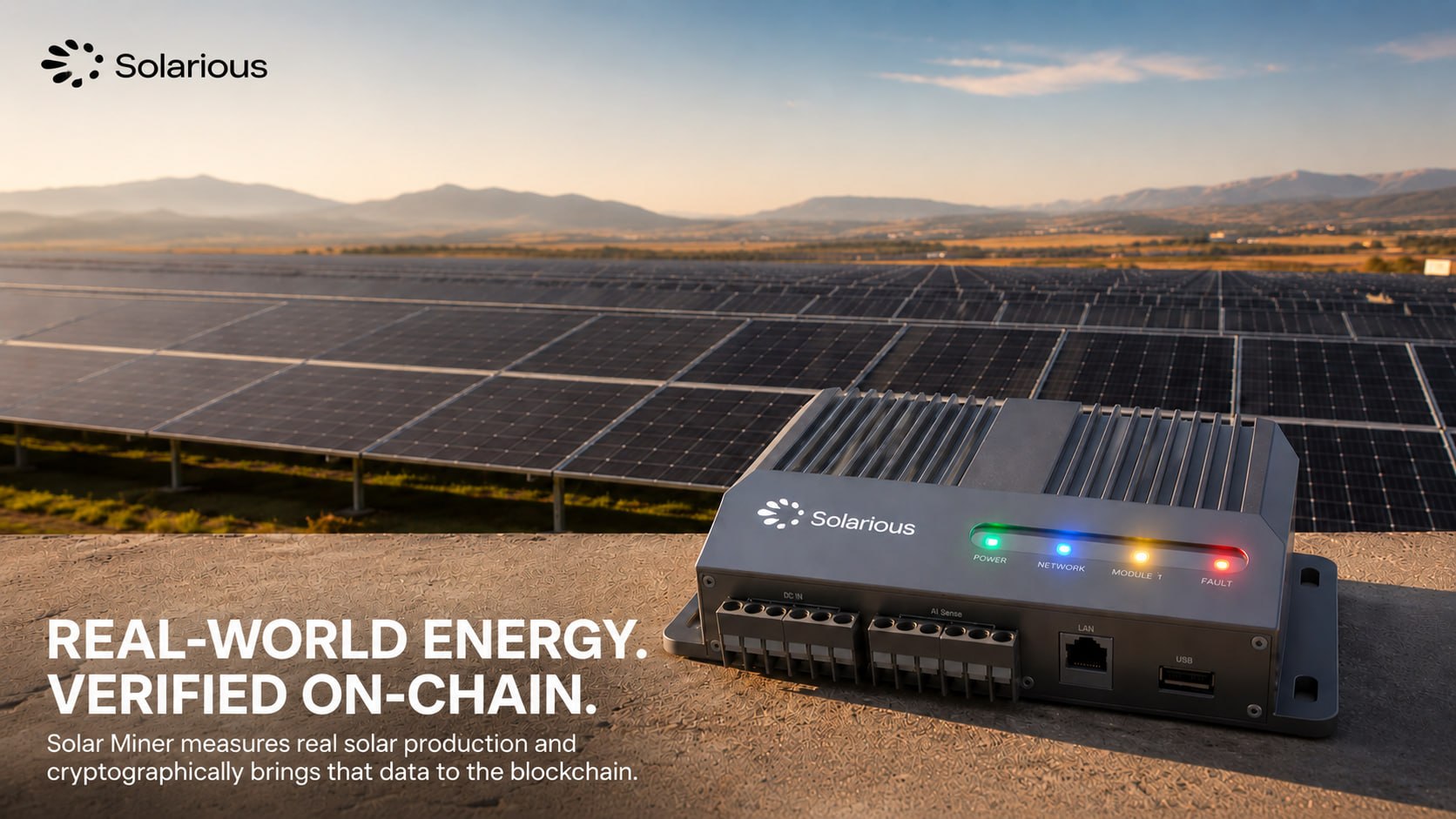
Participating installations are connected to Solarious telemetry hardware, which measures the renewable energy being generated and authenticates the resulting data. That information is then submitted to the network, where validators verify it through a system called Proof of Energy.
If the process works as intended, a solar installation isn't just sitting in the background generating electricity. Its verified production can become recognizable activity on the network.
That's an important distinction.
The blockchain isn't replacing the electricity market. A homeowner can still save money on their power bill, receive net-metering credits or sell electricity to the grid. Solarious is essentially looking at whether there is another layer of value that can sit on top of that existing activity.
Where SOLAR comes into the picture
That additional layer is tied to Solarious' native token, SOLAR.
The token is intended for network transactions, validator participation, smart contracts, governance and various renewable-energy and marketplace functions. Solarious also says 85 million SOLAR has been allocated for producer and validator rewards over an approximately ten-year period.
For producers, the idea is fairly straightforward: verified renewable production can potentially qualify them for SOLAR rewards.
But the bigger opportunity may be outside the token itself.
Solar generation can also create environmental attributes, including Renewable Energy Certificates and, where applicable, carbon credits. Solarious wants to build infrastructure that can connect those assets with buyers such as companies, utilities and institutions.
That gives the project another reason to focus so heavily on reliable production data.
If nobody can confidently verify where an environmental asset came from, its usefulness is limited. Solarious is betting that authenticated production data can make that process easier to track.
It also tackles a problem smaller producers face
Environmental markets aren't necessarily easy for a small solar operator to navigate.
A large energy company can have dedicated teams handling registrations, verification, buyers and compliance. A homeowner or smaller commercial producer usually doesn't have that luxury.
Solarious' proposed infrastructure is meant to bring those pieces together, measuring production, authenticating data, verifying it on-chain and eventually connecting producers with environmental markets.
There's an interesting network effect here.
One small solar installation might not produce enough environmental assets to attract major buyers. A network containing thousands of installations is a different proposition.
Solarious could aggregate those smaller amounts and potentially make them available as larger pools to commercial or institutional buyers.
The project's own flywheel captures the idea: more producers create more verified renewable production, which can create more environmental assets, which can lead to more marketplace activity and more use for SOLAR.
The business isn't just about the token
Another thing worth noting is that Solarious isn't positioning network fees as its only source of revenue.
The project outlines several potential business lines, including environmental-commodity trading margins, marketplace fees, network transactions, Solar Miner hardware and services, and enterprise products built around renewable-energy data.
That makes the project somewhat different from a typical crypto network whose main argument is simply that its token will become more valuable as adoption increases.
Here, the intended relationship is more circular. Solar production brings real-world activity into the network, while the network provides infrastructure for rewarding producers and connecting that activity with other markets.
Of course, that's the model on paper. Whether it works at scale is a different question.
Solarious still has to attract producers, build demand from buyers and navigate the standards and regulations that govern environmental assets. The project itself acknowledges that rewards and environmental-asset eligibility depend on network rules, market conditions and applicable requirements.
For that reason, the interesting thing to watch isn't just the $SOLAR token.
It is whether actual solar installations start connecting to the network, whether the resulting data becomes useful to businesses, and whether environmental-market participants see enough value in the infrastructure to use it.
If those pieces come together, Solarious could offer a different way of thinking about renewable-energy infrastructure.
Instead of solar panels being viewed only as machines that produce electricity, their verified production could become part of a wider digital economy, one where physical renewable activity, environmental assets and blockchain infrastructure are connected in the same system.Get Started with Solarious
Want to explore the project and see how the ecosystem is developing?
Always use official Solarious channels for current campaign, wallet, presale and participation details.